




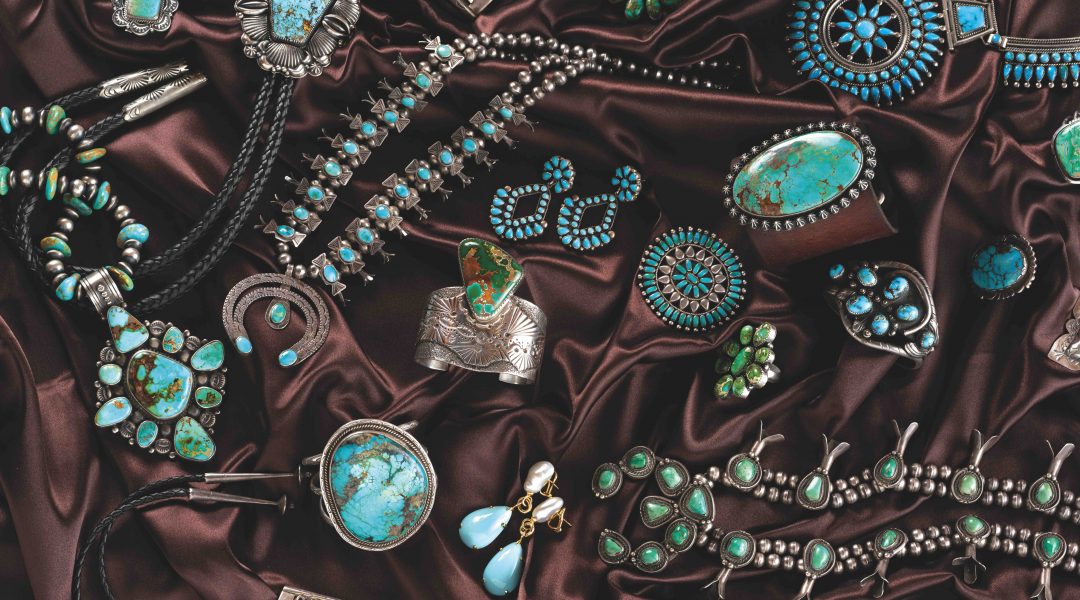
Few marinated minerals have been enchanting artisans, gallerists, rock hounds, style mavens, and generations of jewelry donners like turquoise. Whether you're already a devout fan of this sacred stone or just catching on, here's a multifaceted, eye-popping primer.
Long before turquoise became a beloved accessory among free-spirited fashionistas, it was a sacred stone for Native American communities across the Southwest and beyond. Since the beginning of time, the beautiful blue-green gem has captivated tribal nations including the Apache, Hopi, Navajo, and Pueblo peoples. This “living stone” — as it has been dubbed, thanks to its color-changing ability — has lived a thousand lives over thousands of years.
The appeal of turquoise transcends place and time, enchanting everyone from the Aztecs in Mesoamerica to the Egyptians in North Africa. Archaeologists estimate that the earliest use of turquoise dates back to 7000 BCE in Persia, while countless Indigenous creation stories tell of its deep connections to water, sky, and life itself since time immemorial. It symbolizes hope, health, protection, and balance. At the same time, it represents Native resilience, cultural preservation, and ancestral wisdom.
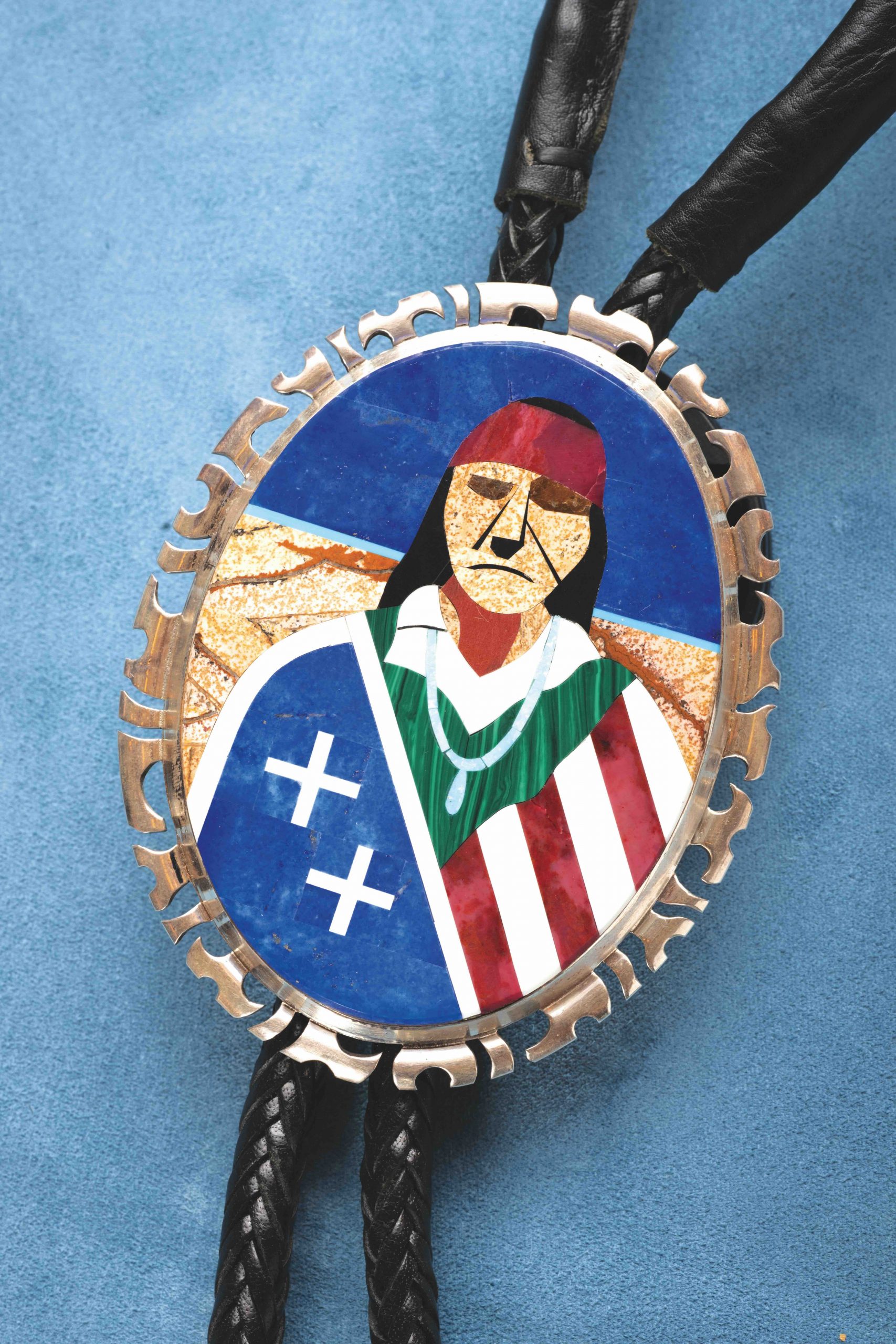
ABOVE: Inlay bolo tie by Calvin Desson (Navajo), simmonsestatejewelry.com.
This revered rock isn’t really a rock at all. Rather, it’s a mineral (technically, a hydrated phosphate of copper and aluminum) formed by the percolation of rain or groundwater through aluminum- and copper-rich rock in arid environments — ranging from Iran, China, and Egypt to Mexico and the American Southwest. As water works its way through rock, it picks up those minerals before eventually settling into a cavity or crevice. When evaporation plays its hand, the minerals bond and harden in an endless geochemical process resulting in layers that eventually form turquoise veins deep within the earth.
Each turquoise deposit is distinct depending on the conditions — hence, the wide variety of colors, patterns, and more — during a process that can take millions of years. That’s why every type of turquoise is uniquely its own, from Arizona’s Kingman specimens to Nevada’s Royston and Colorado’s Cripple Creek. Traditionally, extracting the stone from the earth by hand was a laborious, exacting process. It makes sense then that this gemstone has mesmerized humans for millennia.
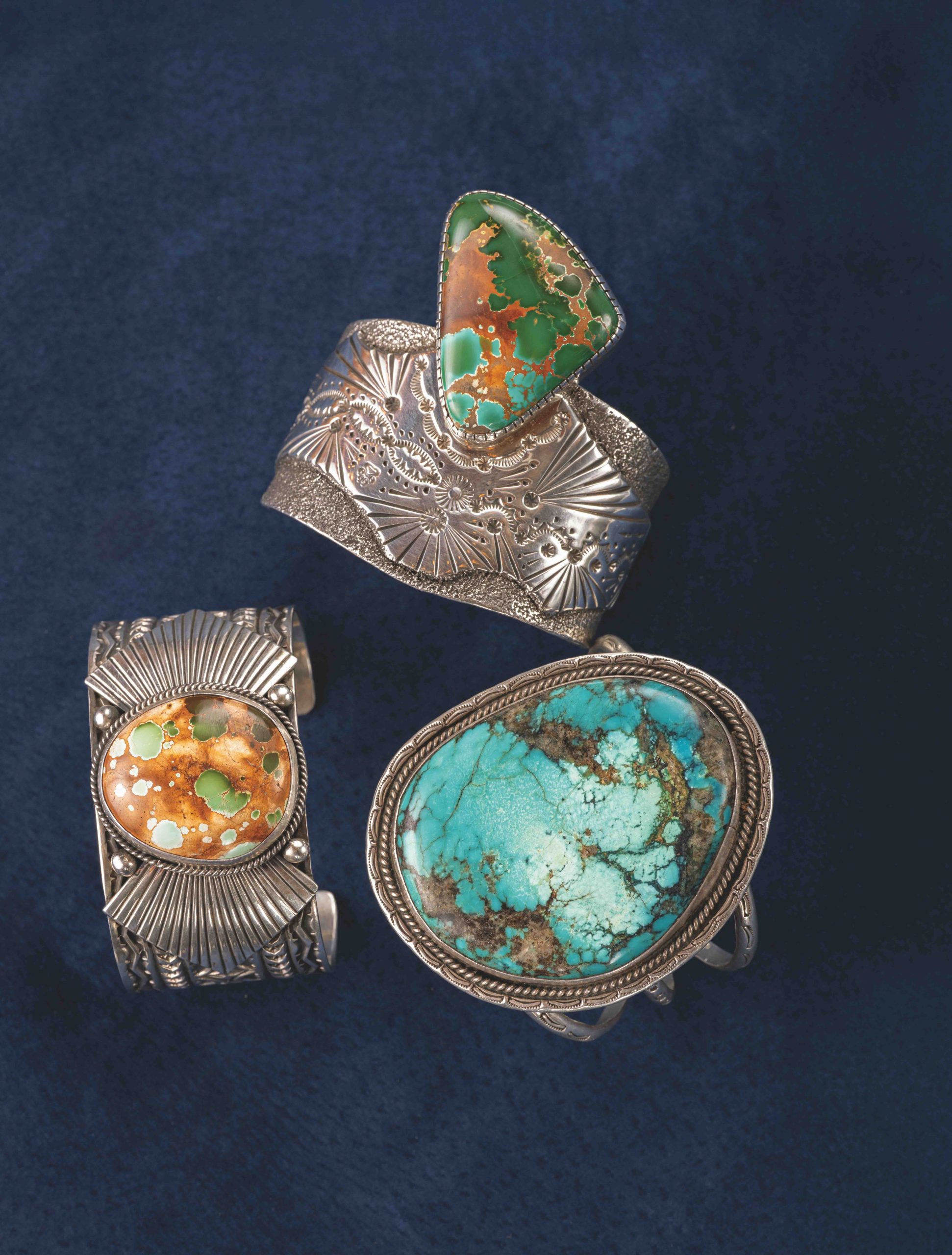
CLOCKWISE FROM TOP: Vintage off-center turquoise and silver cuff, persimmonhillstore.com; Navajo sterling silver and turquoise cuff from Moontower Vintage, reneerangel.com; Sunshine Reeves (Navajo) Royston cuff, turquoiseinstyle.com.
There’s simply nothing quite like it.
Turquoise is having yet another moment — beguiling its latest broad fanbase of Native and non-Native aficionados with intrinsic charms and myriad styles. The allure of this standalone stone knows no bounds, attracting art connoisseurs, coastal cowgirls, bohemian fashion mavens, and technicolor trendsetters of all ages — from Boomers to Gen Zers (who are now getting in on the gemstone action). The hue itself is trending in fashion, home, and design spheres, according to the likes of Vogue, Who What Wear, and The Zoe Report.
The latest turquoise wave means that business is booming for artisans, gallerists, retailers, and other purveyors of this multifaceted mineral. As for turquoise shoppers, the tricky part is navigating its nuances — including deciphering the real deal and understanding who your dollars are truly supporting. Our wide guide to all things turquoise — including savvy tips and terms, marvelous museums, mines, and galleries, spectacular styles, handy resources, and the alluring words of Indigenous artists, inveterate collectors, and lapidary pundits — all aim to steer you deep into the vibrant maze of turquoise.
There isn’t a more bewitching landscape in which to get lost.
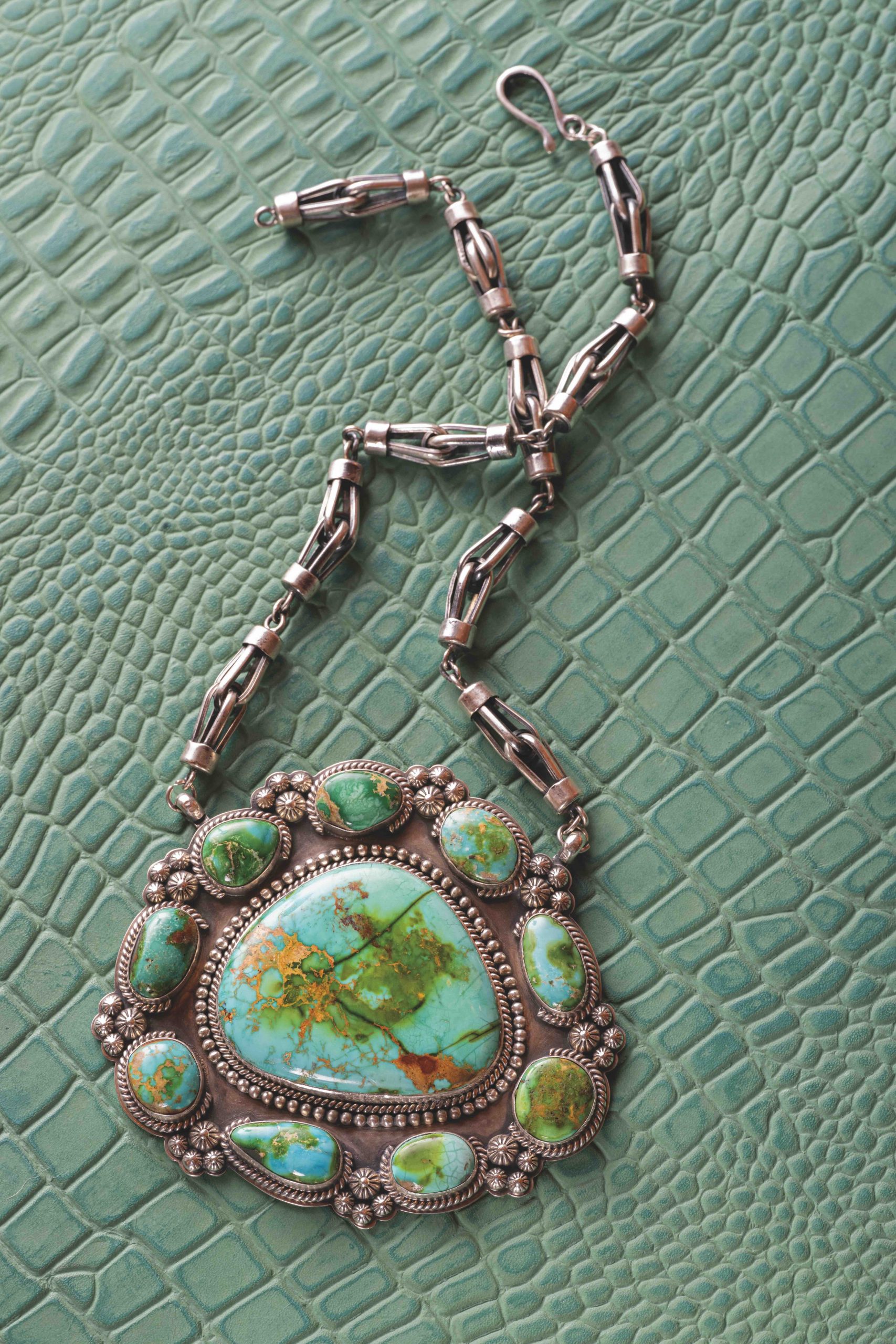
ABOVE: Sonoran Gold turquoise massive cluster necklace by Gilbert Platero (Navajo), turquoiseinstyle.com.
Turquoise 101: Joe Dan Lowry's Teaching Points
“Turquoise is the people’s gemstone,” says Joe Dan Lowry, whose Turquoise Museum in Albuquerque features many of the nest specimens found anywhere — including reputedly the most photographed massive piece of turquoise on the planet (the 6,888-carat George Washington Stone) and a chandelier comprised of over 26,000 Sleeping Beauty turquoise beads. “Each person is drawn to turquoise for their own reasons — color, story, or use — and that’s the subjective beauty of it,” Lowry adds. Here are five instant turquoise IQ-raisers from a fourth-generation aficionado in the field.
1. Natural turquoise is one of the world’s rarest gemstones — with a name that has evolved over the millennia. The Zuni word for turquoise can be translated as “sky stone.” Pliny the Elder called it callais, and the Aztecs said chalchihuitl. Our word turquoise arrived fairly recently in the 17th century.
2. There are many global sources of turquoise used in Native American jewelry.
3. Even more varied and colorful than this gemstone are the artists, dealers, and retailers orbiting it. Take the term “turquoise expert” with two grains of salt — and browse freely until you find the piece that truly beckons.
4. Get a jump in this game by learning the difference between natural turquoise (high-grade with peak hardness for jewelry making), stabilized turquoise (lower-grade, hardened with epoxy or resin), enhanced turquoise (treated for durability and appearance), block turquoise (manipulated stone or plastic made to look like turquoise), and other imitations.
5. Know your turquoise by having the seller put words on paper. Buyers should ask for “natural” in writing along with a statement that “no fillers, oils, dyes, or epoxy” have been used. Any gemstone dealer worth their reputation shouldn’t balk at this request.
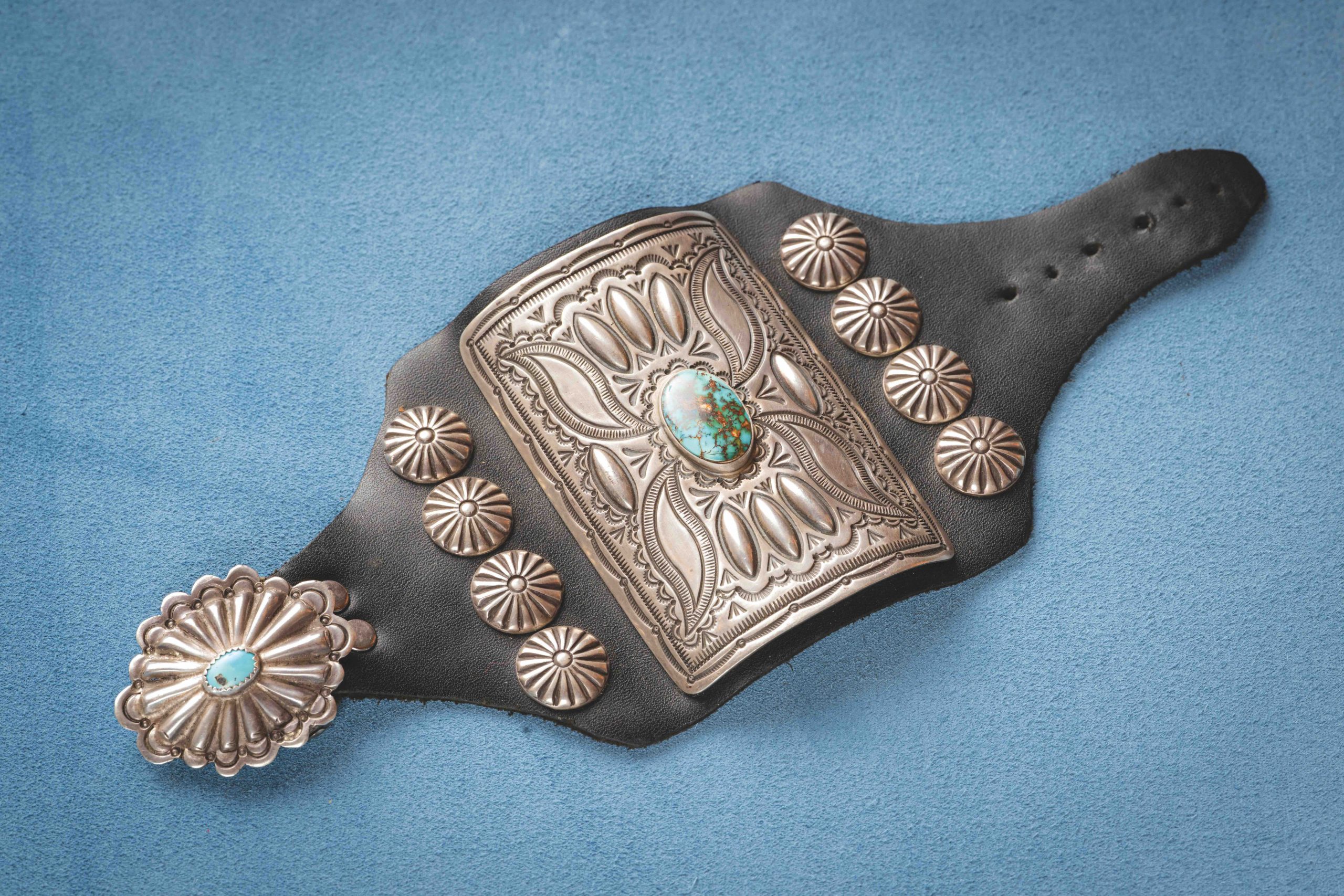
ABOVE: Navajo-made Keto bow guard leather wrap bracelet with Navajo belt buckle closure from Moontower Vintage, reneerangel.com.
Turquoise 101: Real or Fake?
Turquoise’s surging popularity has led to a prevalence of cheap imitations that can be tough to spot. “A single test or quick look might not be enough,” says Lowry, who recommends having your natural turquoise certified and points to institutions like the Gemological Institute of America (GIA) to scientifically ascertain turquoise authenticity — depending on the investment. These five hands-on factors can help distinguish turquoise from “turquoise.”
1. Cost: All false claims aside, there’s generally a vast difference in price between an authentic piece of turquoise and a replica of some sort. Unless you luck out at an estate sale, expect to see higher costs for higher grade.
2. Color: Recognizing the myriad varieties of turquoise’s blue-and-green color spectrum takes years of training — and “imitations can copy almost every one of these spectrums,” Lowry warns. There are some easier imitations to identify with a little knowledge, he adds, “such as dyed howlite, paste, or compounds.”
3. Matrix: Traces of the host rock within a nugget of turquoise form a specific pattern or “matrix” — with tones ranging from coppery gold to brown and black from associated minerals such as pyrites and quartz. The natural pattern is rarely uniform, which can be a telltale for replicas. Watch for dye pooling or artificial (uniform) patterns that starkly contrast with the stone’s coloring.
4. Weight: Real stones and silver carry real weight, both literally and figuratively. A suspiciously light or hollow piece can indicate an imposter. The caveat: “Smaller cabochons [slightly domed cut gemstones] can become impossible to tell by weight,” Lowry notes. “Especially if they’re already set in jewelry.”
5. Source: Consider a retailer with established turquoise artist relationships and a wide selection of collector’s items in their inventory. Estate sales and auctions are potentially great places to source vintage finds and hard-to-land pieces that aren’t widely available on the retail market.
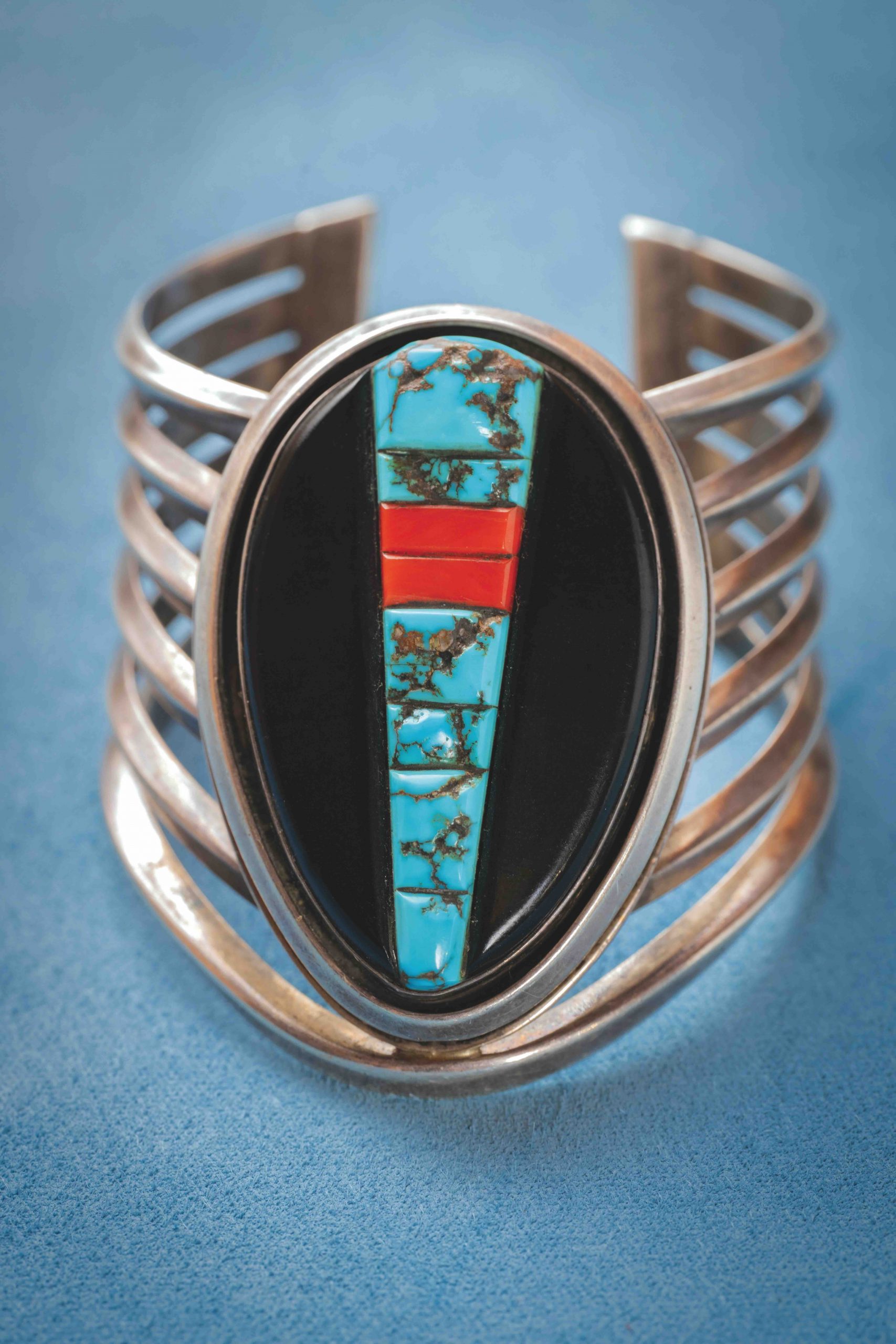
ABOVE: Handmade mosaic inlay cuff by Victor Beck (Diné), samsvillegallery.com.
From our April/May 2026 issue.
PHOTOGRAPHY: (All Photos) Dixie Dixon. (Cover photo) King turquoise ring, danavoorhees.com; Royston turquoise bolo by Delbert Gordon (Navajo), coloradojo.com; Turquoise and mother of pearl inlay buckle from Moontower Vintage by J. Quam (Zuni), reneerangel.com; Sonoran gold turquoise hula earrings, britwest.net; Vintage Kingman turquoise cluster necklace by Francis M. Begay (Diné), samsvillegallery.com; Vintage Bisbee turquoise necklace, danavoorhees.com; Vintage Kingman turquoise Navajo box bow squash blossom, peyotebird.com; Vintage off-center turquoise and silver cuff, persimmonhillstore.com; Turquoise cluster earrings by Don Lucas, sorrelsky.com; 1950s silver and turquoise Zuni pin, peyotebird.com; Ultimate Shotgun turquoise and leather cuff, britwest.com; 1950s Navajo silver and Persian turquoise cuff, Vintage tur quoise Navajo ring, peyotebird.com; Navajo sterling silver and turquoise cuff from Moontower Vintage, reneerangel.com; 18k yellow gold with white South Sea pearls and Persian turquoise earrings, pearlsbyshari.com; Vintage turquoise squash blossom from Moontower Vintage by J. Quam (Zuni); Coral, turquoise and mother of pearl inlay bolo, reneerangel.com.
STYLING: Andrea Thorp