




In equine-assisted psychotherapy, the healing power of a 1,200-pound partner is helping veterans, addicts, trauma survivors, struggling youth, Indigenous communities, and other groups address challenges.
Jason came up in the high sweep of the Flint Creek Valley outside Phillipsburg, Montana, working cattle on the family ranch. “I’ve been around horses my whole life,” he says. “I haven’t been around them a whole lot lately, though. Just been too far into my addiction. Addiction drags you away from the things you enjoy doing.”
Jason says to call him by his real name because he’s “got nothing to hide.” Today, he’s two basins west of his family ranch in the bustling Bitterroot. He’s also three weeks into a monthlong stay at the Bear Creek Wellness rehabilitation clinic between the cities of Missoula and Hamilton. “I got a bunch of family in this valley. I got my first DUI in Hamilton; I got my second DUI in Hamilton. I got trauma in Hamilton. So, to be back in this area, be in the Bitterroot, it’s where it all started. It’s a good place for me to come.”
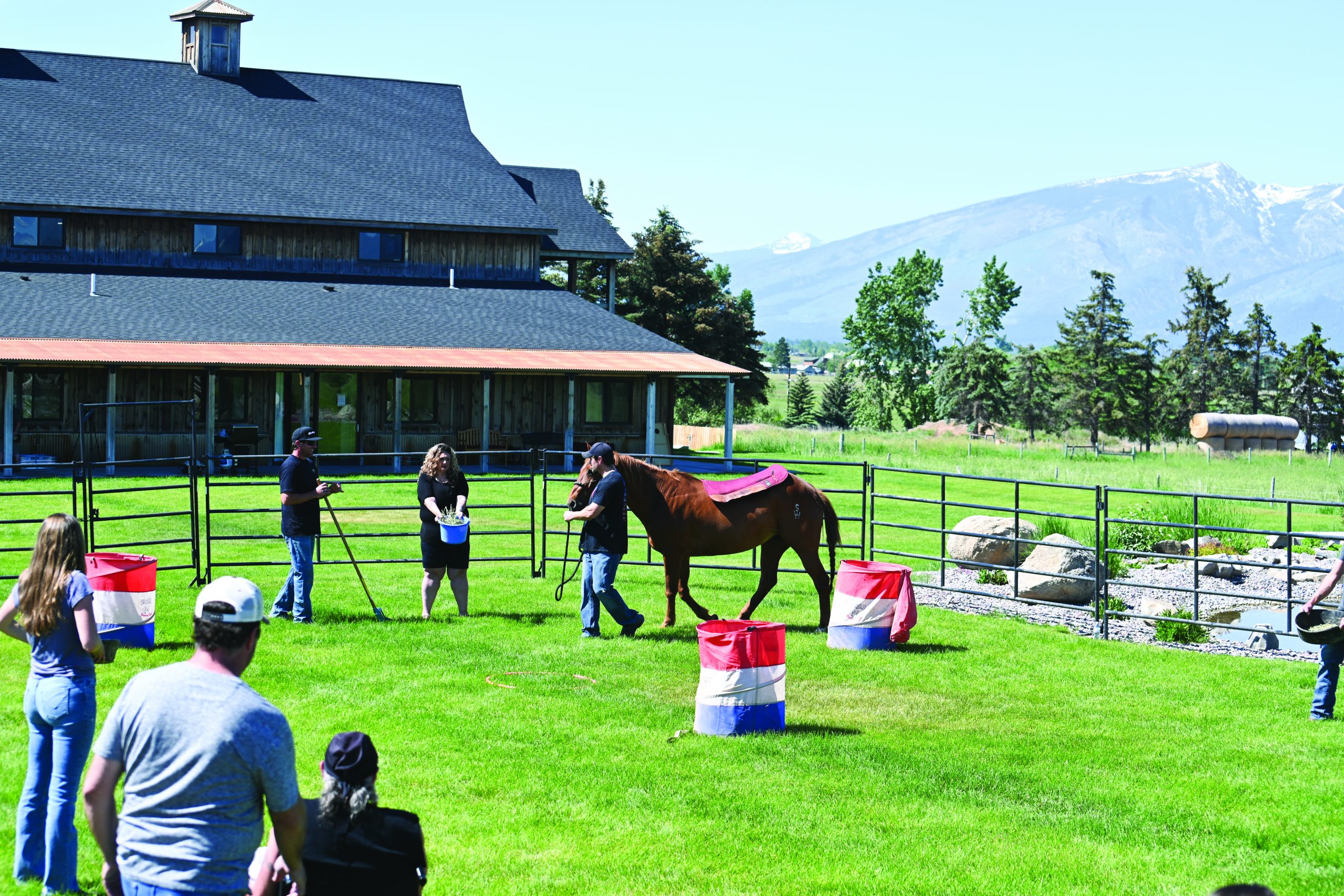 Residents at the center lead horses through an equine-assisted psychotherapy activity.
Any cowboy will tell you there’s healing power in a horse. That intuition lies at the heart of an emerging mental health treatment in the American West: mounts as a medium for reflection and recovery. Equine-Assisted Psychotherapy (EAP), or simply equine therapy, is not about riding skills or tack—it’s about reading body language, building trust, and confronting emotional truths alongside a steadfast and silent 1,200-pound partner. While it’s not meant as a replacement for traditional talk therapy, studies have linked the practice to positive outcomes for veterans, addicts, trauma survivors, struggling youth, Indigenous communities, and other groups suffering from stress and various mental health challenges.
“A lot of people misunderstand equine therapy. It’s not therapy for horses, although they do seem to get something out of it,” says Leah Finch, LCPC, a mental health therapist licensed in three states, a doctoral candidate in counselor education, adjunct professor, lifelong horseback rider, equine therapy researcher, and practitioner. “Horses become metaphors and symbols for what people might be working on in their personal lives. Having a physical experience and interaction with an animal so powerful and attuned can be deeply meaningful.”
Jason and six other attendees are out for an hour-long equine-assisted therapy session with two retired ranch horses and two licensed clinical therapists: Finch and her business partner, close friend, and fellow counselor Morgan Beavers. The practitioner pair, who operate as On the Trail LLC, explain to attendees what they will experience in the corral. Finch and Beavers practice a model created and promoted by Eagala, the Equine Assisted Growth and Learning Association. It’s a team-based collaborative approach that fosters open dialogue as well as internal monologue. The model allows the horses to make their own choices with input and encouragement from participants. Sessions involve a credentialed mental health therapist paired with an equine specialist. In this case, two Eagala and Montana-licensed therapists who are also dyed-in-thewool horse girls work together, each holding knowledge of both sides of the equine and therapeutic spectrum.
 The Eagala model focuses on a team-based approach to equine therapy.
“There’s no riding involved, unfortunately,” Beavers tells the participants, not entirely faking her frown. “We’re all on the ground today, and it’s probably a new way of interacting with horses for a lot of you. If you’ve been around horses before, you might not have interacted with them in this way. And if you’ve never been around horses a day in your life, that’s great, too, because we’re all coming in with a beginner’s mindset.”
Finch chimes in: “What makes this model really cool is that it’s so experiential. The horses become metaphors that represent things that you might be working on in your life or people that you might have relationships with. The approach we use really believes that you have the solutions you’re looking for already. We use this experience with the horses to facilitate the clarity you might be seeking.”
Beavers spends most of her weekdays seeing talk-therapy patients at her office in downtown Missoula. Still, she’s quick to highlight the distinction between this and that. “It’s pretty different from typical talk therapy,” she says. “You’ll do a lot of talk-therapy groups, individual sessions, where you’ll just sit down and talk it out. This is about getting out there, exploring, experimenting, being curious, learning. And the great thing is you can talk with each other, you can talk with us—we can process out loud. Or you can really have an internal experience, keep it to yourself, and process today, tomorrow for days, months, years to come.”
The cowgirl therapists welcome their participants into the corral. Beavers reminds the group not to walk directly behind or make sudden moves that might spook the animals. Finch declines to assign names or résumés to the horses, preferring that the participants imagine or project such things.
The facilitators ask the group for some general issues they might want to address together. “Anxiety,” three participants exclaim almost in unison. “Depression,” another offers. “Forgiveness,” a woman named Janelle says bluntly.
The group is visibly thrilled to meet the horses. They begin to pet and brush the animals, sharing treats on a flat palm. Finch and Beavers slowly guide the group into the therapeutic activity, an Eagala-designed program called Temptation Alley. Together, the participants create something like an obstacle course or journey through which to guide the horse, using pool noodles, traffic cones, and other items to delineate a path, each article representing something to a participant or the group. One at a time, they guide the horse with halter and lead rope through a gauntlet of other participants offering grain or hay as temptations to stray from the course. It’s a situation clearly ripe for addiction allegories.
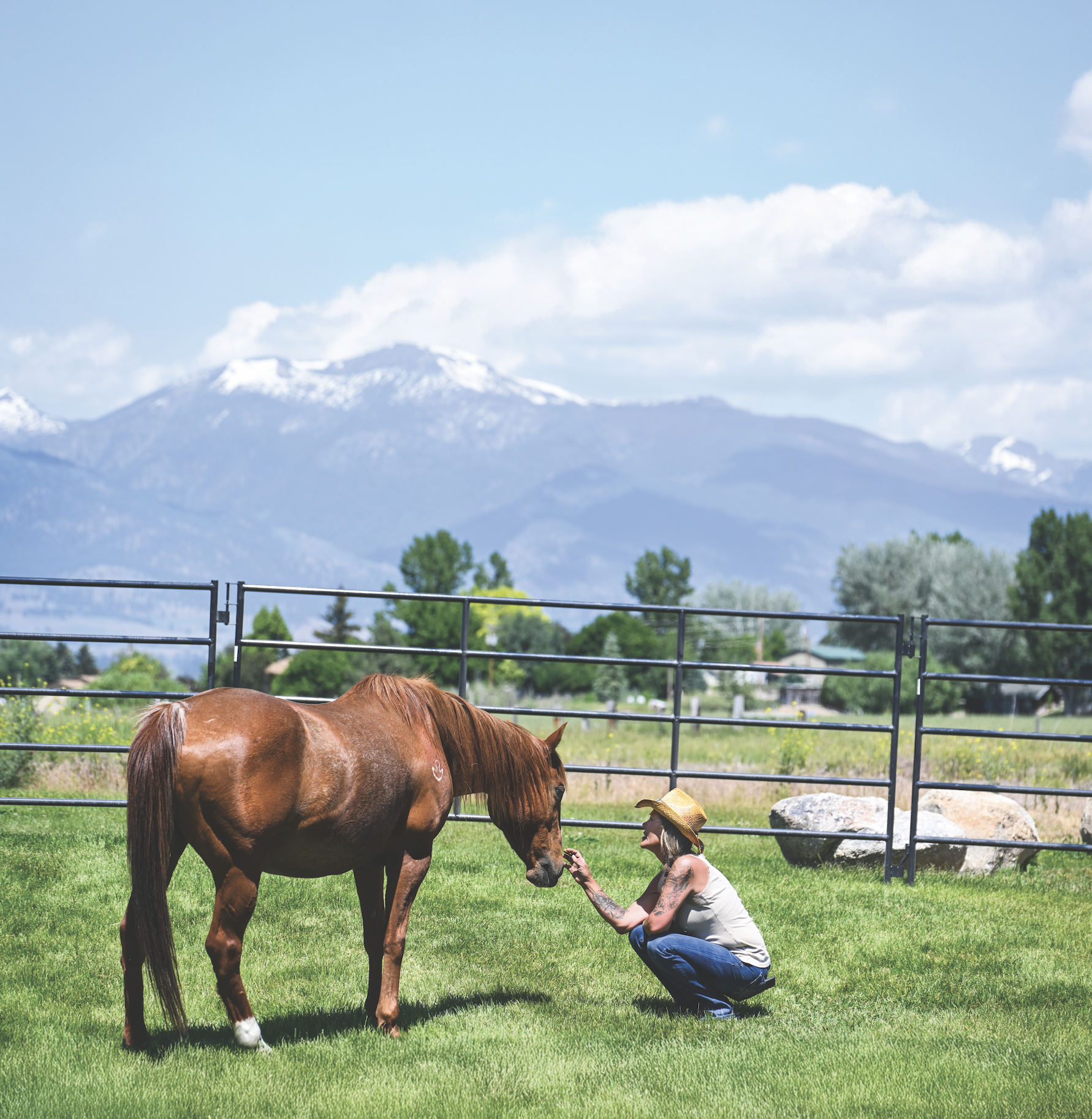 At the Bear Creek Wellness Center in Corvallis, Montana, horses serve as a medium for reflection and recovery.
Janelle mentions that the parallel pool noodles could be her husband and daughter—both as obstacles and guardrails. Someone suggests they put a saddle pad on the horse’s back to represent safety. Some participants choose to rake a path before the horse. It’s crystal clear to those assembled what the path and the temptations symbolize. A man in a wheelchair holds up a bucket of grain toward the horse and jokes: “I’m making it, I’m sober. Oh, shoot, I’m at the bar.” Everyone laughs.
Janelle goes first, cautiously tugging on the lead. The horse insists on grazing another moment before acquiescing. She tells her equine partner about her husband and daughter as they pass the pool noodles. She’s lifting her sunglasses to wipe wet eyes by the end.
Jason whispers quietly to the horse for some time before gently encouraging it forward. He allows the old mare to stop and look around. Pressure and release. She glances toward the bucket of grain, and he gently guides the halter away.
Anthropologists believe that humans domesticated horses some 5,500 years ago. Millions of people today are still familiar with and fond of the uncanny bond between steed and rider that allows humans to mount, command, and achieve great feats of endurance and agility atop an animal more than five times our size. That symbiosis is clearly coevolved.
Ancient Greek philosopher and physician Hippocrates wrote about riding as natural exercise around 400 B.C. Countless others have documented the healing and spiritual powers of horses through the millennia, including the oral traditions of innumerable Indigenous groups.
The modern use of horses in physical or occupational therapy for the injured or disabled, as well as for speech and language pathology, is called hippotherapy. It arose in the Alps region of Europe in the 1960s and is distinct from equine-assisted psychotherapy or EAP, which focuses on mental health rather than physical. Unlike EAP, hippotherapy often includes therapeutic riding.
Eagala founder Greg Kersten coined the phrase “equine-assisted psychotherapy” in 1996. He grew up on a hog-farmturned-quarter-horse ranch near Omaha, Nebraska. His father—a “cowboy, hell-raiser, drinker, smoker”—died of a fourth heart attack in the early ’70s, when Greg was 10. Soon after, Nebraska started bussing kids into bigger schools from outlying areas. On his first day at the big Omaha school, Kersten recalls being overwhelmed by the number of students, so he walked straight out the back door and ran all the way home in his cowboy boots to be with the horses. With easily intercepted and concealable mail, no voicemail, and a mother who worked all day at a saddle store, he was able to keep up the con until nearly Christmas break. It was an early indicator of the therapeutic presence and pull of the herd.
He served in the Army as a military police K-9 handler in Panama and elsewhere for six years, studied sociology for a spell, then wound up working at a youth corrections facility in Washington, D.C. He began training quarter horses on the side and one time came into the corrections facility still attired in his hat and boots. The residents questioned him so rigorously about cowboying that Kersten eventually convinced judges and probation officers to let him take some of the residents to the ranch.
“I just started doing rudimentary things,” Kersten says. “I wouldn’t teach them how to halter a horse. I’d go out there and have them guys try to figure it out themselves, and then I would loan them books that they could take back to the facility and read up. I’d come up with challenges for ’em to do with the horses without instructing them, like how to get a horse to jump over a couple buckets with a pole across it, which became life’s obstacles eventually.” Those experiments proved prototypical for many Eagala therapeutic activities, including Finch’s and Beaver’s go-to, Temptation Alley.
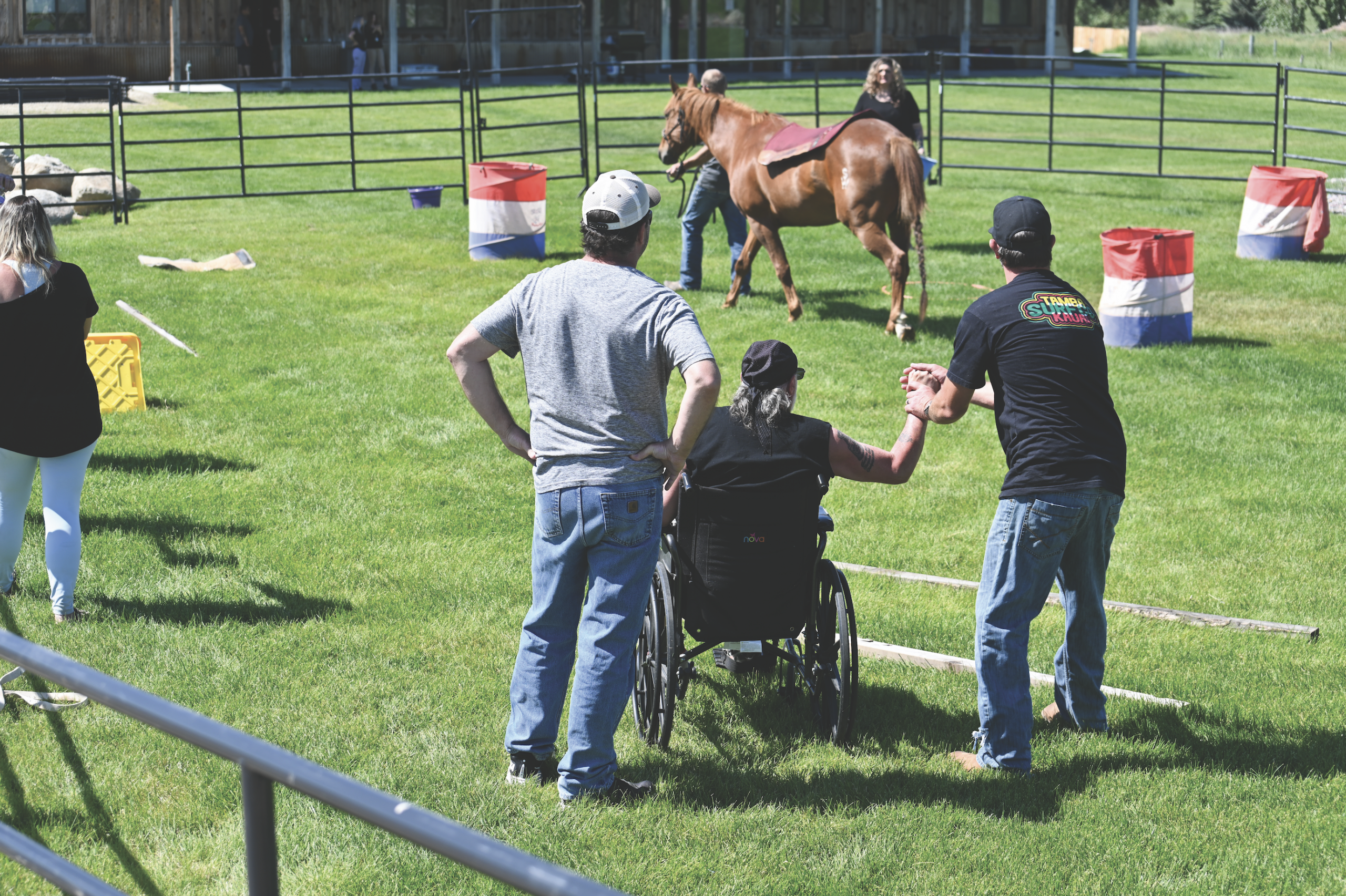 This form of therapy actively elicits peer support and encouragement.
Kersten saw improvement immediately: “Those kids were going back to the facility, and even their therapists would say, ‘What are you doing with these kids down there? They’re so mature.’ They came up with a saying, especially if a kid was in trouble: ‘If you were more like a horse, you wouldn’t be here right now. Be a herd animal.’
“I said to myself, ‘This is what I want to do for the rest of my life,’” he remembers.
Across the late ’80s and early ’90s, Kersten continued developing his models and ideas, primarily at youth facilities, from Florida to Colorado to Utah, in frequent contact with psychology and counseling faculty at several universities and nonprofits, including early wilderness therapy and hippotherapy theorists.
He founded the Eagala nonprofit in 1999 with Lynn Thomas, a close friend who worked with him at several treatment centers for troubled youth in Utah. The organization grew quickly alongside others of its ilk and now claims more than 2,000 certified practitioners in 40 countries across Europe, the Middle East, Africa, Australia, and Asia.
Kersten left Eagala in 2006 to start OK Corral Series LLC. There he teaches what he now calls “equine-assisted philosophy” in youth centers, Native communities, and corporate retreats. Since Kersten gave a name to the practice, a body of research has frequently demonstrated its effectiveness in treating a host of mental health issues using EAP. While early studies focused on young people suffering from trauma, ADHD, schizophrenia, abuse, autism, and other ailments, interest has spread to countless aspects of adult life as well. A recent meta-analysis of 13 studies related to the benefits of EAP for military veterans with post-traumatic stress disorder found an average 22.6 percent reduction in PTSD score following EAP sessions. The British Journal of Social Work published an article in 2019 discussing EAP’s potential for treating trauma in Australian Aboriginal Peoples and other Native groups. A 2022 review published in the journal Substance Abuse, Treatment, and Policy found that EAP showed positive and promising effects on retention and completion of substance abuse disorder treatments like rehab—exciting results given a high relapse rate. While the first three decades of study are encouraging, most published works still call for increased standardization and larger-scale studies.
A good deal of competition in the marketplace of ideas surrounds EAP. Differences of opinion regarding safety, methods, and certification protocols have led to inconsistent criteria and data, dueling nonprofits, and legal conflicts. There is even some debate within the broader mental health community whether EAP inappropriately diverts funding and attention that might otherwise go toward more-established and proven mental health interventions. There’s an intuition at play here that sometimes gets called bias in an academic setting: Certain clients and clinicians simply like horses. Does EAP lead to better mental health outcomes for people who are buoyed by the presence of horses? If there’s an issue of bias in the research, it likely exists at the client level, too. Some thought leaders even suggest that EAP can achieve outcomes unavailable through talk therapy to certain patients, such as nonverbal children and particularly cagey cowboys.
Janelle, a mother and small business owner, wants to speak on the record. She says she started using prescribed ketamine to treat depression, anxiety, and the trauma of caring for her young daughter through multiple life-threatening infections, massive seizures, and more than 100 hospitalizations in three years. Janelle’s prescription soon became a debilitating addiction, which she chose to address at the Bear Creek Wellness Center. “I came here with severe anxiety,” she says. “I almost didn’t make my second flight from California. I had to go in and buy some Sudafed to calm down.”
After her EAP session, Janelle comments that the horses symbolize stability. “It was so calming,” she says. “They’re so attuned to emotion. I felt the best I’ve felt coming out of there.”
 Leah Finch (left) and Morgan Beavers (right) found a way to combine their passion for horses with their professions in counseling.
This was not Janelle’s first time seeing equine-assisted services. “My daughter is nonverbal, and when she’s on a horse, it’s amazing to see what that brings out in her. I’ve seen this with her, too. They can sense that she doesn’t use words to talk. I’m excited to get her back into horse therapy. This really inspired me.”
Jason says he was nervous walking up to the corral from his cabin. The rehab center hired a videographer to capture marketing materials during this equine therapy session, as well as inviting a well-connected reporter to photograph and interview the willing participants. Another group would go through a private session after. But Jason felt he had something to share.
“Being around all the people and the cameras and things, that gives me very bad anxiety,” he says. “I’ve dealt with anxiety for many, many, many years. But I got in with the horses, brushing them and getting to know them. It takes your mind off everything. You focus on the horses. And my anxiety left. It left. I was afraid to do the obstacle course. I was afraid to come to rehab. But facing your fears is part of it.”
Jason struggled with drugs and alcohol for 25 years before deciding to get his life on track. “This is my first rehab. I finally had enough,” he says. “Every time I’d gone through counseling sessions, [the courts] made me do it. But this time I actually want to change and be better for my 13-year-old son.”
He looks out at the horses and beyond to June snow contouring the Bitterroot Mountains. “Starting through the obstacle course, I just told the horse, ‘Hey, I got you. You got me. I got your back. We can do this together. We can make it through. If we hit a speed bump, we’ll go around it, but we’re going to make it through the recovery process. We’ll make it home.’”
PHOTOGRAPHY: (ALL IMAGES) SAM LUNGREN
From our November/December 2025 issue