





The next big thing for Western ranchers? Managing grazing by trading barbed wire for electronic collars.
Situated on Montana’s northeastern shortgrass prairie, the remnants of dubious cattle containment methods present a plethora of ills for Leo Barthelmess and his family. Rusty barbed wire and derelict woven-wire sheep fence litter the century-old Barthelmess Ranch, with some strands dating back to original homesteaders — well over a century ago. It’s not just Barthelmess who deals with this twisted, coiled, pants-grabbing legacy. Across the American West, an estimated 1 million miles of barbed wire is strung from Dodge City to Sacramento and San Diego to Billings. Forgotten wire on the landscape blocks the seasonal migration of pronghorn antelope and mule deer, while tangling up other wildlife regularly. It also injures domestic cattle and sheep that get snared in the strands. For every mile that’s maintained for enclosing livestock, another is abandoned to time, weather, and the endless horizons that fences were intended to quarter and contain. A new technology aims to make wire fences obsolete, through conditioning cattle to heed a different sort of constraint. Virtual fencing creates invisible barriers that are delineated by satellite maps and enforced by electronic collars worn by cows. These high-tech collars send either encouraging beeps or sharp discouraging shocks to guide cows around pasture boundaries and move them to corrals, while ensuring they stay alive, healthy, and profitable.
Early adopters of this intersection of Silicon Valley and Flyover Country are cinching collars to their cows, investing in remote radio stations to relay signals from the pasture to the ranch house, and learning how to manage their herds without horses, ATVs, or barbed wire. Don’t expect collars to replace corner posts anytime soon, though. The technology is expensive, glitchy, and time-consuming. This impedes an industry where efficiency and practicality aren’t only characteristics of working ranchers: They’re key determinants of their operations’ success. But backers of virtual fencing expect the technology to catch up to modern needs. As systems become more mobile, powerful, miniaturized, and accessible, barbed wire will become memorialized —alongside covered wagons and one-room schoolhouses — as an artifact of the pioneer West.
“I don’t think we’ll see wire fences go away entirely,” says Travis Brammer, director of conservation at the Property and Environment Research Center, a Montana-based think tank that advocates for innovation and market-based resource stewardship. This year PERC — through its Virtual Fence Conservation Fund — awarded $250,000 to producers who demonstrated various conservation benefits of e-fencing. “Our legal system requires external fencing to physically contain livestock and separate land ownership,” Brammer explains. “But I think thousands of miles of internal fencing could be removed and replaced with virtual fences.” Fence removal possesses obvious benefits for migratory wildlife, but also for reduced maintenance costs and aesthetics. Virtual fencing could also keep livestock out of sensitive areas and facilitate rotational grazing plans. Most cattle have been exposed to electric fencing at some point in their lives; the collar simply takes the physical fence method to their necks, rather than the usual “hot wire” type of fencing that holds an electric charge.
Application of cow collars is part of a wider reconsideration of traditional fencing across the West, where designs that better protect wildlife are being implemented. Land management agencies are actively replacing the standard “government fence” (five-strand barbed wire) with three- and four-wire fences. Smooth bottom wire allows pronghorn antelope to pass underneath, while a top wire is strung low enough that deer and elk can easily hop over. In sage grouse country, the top wire is hung with “fladry” (fabric or metal flagging) that creates a visual barrier. This keeps rare grouse from decapitating themselves while flushing near fencelines. Additionally, conservation groups use both volunteers and federal stewardship grants to remove obsolete fences that haven’t held a cow or sheep since the Eisenhower Administration.
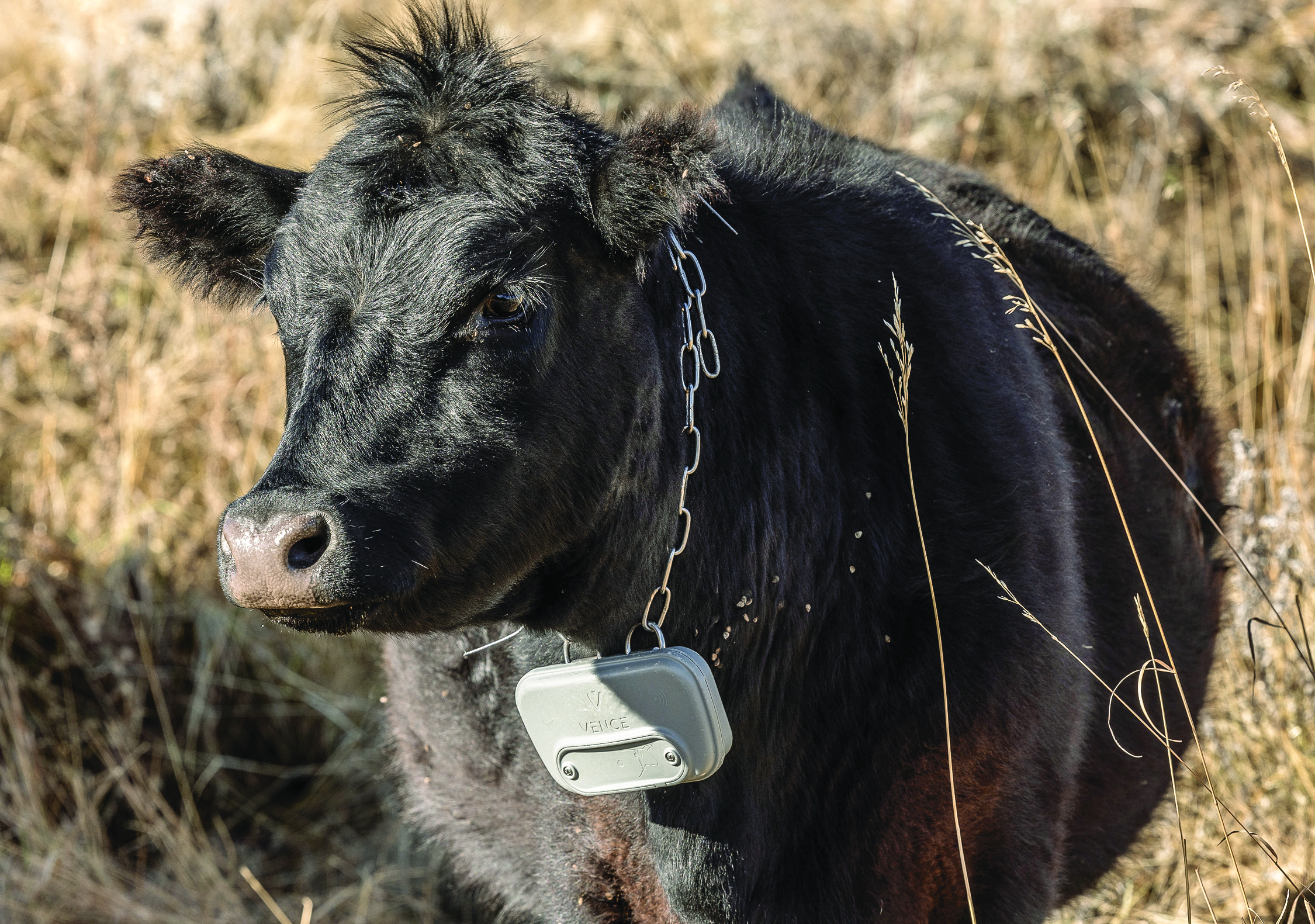 Cattle on the McFarland-White Ranch in Twodot, Montana.
Collared Cattle Combat Costs
Cattle collars and virtual fences aren’t so different from the invisible dog fences of suburban lawns. The system employs “Skinnerian operant conditioning” methods to train animals to mind intended electric boundaries. The system starts with a digital map that dictates where the animals are welcome to roam, but also where boundaries exist. The next step is establishing both warnings and consequences for crossing those virtual boundaries. Using psychologist-behaviorist B.F. Skinner’s philosophy of operant conditioning, the collar emits an audible warning before an animal crosses a boundary, but once the animal encroaches onto the boundary, the collar delivers a humane but surprising shock. Skinner’s training method touts that the animal will soon respond to the “reinforcement” of the audible cue to avoid the “punishment’” of crossing the boundary. Over a short period of time, both cattle and canines are conditioned to both the boundaries and the unpleasantness of crossing them and will stay in their lane. Or yard. Or pasture. As with solar projects or municipal infrastructure, the upfront costs of adopting virtual fencing are significant. Radio transponder sites cost around $12,000, and each collar runs around $50. But supporters say that the initial cost is paid down over years of reduced maintenance of wire fences and lost time spent locating and gathering livestock. Added bonuses include the potential conservation benefits of cleaner water, healthier landscapes, and reduced conflicts with predators.
“I wouldn’t expect a manufacturer to say that their systems are cost-neutral, but not all the benefits can be measured financially,” Brammer says. “They can be used to keep livestock out of sensitive riparian habitats, or to stay away from areas with grizzly bears or wolves. But, at the end of the day, wide adoption of this technology requires that it works for producers. If it doesn’t produce practical benefits, we’re never going to get to the next phase of using it as a conservation tool.” The technology is especially appealing in cases where wholesale fence reconstruction is cost-prohibitive. Last year’s Lone Rock Fire burned some 50,000 acres of timber, grazing, and nearly all fences in eastern Oregon’s Gilliam County. Ranchers placed the cost estimate of 300 miles of fence reconstruction at $9.5 million. Virtual fencing, on the other hand, runs about $400,000. That covers equipping the cattle with collar systems in the same grazing district. Public-land ranchers opted for the collars, with more than half the cost covered with federal grants matched by conservation groups. “Virtual fencing is incredibly flexible, but what made the difference for our members is that it’s much less costly than traditional fencing,” says Herb Winters, district manager for the Gilliam County’s Soil and Water Conservation District. “This project allows our family-owned ranches to get their cattle back on the land and stay in business, while keeping cows away from sensitive areas like rivers and streams.”
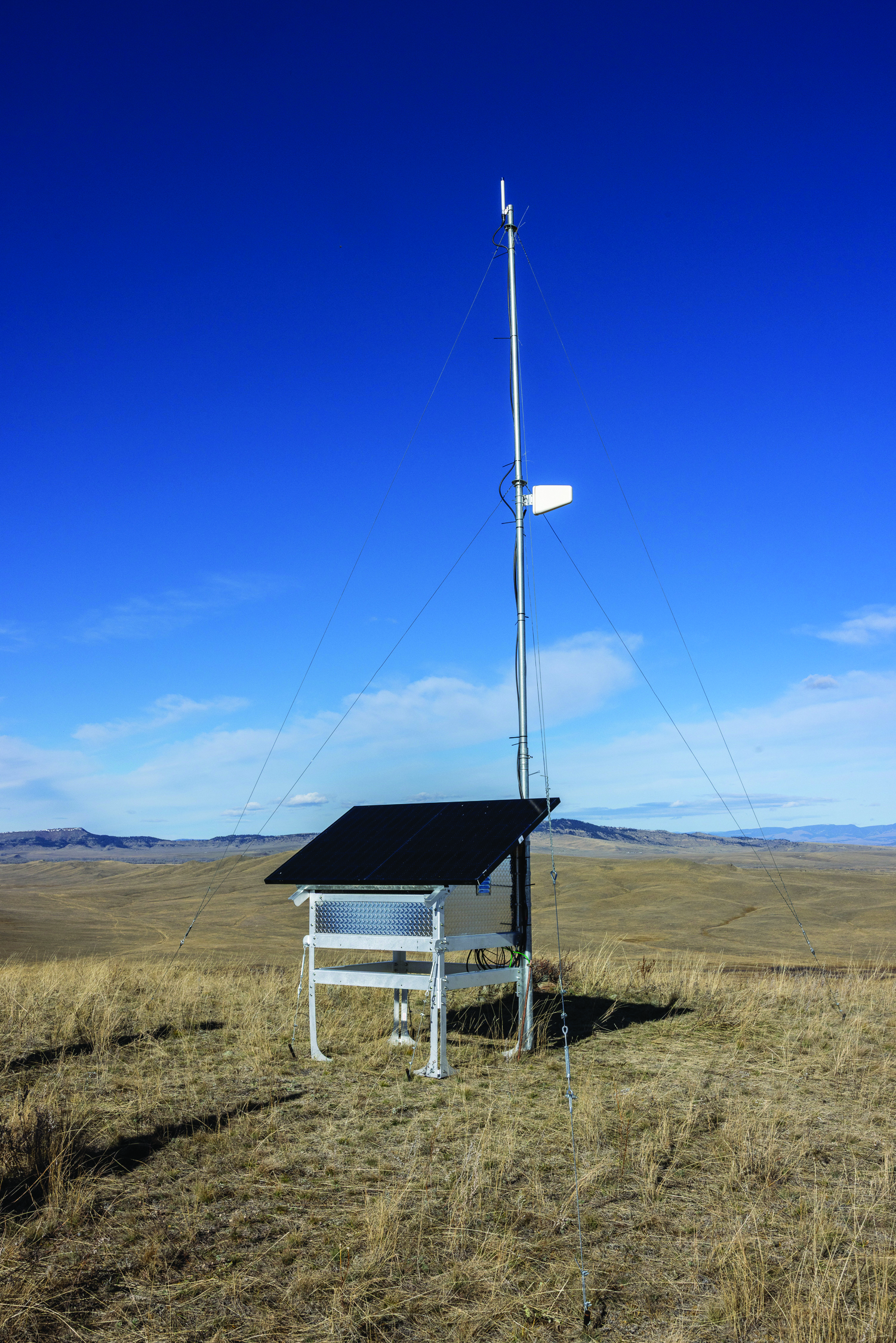 The satellite for the Vence collars on the McFarland-White Ranch in Twodot,
A Dust-Country High-Tech Laboratory
As the recipient of a grant to utilize virtual-fence technology on his 550-head cow/calf operation in northern Montana, Barthelmess sees both the promise and the drawbacks of the technology. Without outside assistance, he’s not sure it would pencil out on his 25,000-acre operation. “It’s an expensive technology, and we’re not managing it well enough for it to pay for itself without some kind of assistance,” Barthelmess says. “It’s not quite right to say that collar-based e-fencing will replace wire altogether. When we’re training cows to use a new pasture, we still have to string an electric fence. That’s the way you train your cows to recognize and honor barriers. You have to show them one. They see it, and they get an audible cue [from the collar prior to crossing the boundary]. If they persist to push through the barrier, you discourage them with a shock. It only takes a day or two to train them, but you need that visual barrier to establish a virtual barrier.”
Barthelmess uses collars from the company Vence, and he says battery life is a secondary issue: “We have to gather our cows two to three times a year just to change the batteries.” There are potential fixes for the headaches. Units with solar chargers aim to extend battery life. Plus, some companies are looking to create partnerships with satellite providers. This would replace the expensive shortwave radio transponders that most ranches currently use. Instead, it would relay location information through a digital cloud that is accessed by a mobile phone app or website.
Despite the challenges, the technology remains promising. Barthelmess believes the system enables him to be a better steward of native rangeland. “We divided two pastures into five as part of our rotational grazing plan,” he says. “With Vence, we can move cows more easily between pastures, intensively grazing one while giving the others more rest. Instead of spending a day gathering and moving cows and opening and shutting gates, we can do it from the house with a mobile app.” Barthelmess says it will take several more years before he’s confident enough in the technology to remove all his internal fences, including those ratty woven-wire homesteaders’ fences that interfere with pronghorn migration across his ranch. “I’m not just going to go pull interior fences that still serve a purpose,” he says. “If a [physical] fence is functional, it will stay awhile, but eventually it has to come down. I’m hoping virtual fencing will replace it, but you have to keep in mind that it’s almost as expensive to take down fence as it is to build fence.”
On other ranches, the benefits of virtual fences remain situational. “We’re working with a producer who raises black Angus right next to a busy highway,” says PERC’s Brammer. “His collars have LED lights. At the push of a button, he can turn those lights on, so if a cow happens to be on the highway at night, it’s less of a hazard to motorists.” Other operators run cattle in grizzly country. “Most collars have a mortality signal that activates when that cow doesn’t move for a period of time,” Brammer says. “This enables producers to get out in the field immediately to locate that cow. They can either prevent it from becoming dinner for a bear or wolf, or move an injured animal out of harm’s way. That’s not only good for the producer, but it can reduce conflict with [federally] protected predators.”
Brammer, who grew up on a Colorado ranch, believes wide adoption of the technology will come with producers’ recognition of the time virtual fencing can save them. “Some benefits of virtual fences are huge, like lowered costs in materials for building and fixing wire fences. Other benefits are smaller but still impactful. I don’t know how many weeks of my life I’ve spent riding around looking for just one or two lost cows. The simple fact of knowing where your cows are — and confirming their location on an app on your phone — can’t be overstated.” Brammer says the virtual fence industry is so competitive — and the technology is improving at such a rapid pace — that costs are coming down while capabilities and benefits continually increase. Plus, PERC hopes to further reduce acquisition costs by awarding grants to producers interested in adopting the technology. In return, ranchers are expected to share their cattle-collar experiences with neighbors and the wider ranching community.
“Ultimately, the tech will take off when a producer sees the value firsthand,” Brammer says. “When they see that they can raise a heavier, healthier cow or calf with virtual fencing, that’s when you’re going to see this technology make wire fences obsolete.”
From the October 2025 Issue
Cover Image: Cattle on the McFarland-White Ranch in Twodot, Montana. By Johns Louise