



We go inside the brutal, beautiful, and breakneck world of bullfighting — and find out what it takes to get between beast and bullrider.
Bullfighters call it getting your egg cracked. It happens to everyone who chooses to repeatedly step between a ferocious bull and a helpless bull rider crouched in the dirt. At some point the bullfighter takes a horn to the face, a hoof to the stomach, or some other physical meeting of man and beast.
And the bullfighter is never the same after.
“It’s when you get a hooking bad enough that you come back and you’re either 10 times better or 30 times worse,” says Knox Dunn, 25, who fights bulls for PBR and the PRCA.
Dunn’s egg-cracking happened when a bull “pretty much stomped a mud hole in me. I got up and ran a little bit. I couldn’t make it to the fence, and he ran me over again,” he says. “It felt like it took me two days to get from the middle of the arena to the fence.”
For Austin Ashley, 23, it came when he was a teenager: A bull rammed his horns into Ashley’s face. His four top teeth broke off at the gum line, and another on the bottom was chipped. As he called his mom from the hospital, he wondered about his future in the sport—by which I mean whether he wanted to keep going. After dentists glued new teeth on a few days later, he thought, that wasn’t so bad, and resumed his career.
This sort of injury happens to bullfighters as they perform what the industry calls “cowboy protection” during bull-riding events. It can also occur during the sport of bullfighting, which looks like the bullfighter and bull are dance partners who hate each other. The bullfighter has 60 seconds to run around the arena trying to stay as close to the bull as possible. He is scored based on the artistic derring-do of what he does in that minute. Dunn once split his kneecap in two when he bashed it into a bull’s horns during his signature opening move—jumping over a charging bull.
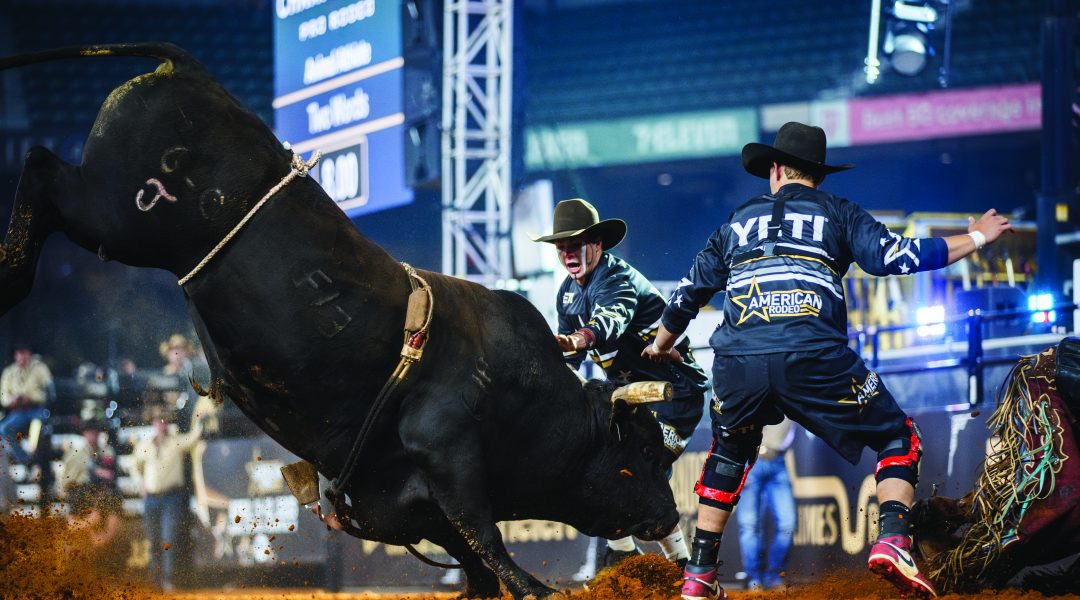
 Austin Ashley prevents a bull from getting at a rider who’s been thrown to the ground.
However it happens, getting your egg cracked is a rite of passage that forces a reckoning for the bullfighter. Is it worth it?
If he says no, he quits and finds a safer way to make a living. If he says yes, he climbs back into the arena.
It’s clearly not for everyone. Working in the West is rugged, hard, and complicated in ways the rest of the country only reads about. It requires you to be comfortable in uncomfortable—and often dangerous—situations.
To find out how in the world a bullfighter ever becomes a bullfighter, and how he stays one after getting his egg cracked, I flew to Arlington, Texas, for The American Rodeo to watch Ashley and Dunn in action.
While there’s no way I would ever actually fight bulls (and no way anybody who has them would let me), I wanted to get a feel for the work. I put on a pair of cleats and joined Dunn and Ashley in the dirt at Globe Life Field a few hours before The American.
I strapped on Dunn’s chest protector. He punched me hard in the chest. I didn’t feel it.
Using a stationary practice bull that spins and rotates up and down, they showed me how to jump on the bull to untangle a rope during a hangup. They also taught me to always be moving in the same direction as a spinning bull. It’s simple physics: If you’re moving in opposite directions, you’re the ball and he’s the bat.
A bull’s turn radius is huge. Bullfighters take advantage of that by positioning themselves in a pocket at the bull’s shoulder. There, you can be close to the bull and distract him, but he can’t maul you. Ashley and Dunn used a piece of PVC pipe to mimic the horns and taught me to move in a circle while tucked inside those horns, with my eyes on the bull’s butt. If the bull is chasing me, he can’t maul the bull rider. And if I stay inside that pocket, he can’t get to me.
That sounds simple. Executing it is not. The most important lesson I learned about bullfighting? Ignore your instincts. As Dunn said, whatever you think you should do, do the opposite of that. If I were fighting a bull, my instincts would tell me to run (wrong), stay far away from the bull (wrong), and even if I managed to stay close, I would move as quickly as possible to get away once the bull moved anywhere near me (wrong again).
To ignore your instincts under duress takes incredible training and uncommon grace under pressure. In bullfighting, sports, and life, we don’t rise to the occasion—we fall to our level of experience. “After a while, you figure it out by trial and error,” Dunn assured me.
To heck with trial and error when the error means I lose four teeth or get a mud hole stomped in me. It just looked crazy. I grew up in the suburbs of Detroit. The only times I’ve ever been around bulls is when I’ve covered rodeo.
I don’t want to get in an arena with them, period, and I sure as hell don’t want to fill the gap between a fallen rider and a bull, which is a bullfighter’s most important task.
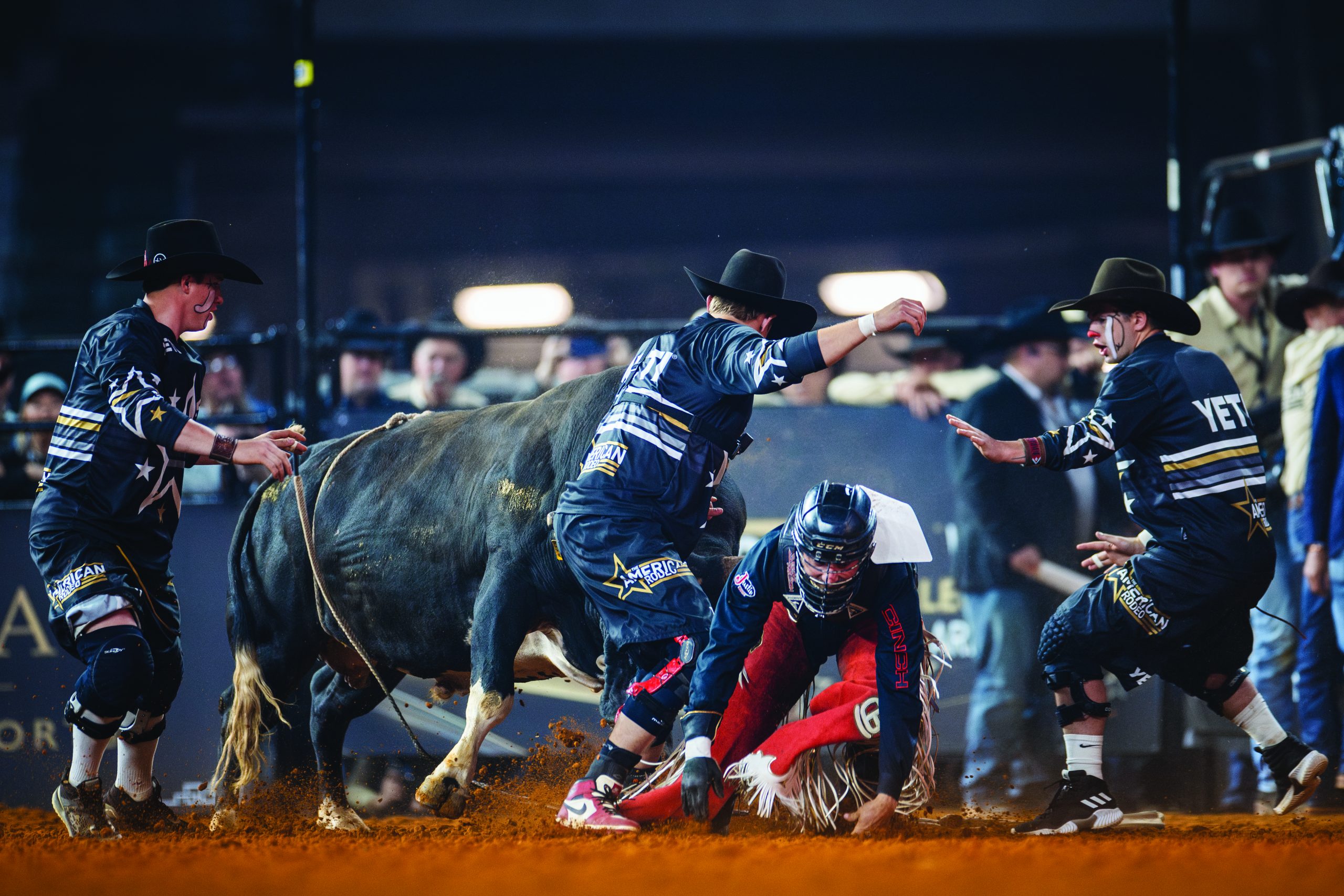 (From left to right) Bullfighters Knox Dunn, Shane Jennings, and Austin Ashley triangulate a bull in a classic bit of bullfighting teamwork that keeps the rider and the bullfighters safe.
Ashley and Dunn both grew up in the sport and around animals, bulls included. Before they ever thought about fighting bulls, they had a comfort level that I simply don’t have. The best bullfighters excel because years of experience has taught them to be “bull savvy.” You can learn it, but it’s easier if you’re born into it.
Not born into it and clearly not able to learn it quickly enough to save my teeth, I elected to watch The American from just off the chute. I had gotten to know Ashley and Dunn by then, so my heart rate spiked as they worked. And while neither one of them got their eggs cracked that day, it reminded me of how I got the idea to write this story in the first place. At a PBR event in St. Louis last December, I watched in awe and fear as a bullfighter stepped between a fallen rider and the bull. The bull tucked his head and essentially became a seat the bullfighter sat on. The bull lifted his head and threw the bullfighter. The bullfighter bashed into the chute, flipped over, and landed in the dirt on his head and shoulders. The bull ran off, the bullfighter took a second to collect himself, and he went right back to work.
Right then and there, I decided I was going to ask bullfighters to show me how in the world they do that. I told Ashley and Dunn that story. Ashley’s response?
“That was me.”
Sure enough, we Googled it, and a few seconds later, there he was, sitting on the bull’s head—and then flying through the air.
After talking about wrecks like that, Ashley, Dunn, and I talked a lot about fear. It’s not that they’re not afraid, it’s that they leave the fear outside the arena. They fight bulls with an uncommon mix of awe, respect, and a “been there, done that” nonchalance. “When I first started, it seemed like every bull ran me over. I don’t need to do that again,” Dunn said. “I’d do something else and get run over again. I don’t need to do that either.”
Eventually he learned what kept him, his teammates, and the bull rider safe. Put another way: There are many ways to crack your egg, and only experience allows you to turn that into an omelet.
Bullfighters Only
Want to see these brave bullbusters in action? If you’re heading to Vegas, they’re putting on a championship show during NFR.
The 2025 BFO World Championship
Want to see bullfighting at the highest level of the sport? Founded by bullfighters, Bullfighters Only is freestyle bullfighting’s premier professional league. Featuring a roster of elite international athletes competing against the rankest fighting bulls for impressive purses, BFO runs yearlong nationwide competitions leading up to four days of world championship bullfighting during the National Finals Rodeo in Las Vegas. Pre-championship rounds take place this year at 1:30 p.m. on December 5, 6, and 11. Each round leads up to the final BFO World Championship on December 13, 2025. Tickets are available at bullfightersonly.com.
The 411
In bullfighting, both bulls and riders are scored. A cumulative score with a maximum of 100 is given. The fighter can be awarded up to 50 points for style, control, and difficulty in maneuvering around and over the bull. The bull can also earn up to 50 points based on his aggression, quickness, and willingness to engage, or “hook up,” with the fighter. Each fight between bull and bullfighter lasts 60 seconds. Bullfighters have the option to end the match at any point after 40 seconds without penalty. But if a bullfighter doesn’t engage the bull through the 40-second horn, he’s disqualified.
The Four-Legged Athletes
The bulls utilized for American bullfighting descend from Spanish Toro de Lidia bloodlines. Long bred for athletic aggression and physical prowess to charge and challenge traditional matadors, the bulls who compete in the U.S. sport are not killed or maimed in the course of bullfighting. The prized animals gain fans of their own, and their safety is paramount to the succession of both bloodlines and the sport. — C&I Editors
View this post on Instagram
PHOTOGRAPHY: (ALL IMAGES) CLAY GUARDIPE
From our November/December 2025 issue