



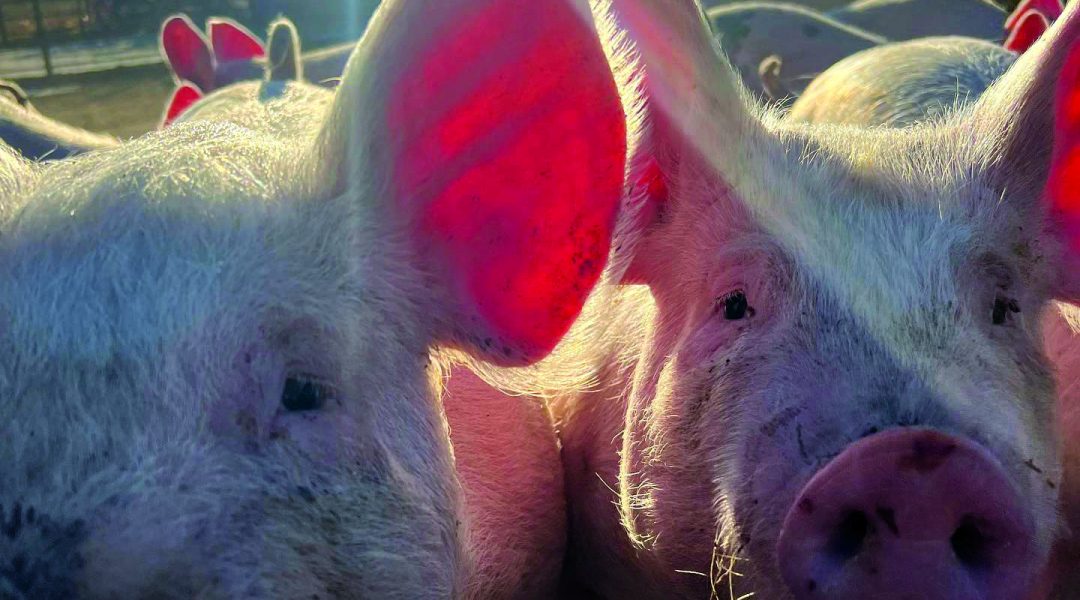
Our correspondent puts in a day of shoveling manure and other crucial work at Nebraska’s The Hog Yard.
I pulled clear plastic booties over my Reeboks and prepared to go to work cleaning pig excrement out of a pen at The Hog Yard, a small operation in eastern Nebraska. The Hog Yard’s owners care deeply about biosecurity and required me to wear the booties to protect their animals against disease — specifically PRRS (porcine reproductive and respiratory syndrome), which would decimate their operation if it was introduced to their hogs.
I care deeply about not getting my shoes thick with manure, so the booties checked boxes for both of us.
I watched Andrew Wiechman, a co-owner of The Hog Yard, navigate the piles. He didn’t need booties because his boots never leave The Hog Yard, so it’s impossible for him to bring PRRS to the farm.
I couldn’t help but compare how he walked around the manure and how I did. I tried not to step in it, even with booties on. At first, I thought that he simply plowed right through it — like, if you’re walking at a farm all day every day, you might as well stop trying to avoid it, right? But then I watched more closely. Nimble as a ballerina, he stepped around or over every pile without breaking stride, like a golfer on a green avoiding walking through someone else’s line. He didn’t even realize he walked like that until I pointed it out.
He handed me a scraper, which made me think of windshield washers at gas stations, only made of metal and with a longer handle ... and infinitely more gross, I suppose. It was like raking the world’s nastiest leaves. Trying to get manure out of corners of the pens was like sweeping cobwebs out of the corner of my garage: I could never quite get all of it. I also chased pigs out of a pen so we could clean it, drove a skid loader to scrape manure across the pen and then used a shovel to turn those smaller piles into bigger piles.
The first thing you want to know about, I’m sure, is the smell. It’s rude to show up at someone’s property and ask about that. But I did anyway. “What smell?” said Andrew’s dad, Glen Wiechman, with a smile.
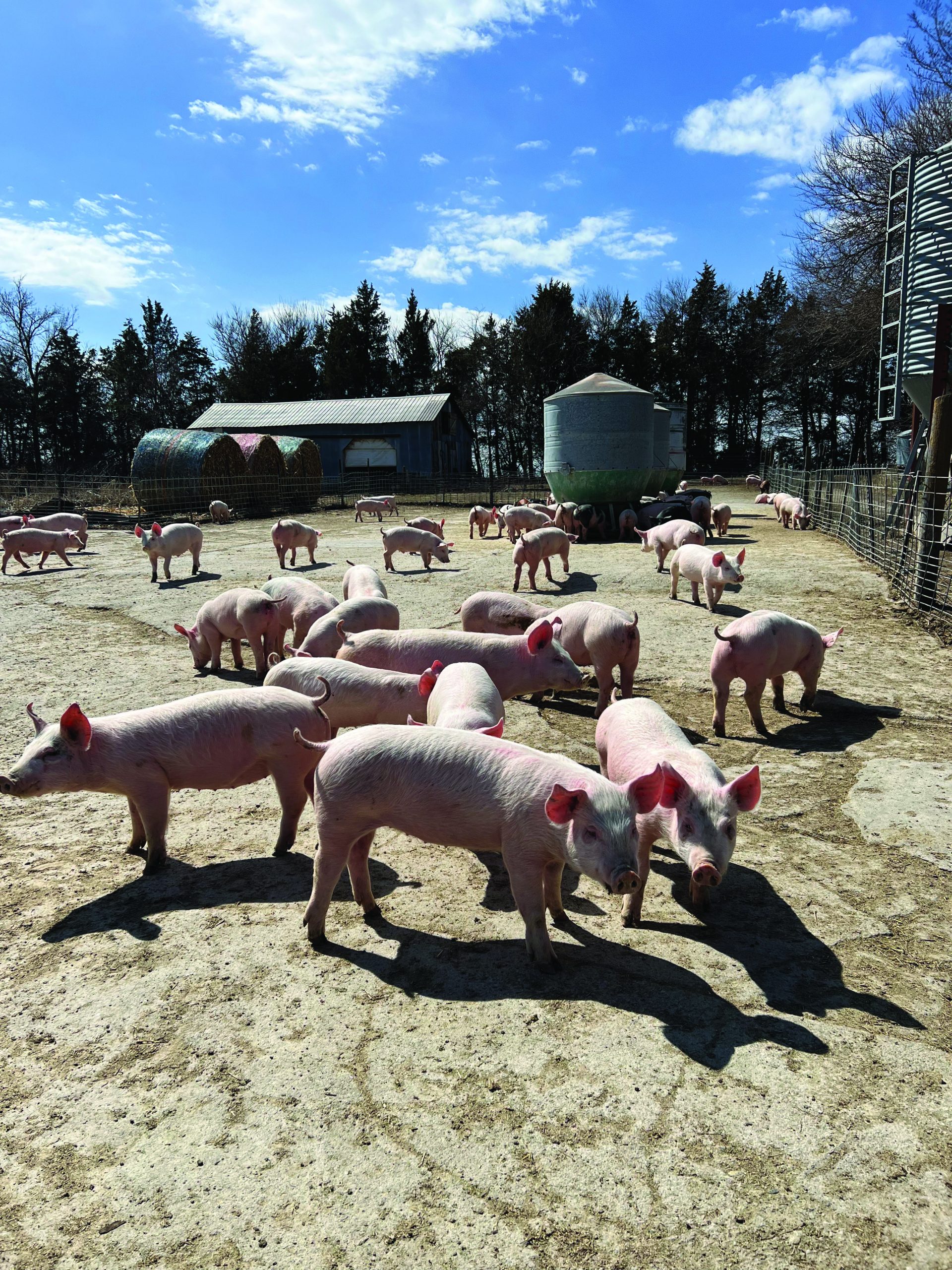 The Hog Yard farm in West Point, Nebraska.
His point: You get used to it. He’s right, but honestly, it wasn’t bad, even for a city boy like me. Now, I don’t want to stick my nose any closer to it than I did that beautiful June day, but the parking lot at my hotel in town smelled worse — it was downwind from something foul.
If being at The Hog Yard was a breath of fresh air, so, too, is its back story: a group of friends joining together to do something they love.
According to the USDA, the number of farms raising hogs has declined by 70 percent since the 1990s. Small farms have been replaced by massive operations with thousands upon thousands of hogs. Increased efficiency in production has given big operations economies of scale advantages that have made it all but impossible for smaller farms to compete unless they carve out a niche like The Hog Yard has, producing premier products and marketing them that way.
The Hog Yard is a collaboration between three couples — Andrew and his wife, Kelly; their friends Aliza and Greg Brunsing; and Andrew’s parents, Glen and Melann. It is, essentially, a group side hustle. Each couple has other, bigger projects in farming. Aliza is a nurse, and Kelly works as an x-ray tech.
The pigs are farrowed (born) at the Wiechman farm and transferred to the Brunsing farm, where they are fattened before slaughter.
Customers can order products online (thehogyard.com). But most of their sales come from local farmers’ markets. Customers often approach their booth and say pork chops don’t taste like they used to. When customers make that familiar lament, Kelly and Aliza work their sales magic.
Pork chops produced in bulk don’t have as much fat marbled in as pork chops from The Hog Yard, they say, and that lack of fat makes them dry out. Take this home, Kelly and Aliza say, and cook it like this.
“That person will be back the next week buying more,” Andrew says.
 Glen Wiechman working the farm.
They sent me home with samples — smoked sausage sticks, jalapeno bacon, and pork chops. All outstanding. I devoured the sausage sticks within an hour of getting in my car.
It’s tempting to think of the pork market as a David vs. Goliath story, with the massive operations as villains, but nobody involved with The Hog Yard sees it that way. In fact, Andrew defends the Goliaths of the industry. He drove me by one about a mile from their farm to show it to me and spoke admiringly of the services they provide.
The giants offer different products for a different reason than The Hog Yard. As Kelly put it, “You need both to feed the world.” Maybe, as Andrew suggests, you buy pork chops from The Hog Yard for your weekend cookout and use mass-produced products you bought at the grocery store for the rest of the week.
With that as the backdrop, and after we were done with the cleanup, Andrew and I talked at length about balance — between working hard and having a family life, between living where you grew up and seeing the world, between running The Hog Yard efficiently and humanely, and so on.
He confesses that in the middle of the winter when he’s fighting the elements, he would much prefer to work in a climate-controlled confinement barn with thousands of pigs than outside with hundreds. “We have a lot of character-building days on the farm,” Andrew says.
 (Left to right) Glen Wiechman, Greg Brunsing, and Glen’s son Andrew Wiechman, whose families own The Hog Yard.
Yes, indeed. But the balance comes when he finds joy marbled into the raking of manure. Aliza — she’s the city girl of the bunch even though she’s lived on a farm for years now — points out that you can visibly see the difference in fields that have had it spread on them and those that haven’t.
And then there’s the source of it: mama pigs and dozens of piglets so cute I would show up frequently to clean up after them if it meant I got to see them suckling ... and being born and growing and maturing.
“We’ve farrowed, I don’t know how many in my life,” Andrew says. “But I still like coming to watch. It’s new life. It’s birth. It’s pretty cool.”
From our October 2025 issue.
PHOTOGRAPHY: Courtesy of The Hog Yard