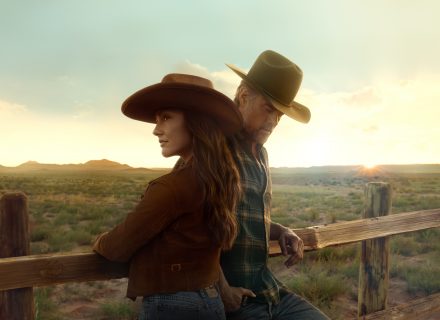
The Sony Pictures Classics release kicks off its theatrical run Aug. 15.
If you’re a director, sometimes you go looking for your film. But other times, if you’re lucky, your film finds you.
Not so long ago, Kate Beecroft had only a few shorts and videos to her credit. She was hoping to add a few notches to her belt with something new — not necessarily a feature-length film, but maybe a commercial — so she drove around the country with her director of photography in search of inspiration.
And then, as the narrator used to say in early episodes of The Fugitive, fate moved its huge hand.
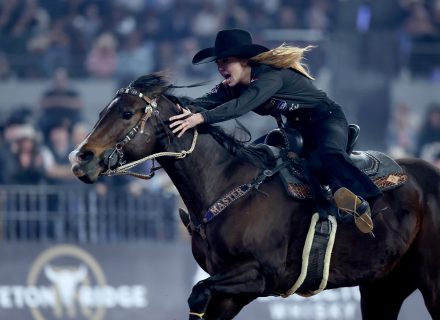
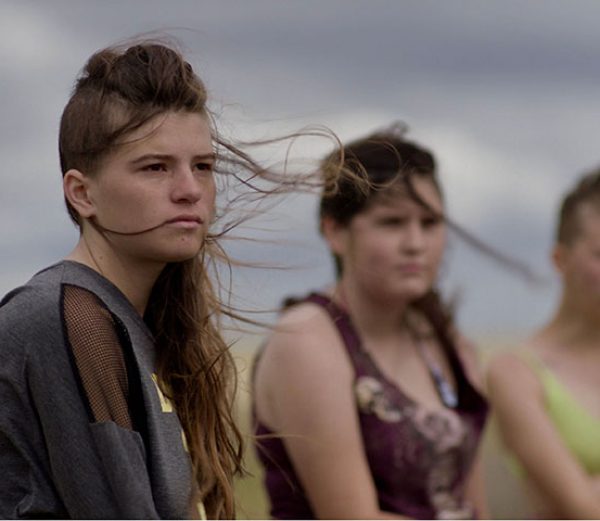
While driving through the Badlands of South Dakota, she was fortuitously directed to Tabatha Zimiga, a rebellious rancher who rescued and raised horses while providing refuge for an ever-expanding group of wayward teens — and looking out for her own daughter, Porshia, a cowgirl in the making.
Beecroft took the advice to heart and drove to the ranch — where she discovered the perfect characters for a movie. Not a documentary, mind you, but a dramatic feature: East of Wall. With real people more or less playing themselves — credibly, creditably, and compellingly.
Only two professional actors figure into the East of Wall cast: Scoot McNairy as Roy Waters, a well-off Texas horse trainer whose motives may or may not be honorable as he seeks to expand his operations into South Dakota; and Jennifer Ehle as Tracey, Tabatha’s sassy, moonshine-sipping, and totally uninhibited mother.
Just about everyone else you see on screen is for real — or as U2 would sing, even better than the real thing.
East of Wall caused quite a sensation earlier this year at the Sundance Film Festival, where Beecroft’s masterful mix of cinéma vérité and scripted drama earned the Audience Award in the Next category. Critics were virtually unanimous in their praise, with Sheri Linden of The Hollywood Reporter raving: “Tapping into universal tensions with a charged specificity, East of Wall is vibrant with its sense of place and, beneath its hard-knocks surface, a poetry of astonishment and yearning, emotions intertwined in the subtle but stirring score by Lukas Frank and Daniel Meyer-O’Keeffe. The place Beecroft stumbled upon is fueled by girl power, and the story she and her collaborators have created is wise and messy, keenly aware of the dark places at the margins as it burns bright with life.”
Peter Debruge of Variety noted that, with all due respect to the experienced professionals in the cast, “while you can teach an actor to drawl, spit tobacco and ride a horse, those shots of Porshia bolting across the horizon faster than her mom’s pickup truck can keep up … well, there’s just no faking that.”
We recently had the pleasure of speaking with director Kate Beecroft about East of Wall in the C&I Studio. Here are some highlights from our conversation, edited for length and clarity.
Discovering A Story Worth Telling
Cowboys & Indians: To begin with the obvious question — how did you come across this remarkable family?
Kate Beecroft: Well, I was just driving across the U.S. with Austin Shelton, my director of photography — I think it was during COVID, or right before COVID. And we were just looking. I mean, I wasn’t looking for a feature. I had really no résumé, so I was just looking for little things that I could maybe put on my reel to show people. Maybe I could direct a little commercial or something like that.
And so we took a wrong turn, and I met a woman there and I filmed her for the day. And then she said, “Hey, if you really want an amazing story, head east of Wall. There’s a woman named Tabatha waiting for you.” And you kind of just get those interesting chills that go through your body in a moment like that. And there was so much mystery there.
So we got off at the exit and we just showed up at this ranch. We pulled up, and it was just such an interesting property. And we pulled up to their lifted trailer home, and all these teenagers started just piling out. And then Tabby showed up and she looked at me and said, “So you’re here to see some real cowgirl shit?” And that was kind of my initiation into their life. And it was probably the most magical moment of my life when I look back on my years.
From Fascination to Filmmaking
C&I: Which decision came first? Your deciding to study these people? Or did you always have a conventional narrative in mind at the start?
Beecroft: What’s so interesting about it is, we all came into it in a very pure way. I don’t even think I spent five days with them. But then I went back to L.A. with all the footage, and I was like, “I just need to keep going back out there. I don't know what this is, but I am addicted to these people.” And there was just something that was pulling Tabby and me together. She’s one of the closest people in my life to this day.
I never once thought this was going to be a documentary. I don’t consider myself a doc filmmaker. To me, it was just like, “These people are incredible at telling stories.” I was starstruck when I met them, and I don't know why. They just have this incredible energy about them.
I basically made the film that I’ve always wanted to see. I think there's an amazing resurgence of cowboy culture and Western films right now, but none of them are being told through the voices and faces of young women. So for me, this was the film I’ve always wanted to see. I’ve always wanted to see a woman like Tabby on the screen — young girls who are fierce and feral in the best way possible. They’re just badasses.
Becoming Part of the Family
C&I: Did it take much convincing to get them to play themselves?
Beecroft: I first showed up there with a camera, and then I lived with them for three years before I even started filming. So I was just building their trust. They’re my friends. I went through brandings with them. I would go to sale barns and rodeos with them. I was there for so much of their life. We just built trust in the way that you do with any person in your life.
The film I would’ve made after I had just met them would’ve been so different from the film I ended up making. I really started to understand their culture. I understand who they are as human beings, and I just have that respect built.
C&I: What about your own background? Are you a horsewoman?
Beecroft: No. I was born and raised in Los Angeles. I’ve only ever lived in L.A., New York, and London. Everyone thinks I’m some horsewoman, but I’m absolutely not. But I went through cowboy camp with them, and they really taught me how to ride. Each day, they’d kind of put me on a naughtier horse so I could get my confidence up. Those girls really taught me everything.
Blurring the Line Between Fact and Fiction
C&I: The mix of cinéma vérité and narrative cinema is striking. For example, when Tabatha goes to family court to assume responsibility for a new member of the household and is turned down by the judge — was that real or improvised?
Beecroft: Basically, the only scene that’s improvised is the one with the women by the fire telling their stories. Everything else is fully scripted. This was a SAG production. They were treated like professional actors — because they ended up being such.
I never wanted to make a documentary because I didn’t want these kids to feel naked. I wanted there to be some sort of fiction protection, or a little hiding behind fiction for safety.
The only really fictional storyline is Scoot McNairy’s character, Roy. Everything else, even though scripted, is based on something I witnessed in their lives — the girls stealing barrels, for example. I was there that night. I would constantly be recording them, learning how they speak, how they express joy and anger, and we wove that into the script.
Playing Themselves — Or Something More?
C&I: Did you get the feeling that they were playing themselves, or were they playing who they wanted to be?
Beecroft: That’s a very interesting question. I’d actually be curious what they would say. I think they were playing aspects of themselves. But we’re all such complex human beings. They were definitely playing themselves, but we also worked on the characters together. I’m not a precious director — I don’t want my fingerprints all over the film.
It was a super-collaborative process. When people ask, “What are you guys doing now?” at Q&As, Tabby says, “Well, whatever you see on the screen, that’s what we’re doing now. That is my life.” And I think that’s a really perfect response.
The Clash of Old West and New West
C&I: When you were devising a plot to structure all of this, when did you decide you needed a Roy?
Beecroft: I don’t even really remember when I came up with Roy. It was pretty early on. Tabatha and her family represent the New West to me, and I needed someone to represent the Old West — and for that to collide. That’s how I came up with Roy. I think Scoot played that role with such complexity. I never wanted a cowboy villain — just someone who’s kind of selfish and as messed up as any of us.
I was thinking, What would be the hardest decision Tabby would have to make? Something involving the ranch, because they identify with it so much. It’s their whole livelihood. Tabby doesn’t look like everyone else in South Dakota — her family doesn’t either. She’s so modern. She just jumps right off the page. She’s my New West.
C&I: Did you always intend Roy’s motives to be so tantalizingly ambiguous?
Beecroft: Yes. I love when a director allows me to have a brain when I’m an audience member — being able to project what I want into a storyline and not have everything spelled out.
I wanted the audience to be like the kids — like Tabby. “Wait, he’s lovely and fun and gives us opportunities. But … is he trying to control us?” Then there’s the reveal that Roy lost a daughter to suicide — something tragically real in South Dakota. I wanted him to project that fatherly instinct onto Porshia, thinking he could have a second chance.
So yeah, I wanted the audience to feel like they were part of the family, asking, “Who is this guy? Do we like him or not?”
Sundance and the Surprise of Success
C&I: Finally, let’s talk about the overwhelmingly favorable response your film received at the Sundance Film Festival. Years ago, when I interviewed the late indie filmmaker John Cassavetes, he was talking about getting the early reviews for Shadows, his first film, and he couldn’t believe the reaction. He said he and his producer were actually laughing while reading the notices, because they were so good. I’m imagining you reading the early reviews and thinking, “Oh, my God! They got it!”
Beecroft: That was crazy. I even have chills right now just thinking about it. We never screened this film for anyone — no friends, no family notes. It had never been seen by anyone other than our tiny team. I thought, OK, I might get slaughtered, but at least I made a film.
We were a hundred percent not expecting this reaction. It was incredibly moving.
And of course, I was so nervous. If this was just an office romance comedy that I wrote, yeah, take all the punches. But I felt scared about how this would come across, because these amazing people trusted me with their lives. If the reviews were bad, it would’ve been heartbreaking to share that with the cast. So this was pretty moving.
PHOTOGRAPHY: Courtesy of Sony Pictures Classics