




Our Working the West correspondent heads down to Texas to try on the work of a custom bootmaker for size.
I sat on a chair on a platform inside M.L. Leddy’s, the high-end Western apparel store, and took off my shoes. Jason McClelland opened to a blank page in a ledger. First I put my socked right foot onto it, and he traced it using a pencil. Then I put my socked left foot on it, and he did the same thing, on the same page, the feet overlapping.
His drawing showed one of my feet is slightly bigger than the other, which I already knew and was crucial information for him as he sized me for a pair of custom-made cowboy boots. Next, using a cloth measuring tape, he took seven measurements of each foot; they showed one of my feet is taller than the other, which I did not know, and again was crucial for him.
He also used a Brannock device — that silver thing you put your foot on at the shoe store — to measure the ball of my foot. With those figures in hand, he fished a pair from the shelf for me to try on.
I slipped on the right first, then the left. They looked amazing, and I wouldn’t have minded walking out with them. McClelland ran his hands over them, as he has done thousands of times in his 19 years of working for Leddy’s, because how they feel to his hands tells him how they fit.
And with that, the 11th different way he measured my feet, the Western Work magic happened.
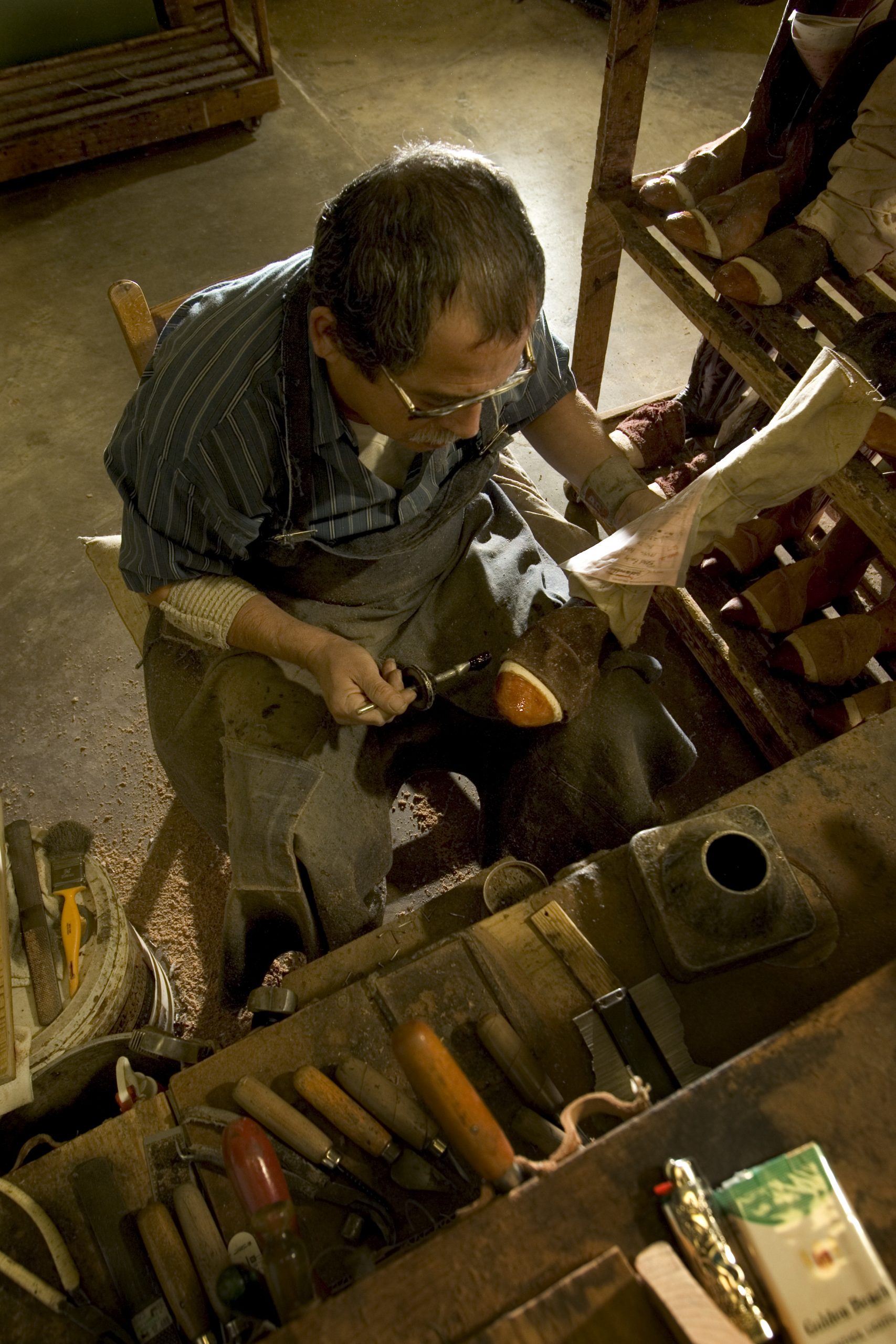
Joe Orozco coats the toe to stiffen it as he works on a pair of boots in the Leddy's factory in San Angelo.
In this series about Western work, I explore themes, trends, truths about life and work in the West. I have looked hard to find them in pig shit in Nebraska, in newborn calves in Missouri, in bucking bulls’ horns in Arizona, and more. In this case, they were as obvious as the shoes on my feet.
I showed up at Leddy’s pop-up store inside the Houston rodeo hoping to learn how a boot becomes a boot. I left having also learned how art becomes art, and that what M.L. Leddy’s sells is not cowboy boots but sculptures you wear on your feet.
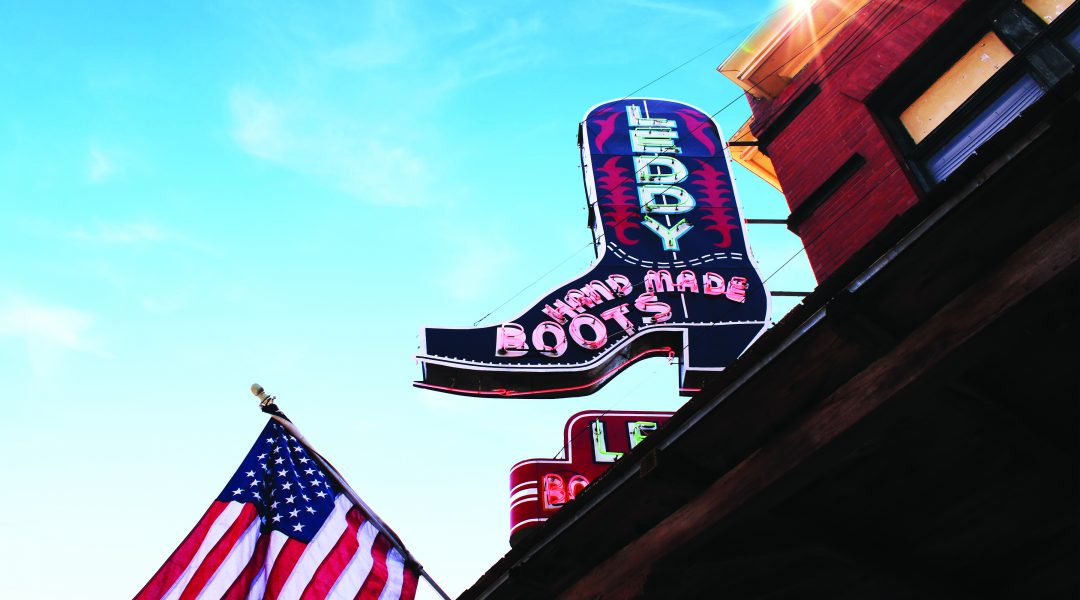
It was a good business to choose, because they’ve been at it a long time. The M.L. Leddy of the company name left his parents’ cotton farm in 1918 to work for a saddle and bootmaking business in the “Heart of Texas” town of Brady. After buying the business in 1922, he moved it 50 miles west to San Angelo about 15 years later and eventually opened his flagship store in the Fort Worth Stockyards in 1941. And they’ve been doing it by the book ever since.
M.L. Leddy’s calls its old-school process “book and page.” The book is thick, like an accountant’s ledger, and each page contains drawings of feet, two to be exact, one person per page. My feet, drawn by McClelland, adorn page 300 in book 36H.
McClelland doesn’t have a job title because no title could cover the array of tasks he completes. He does what needs to be done — an utterly Western view of work. After talking to him about how boots are made, I think of him as an art curator, a maître d’ and a personal shopper whose job it is to help you conjure from scratch the perfect pair of boots, starting with taking your measurements, all of which he has perfected in his two decades with M.L. Leddy’s. He then spends up to a year shepherding them to creation.
To create that work of art, you face myriad choices, from the style of toe, height, and slope of the heel to the type of leather, design of the four panels, stitching, and on and on.
There is no wrong answer to any of those questions. Beauty is in the eye of the boot-holder. I find ostrich boots particularly attractive; they look like manifestations of confidence. I favor toes on the wide side and heels on the high side (because I’m 5-foot-9 and every little bit helps). You might like alligator, rounded toes, and short heels, and we could still be friends.
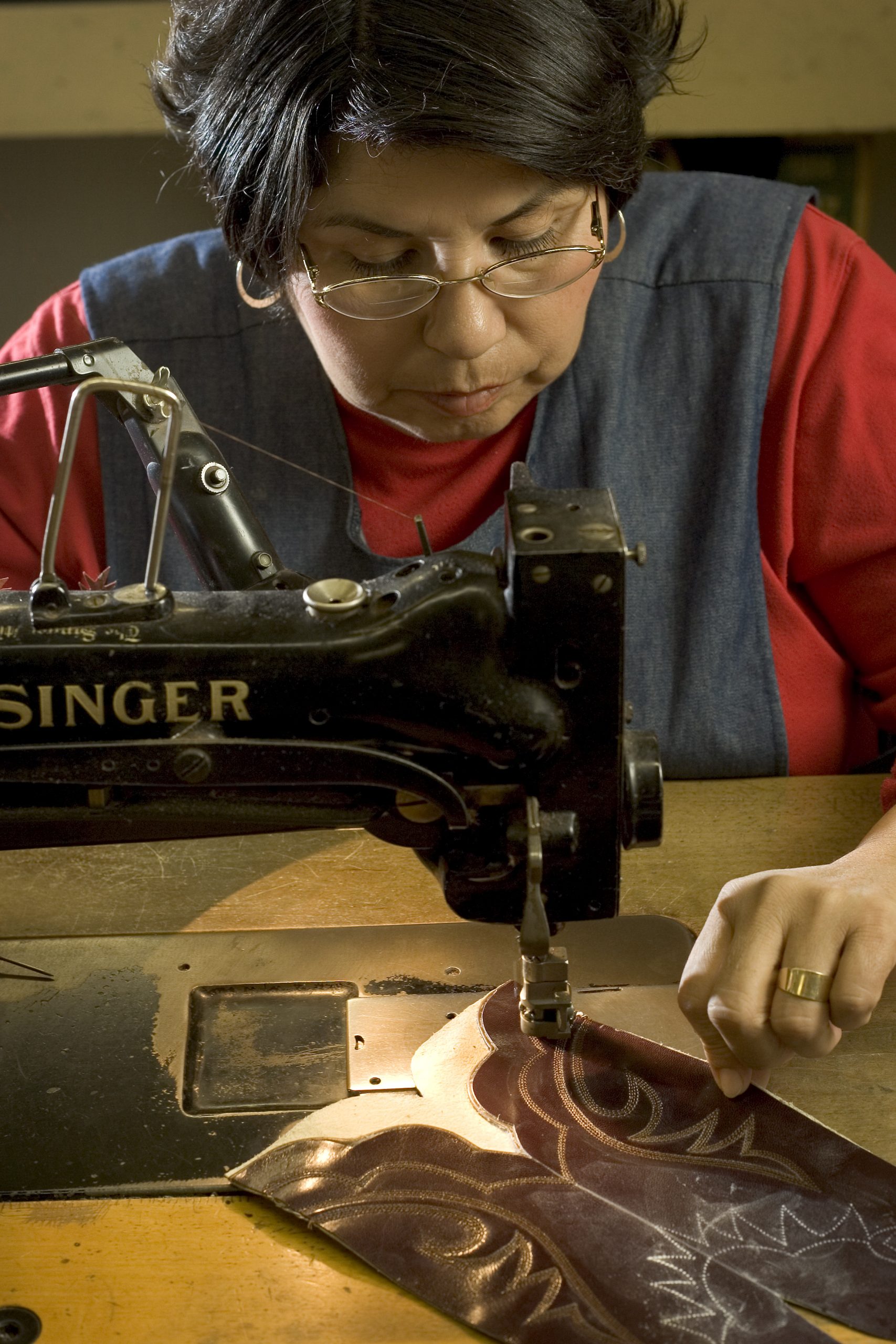
Maria Reyes stitches a pattern into the top of a boot using colored threads.
The one thing everyone agrees on: A boot that doesn’t fit is useless.
Getting your feet properly measured is a long-dead craft, and its passing is emblematic of the loss of human interaction that has infected our entire culture. We have contactless delivery, lest, God forbid, we say hello to the pizza man. AI screens our résumés, conducts our job interviews, analyzes our answers. Everything is online, everything is automated, and face-to-face interaction seems a quaint throwback.
M.L. Leddy’s stands athwart that yelling stop.
The modern way is efficient, practical, scalable. But the customer doesn’t get what they want or need. They get what’s available and nothing else. It’s all general, no detail. There’s no craft in it. There’s no art in it. There’s no love in it. “It’s all about quantity, quantity, quantity,” McClelland says. “To me, that’s sad.”
He’d rather make something that lasts, something whose value is shown by the time and care taken to make it. “What about being patient, making sure it really fits good and has the quality that you want to have? That way, you’re going to have that craftsmanship.”
And also that relationship. Jason and I bonded over my feet. He knows his third-generation customers by name — fathers, sons, and grandsons. That’s fitting because family relationships are a big part of how the company operates. The owner, Wilson Franklin, is the third-generation owner and grandson to the namesake, M.L. Leddy. Franklin’s two children — son Jim and daughter Josilyn Franklin Bigoness — have leadership roles in the company.
M.L. Leddy’s could walk away from their time intensive, face-to-face style and do things the easy way. They could buy a sensor like the ones at a running shoe store and have customers stand on that to measure their feet.
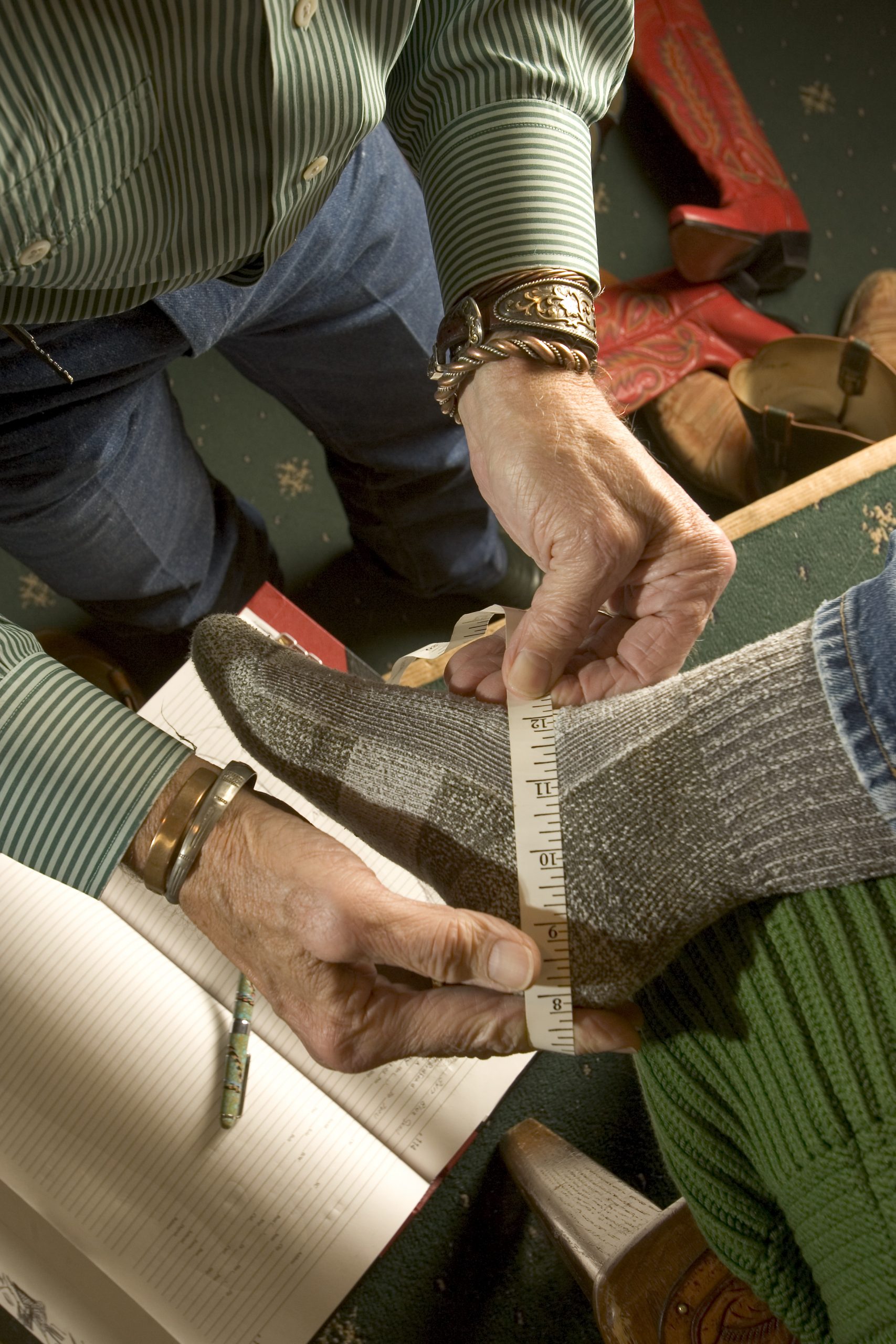
Gene Lee Reynolds takes a number of measurements of each persons foot as well as a tracing of the outline which is kept in the book, and M.L. Leddy's has the books on file back to 1922.
But they won’t, and McClelland bristles at the thought. That’s not the Western way. They’d no longer be distinct, they’d no longer be unique, they’d no longer be M.L. Leddy’s. Their deeply Western authenticity would unravel like a poorly stitched boot.
All of this requires patience on the customer’s part, which a customer probably knows before they walk into M.L. Leddy’s — and learns soon enough if they don’t. McClelland told me Leddy’s makes seven pairs of boots a day, max.
Back to the magic.
As McClelland rubbed his hands over the boots, I thought, That right one is a little tight on the top of my foot. The thought had barely finished forming in my head when his hand stopped on that foot, and using his index finger, he touched exactly where it was tight.
It didn’t feel awful, but he would have insisted he make me another boot that fit properly.
“We go through all that process, so at the end, we want to give you the best-fitting boot we can possibly give you,” he said. “You want it to be a great experience. That’s what gets your customer to come back to you and say, ‘I can’t get this anywhere else.’”
PHOTOGRAPHY (ALL IMAGES): Courtesy M.L. Leddy's
From our August/September 2025 issue.