





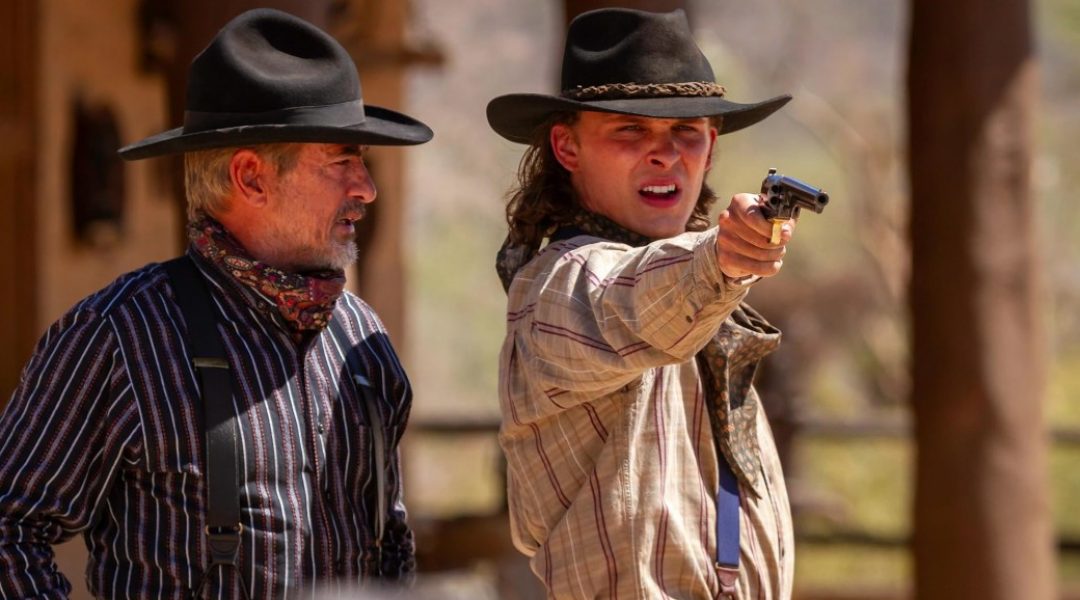
The versatile verteran actor spoke with us about his new western Long Shadows.
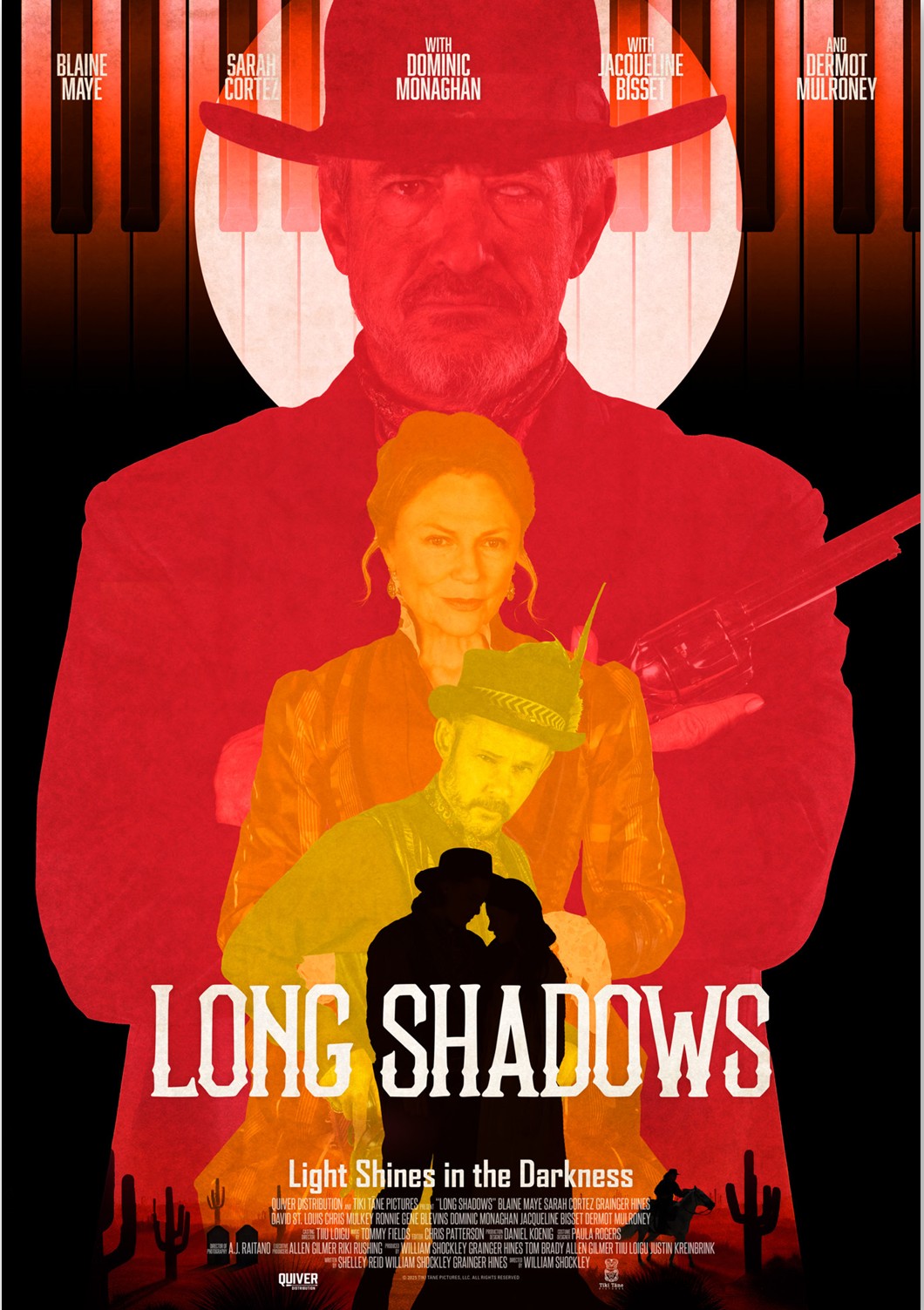
Dermot Mulroney is back in the saddle again, playing a notorious outlaw named Dallas Garrett in Long Shadows, a new western set to open Friday, November 7, at theaters and drive-ins everywhere.
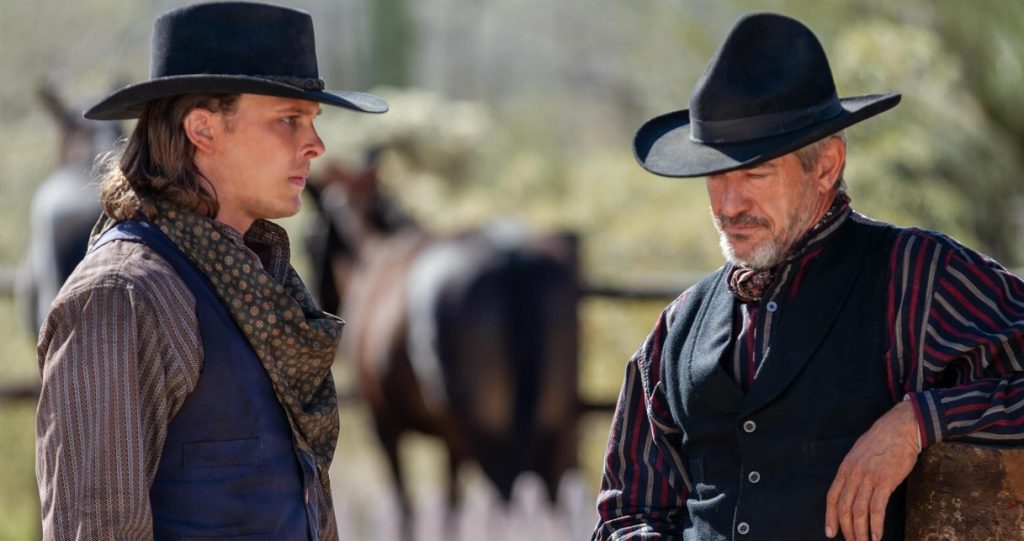
The first feature film directed by Dr. Quinn, Medicine Woman star William Shockley, it’s a tale of obsession, revenge, and dangerous delusions in the Wild West, with Blaine Maye (Joe Bell) starring as Marcus Dollar, a young man who’s eager to go gunning for the horse thieves who killed his parents just as soon as he ages out of an orphanage in the 1880s Arizona Territory. While he proceeds along the vengeance trail, he is aided by Mulroney’s Garrett, who reluctantly teaches Marcus how to draw fast and aim true.
Or does he?
There are a few ingenious twists in the script credited to Shockley, Shelley Reid, and Grainger Hines, which made it difficult, if not impossible, to discuss the movie in detail with Mulroney without spoilers entering the conversation.
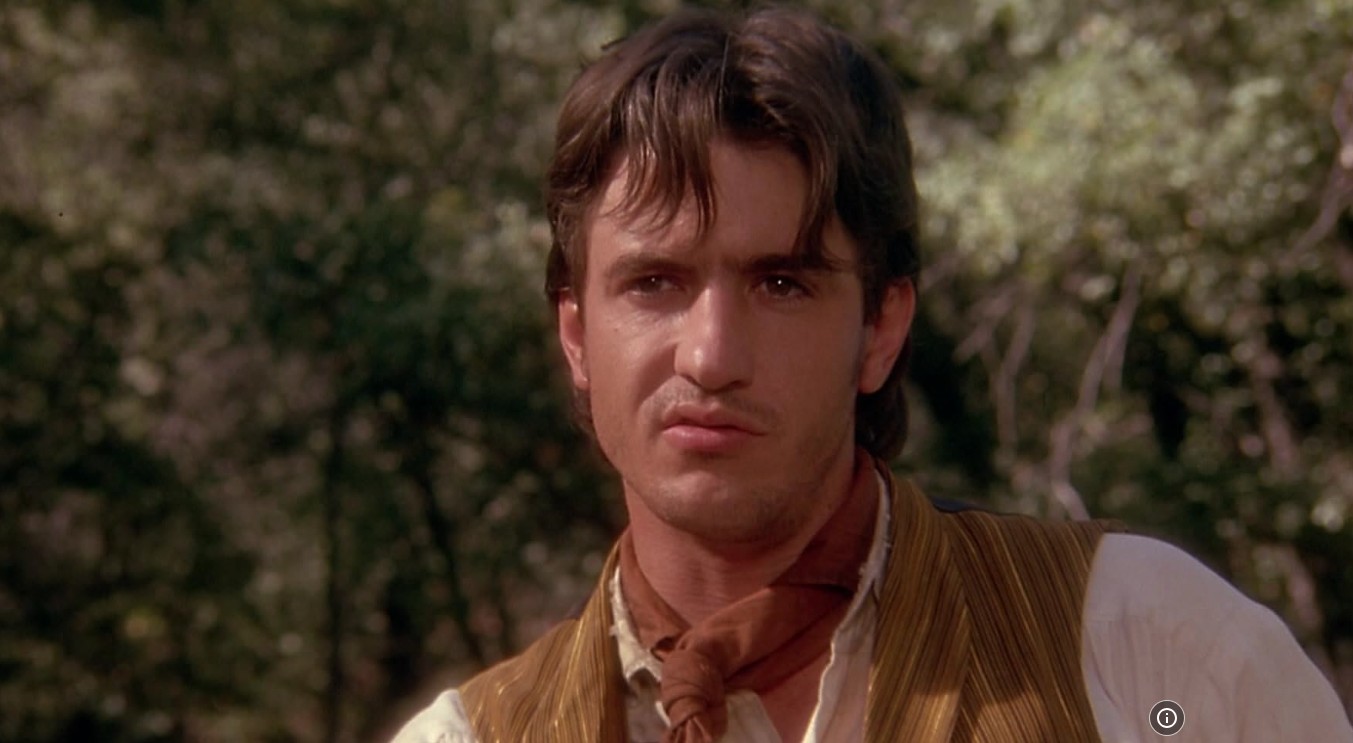
But never mind: You never want to pass up an opportunity to talk with Mulroney, an impressively versatile veteran actor whose lengthy list of credits includes Young Guns, the 1988 action-adventure in which he rode alongside Emilio Estevez, Lou Diamond Phillips, Kiefer Sutherland and Charlie Sheen; The Thing Called Love, Peter Bogdanovich’s pleasantly entertaining 1993 dramedy about ambitious young country artists in Nashville; and Silent Tongue, a relatively obscure 1994 western drama written and directed by Sam Shepard, and co-starring Shepard, Richard Harris, Alan Bates and River Phoenix.
Also: Kansas City, Robert Altman’s well-crafted, jazz-filled 1996 period drama in which Mulroney’s small-time thief runs afoul of a powerful Black crime lord (Harry Belafonte) in the titular location circa 1934; My Best Friend’s Wedding, director P.J. Hogan’s smash-hit 1997 romantic comedy that cast Mulroney as the best friend of an inconveniently smitten Julia Roberts; Scream VI, the 2023 installment in the seemingly endless horror movie franchise; and The Warrant: Breaker’s Law, the 2023 INSP western sequel starring Neal McDonough as resolute lawman John Breaker and featuring Mulroney in the dual role of twin brothers — one bad, the other much worse — who ride on the wrong side of the law.
So I jumped at the chance to interview Mulroney a few days ago, even as I knew there were certain things about Long Shadows it wouldn’t be fair — for the filmmakers or the audience — to ask him about. Here are some highlights from our conversation, edited (very carefully) for brevity and clarity.
Cowboys & Indians: I’ve got to be careful about the questions I ask you about Long Shadows, because I don’t want to spill any beans. But let’s just say your role, Dallas Garrett, is a lot trickier than it initially looks. What sort of special demands did that place on you as an actor?
Dermot Mulroney: Well, there’s a wonderful narrative in the film. It deceives you into thinking that it’s quite straightforward because it hits these wonderful familiar western icon tropes. So you’re kind of lulled into a false sense of thinking that everything is what you think it is.
It’s always amazing to play a part that has a twist in the story. And so then you get to — in theory, I guess, it’s like reverse engineering it. Scream 6 comes to mind. Spoiler alert? Hey, I’m not going to alert you — I’m just going to fricking spoil it. To be the mild-mannered Ghostface killer had its own little diagram. Like, how much do you act mild-mannered, how much do you act in other scenes, et cetera, et cetera. You have to balance those things, so the payoff’s really big.
This isn’t that. But you’re asking about how I helped tell the filmmaker’s story by having the character land right in enough scenes so that if he goes in a different direction, it’s warranted and it’s supported by the performance. So it was a really cool assignment for me. And for that reason, there was a little bit of character engineering involved because of how the story turns. The shadows in this movie really are about shadow selves, and of course it has incredible historical flashbacks that are a combination of traumatic and motivational. And my character plays in that world too, where it’s shadowy.
C&I: You’ve done a few other westerns before this one — everything from the original Young Guns to Bad Girls to, most recently, the INSP movie The Warrant: Breaker’s Law. And it must be said that you look pretty comfortable on horseback.
Mulroney: Well, I ride every year with my kids. My daughter right now is a champion equestrian. But even before me, my father was a champion barrel racer in the Midwest in the ’50s. So it’s literally in my blood, proven by how well my daughter’s a natural rider. There is something in your body built in, and I can see it in my child that she was just meant to sit in the saddle.
As for me, I was a natural from the start. I rode as a kid long before Young Guns, which was the first western I did, and that was intensive riding. But nothing I’ve ever done has been as rough as The Last Outlaw — that had some pretty gnarly turns on horseback. That was the 1993 HBO Western with Mickey Rourke and an incredible supporting cast that had Steve Buscemi, Ted Levine, John C. McGinley, and Keith David. There’s a western out there people don’t know so much. It’s got a rocking cast and a lot of action. Don’t forget about The Last Outlaw, folks.
C&I: Well, if we’re going to talk about overlooked or underrated westerns, I have to say I liked your 1994 movie Bad Girls.
Mulroney: So do a lot of people now. They didn’t like it back then, but I think it’s starting to have a following. What’s going on? Why do you like it?
C&I: Well, for openers, it didn’t resort to the cliché we usually see in westerns where women have to be taught by men how to handle six-guns before they battle the bad guys. In Bad Girls, these ladies — Madeleine Stowe, Mary Stuart Masterson, Drew Barrymore, and Andie MacDowell — already know how to shoot before the gunfights really start.
Mulroney: And as I recall, that was a pretty huge thing back then. You know, there’s people that saw Bad Girls when it originally came out and still love it. But I think what’s happening on streamers is that, for a lot of people, movies seem to come out of the blue. They return from the 1990s or the early 2000s or whatever, and suddenly they’re relevant again. So maybe Bad Girls has a chance of that happening.
What I know is, we all put our real hearts into that movie. It took extra time. There were delays in filming it, and a lot went on in our lives during that period. So it's a really indelible filmmaking experience to me that I hold dear.
C&I: Jonathan Kaplan, who passed away recently, was brought in fairly late in the game as a replacement for the original director, right?
Mulroney: And he made a hell of a movie with us under really tough conditions, coming into it under rough circumstances. So bravo to the whole gang that did that. It wasn’t an easy movie to make, I’ll tell you that.

C&I: Let’s get back to Long Shadows. We talked about looking convincing while on horseback. But what do you do to prepare for a western where there’s a lot of gunplay involved? Do you have to go out into the desert somewhere or to a shooting range and practice being comfortable with your firearms?
Mulroney: Good question. No, I would not go fire live ammunition. No, never. And as to being comfortable with those weapons — well, that’s a complex thing. Because guns kill people. So as I age into roles where I’m using guns, it’s a totally different experience, especially how guns are viewed in America since I started using them in films in the ’90s. I don’t take it lightly, and obviously the whole film industry doesn’t take it lightly either.
But let’s get to the practicality of a quick draw, which is what was required in that scene. Anyone who does know about Colt revolvers knows that it’s near-impossible to get your thumb up on that thing and cock it back fast. So I did it as quick as I could possibly do it. But then there’s a cut in the edit, and they speed it up, and then they show a close-up. So there’s super great little edit run right there. I don’t know the editor’s name, but give him a gold star for how he made me look super-fast.
C&I: One last question — and yes, it’s about another underrated movie on your résumé. I know Kansas City is widely considered to be one of Robert Altman’s lesser works. Indeed, I practically had a shouting match while discussing it with another critic on a cable-news program decades ago. But I was greatly impressed by it, in no small part because of the tension generated during the close encounters between your character and Harry Belafonte’s crime lord Seldom Seen.
Mulroney: Altman really took me under his wing. He was an incredible, incredible figure in my life. Look, I want to thank you, Joe, for bringing up these men that I so admire, and how I was thrust into these incredible situations. Please imagine me at maybe 32 or whatever age I was, in the kitchen with Robert Altman and Harry Belafonte. We were there working on those scenes. I had no lines at one point, so I’m just sitting there, grateful to be in their presence as they worked out those incredible monologues that Belafonte has in the basement of his Hey Hey Club where I’m being held captive.
Memories like that, no one else but me has now. And that also makes me want to jump back to Silent Tongue, a western that many of your readers probably haven’t seen yet. And now all of those other guys are gone. Richard Harris and Allen Bates, the brilliant English actors of their age, and Sam Shepard and River Phoenix. That's why it always stops me in my tracks when people like you ask me about them. But I have them in me. That’s all I want to say. I watch that movie, and it’s like my own private island.