





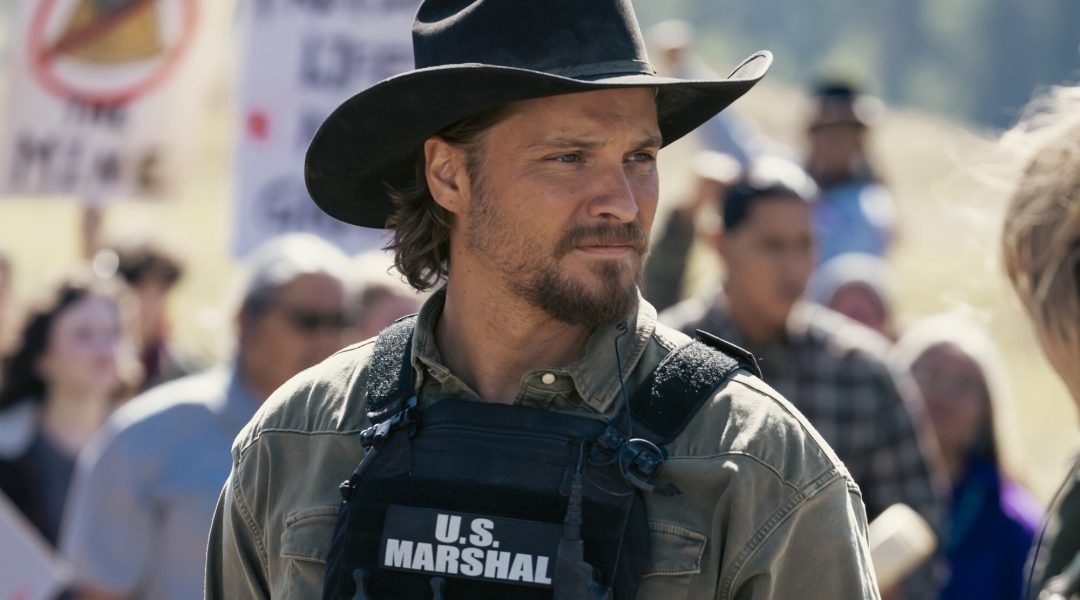
The new Yellowstone spinoff premieres March 1 on CBS.
When we last saw Kayce Dutton in the series finale of Yellowstone, he appeared to be in a good place. True, he had sold most of the Dutton Ranch back to the Confederated Tribes of Broken Rock, the original owners of the land. But he held on to a small patch of the Montana property to establish a ranch with his wife, Monica, and their son, Tate, where he hoped they would live happily ever after.
Unfortunately, as most of us learned a long time ago, happily-ever-aftering is an infrequent occurrence in any series bearing the brand of producer Taylor Sheridan.
Sure enough, when we’re reintroduced to Kayce in Marshals, the new CBS series with actor Luke Grimes back in the saddle as the main character, we see the poor guy is still troubled by memories of his wartime experiences as a Navy SEAL — and lacking the comfort and companionship of Monica, who’s now very seriously dead.
He obviously needs a change of scenery. Or at least a new purpose in life. So when he’s told that “Montana’s been infiltrated by the most violent criminal network in this hemisphere,” he’s surprisingly receptive when he’s recruited to become a lawman. And when his friend Thomas Rainwater tells him, “My home has become a beacon for the devil,” that pretty much seals the deal.
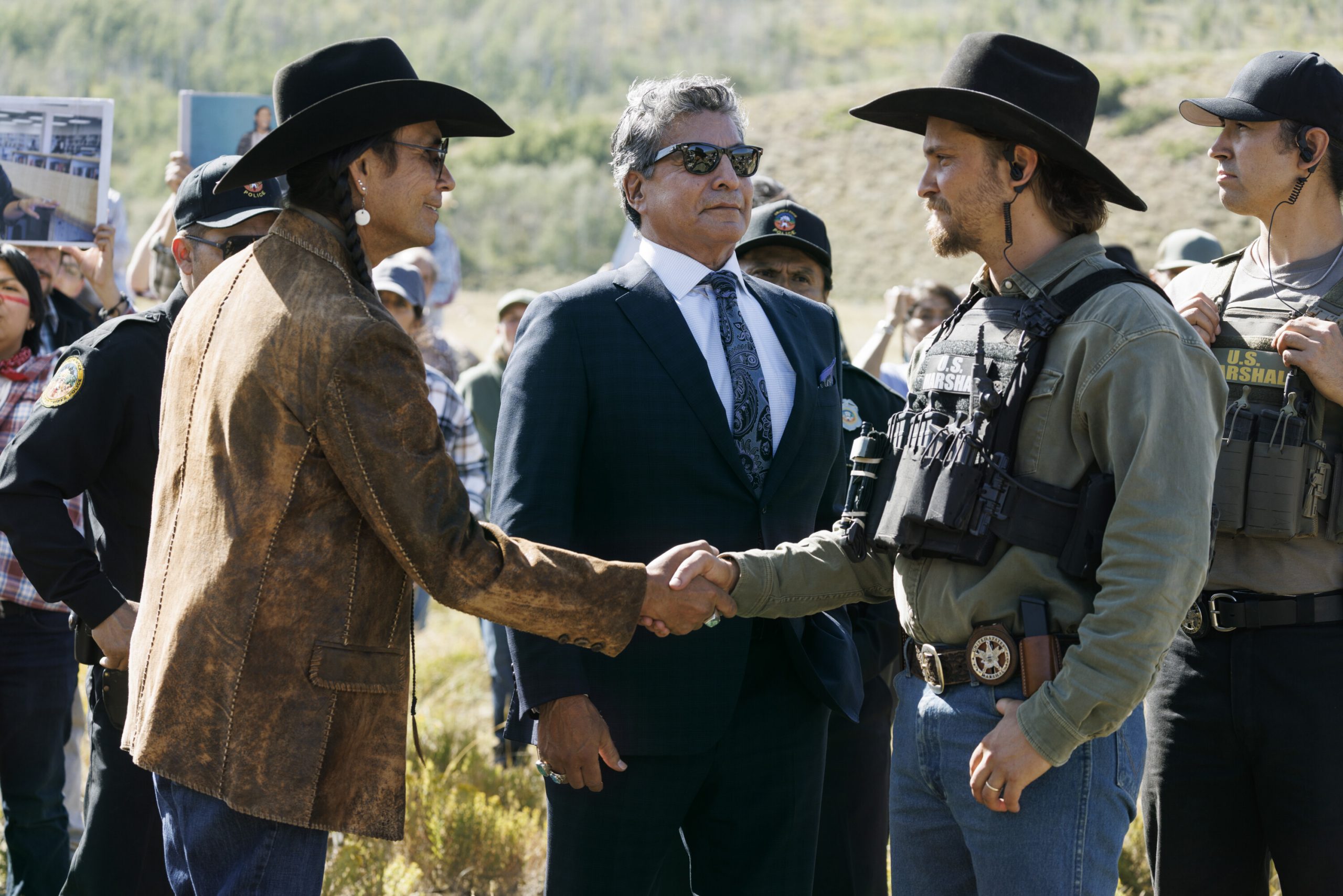
The official Marshals logline: “With the Yellowstone Ranch behind him, Dutton joins an elite unit of U.S. Marshals, combining his skills as a cowboy and Navy SEAL to bring range justice to Montana. Kayce and his teammates — Pete Calvin (Logan Marshall-Green), Belle Skinner (Arielle Kebbel), Andrea Cruz (Ash Santos), and Miles Kittle (Tatanka Means) — must balance the high psychological cost of serving as the last line of defense in the region’s war on violence with their duty to their families, which for Kayce includes his son, Tate (Merrill); and his confidants Mo (Brings Plenty) and Thomas Rainwater (Birmingham) from the Broken Rock reservation.”
Indeed, in the premiere episode, titled “Piya Conti,” Kayce is reunited with Mo and Bridgewater when he joins his marshsals unit to track down a bomber who has been terrorizing Broken Rock.
“When it comes to Indian country,” Mo Brings Plenty told C&I, “there’s a lot of issues that society doesn’t even know about. And so of course with Rainwater being the educated individual that he is, and Mo being the traditionalist working side by side with him, they’re able to make an impact and face those issues head-on.
“So you’re going to see a lot of that carry over from Yellowstone. And I’m thankful to the writers and to [series creator Spencer Hudnut] and the crew for giving us that opportunity — to kind of bring light to what we are up against in real life.”
And yes, he added, it’s great to be working with Luke Grimes again, to “continue this journey Gil and I started with him on Yellowstone.”

So far, Grimes has made quite an impression on his new costars.
“Luke is without a doubt the kindest actor I’ve ever worked with,” says Ash Santos (who, not coincidentally, is a veteran of another Taylor Sheridan series, Mayor of Kingstown). “I didn’t expect him to be so warm and incredibly helpful to all of us as the new cast coming in. If there were things that were a little bit confusing for us, he would take time to explain it.
“But the way that he leads by example is something that I want to emulate as I keep moving forward in my career. That man is a class act. He will treat every member of the crew as if they’re a member of his family. And when that is the tone that's set for the entire series, it just trickles its way down through the whole crew. So I think we’re very fortunate that we have Luke at the helm because he’s an amazing leader.
“I didn’t expect that from him,” Santos adds, “because you might think he’s been portraying this character for so long, he’s probably tired of this. But no, this is his baby. He loves Kayce Dutton so much. He wants to do this for years to come. And so we’ve been really fortunate to have him.”

We recently spoke with Luke Grimes about making the transition from Yellowstone to Marshals, and whether he felt any trepidation about trying to make lightning strike twice. Here are some highlights from our conversation, edited for brevity and clarity.
Cowboys & Indians: Were you at all reluctant to do a spin-off like this? Did it enter your mind that, no, when we left this character he was doing well. Let’s go on to something else. Did they have to do a lot of convincing to get you on board?
Luke Grimes: To be frank, I did say no the first time just because I thought [Yellowstone] ended perfectly for Kayce. And I didn’t even know what a spin-off would look like. Honestly, at the time, I was filming the last few episodes of the original series when I started feeling a little tired at the time and I thought, I’m ready to do something else. This has been a dream, and I’ve loved every minute of it. It’s been intense, but very fulfilling, and I’m ready to move on.
But what happened is I had my kid, I had my baby boy, and there was an offer on the table. And had that not happened, I don’t know if I would have agreed. And I remember thinking how funny that there’s sort of art imitating life here, where Kayce’s kind of doing something for his son, and here I have this son now and I feel really irresponsible about not taking this opportunity. So I’m like, Oh, here I’m becoming Kayce again. This is all happening and it feels right. And that sort of reluctance switched to excitement about what we could possibly do with this. And the world sort of opened up.
C&I: We already established back in Yellowstone — fairly early in the series, actually — that while Kayce was in the military, he saw some terrible things and did some terrible things. And he’s haunted by them. There was that scene in the second season when he’s talking to his dad, and he recalls what he had to do while on an unauthorized mission in Pakistan. Is Kayce still carrying that weight?
Grimes: Yeah, I think the arc in the original show was him trying to heal from that trauma, and that sort of PTSD, from things he had to do at war. And that was part of why he was so concerned about the life that he wanted with Monica, right? The life that he wanted was very simple — he wanted his little piece of land with some cattle, and he wanted to cowboy and be with his family. And he got that at the end of Yellowstone.
But obviously at the beginning of [Marshals], that has been taken away from him. And so he has no choice but to find a new path for himself. And that’s sort of the impetus for the start of our show.
C&I: Of course, I can’t help wondering whether Monica would have approved of your new job if she still were alive.
Grimes: I think had she been around, there would be no reason for him to do this. I think he would’ve felt like why put himself in harm’s way and possibly jeopardize this beautiful life that he’s carved out for himself. But obviously that life has gone away, and he can’t sit around and do nothing forever. He’s dealing with a lot of grief. And I think this is a way for him to have some purpose in his life.
C&I: Tribal Chairman Thomas Rainwater, played by Gil Birmingham, is another Yellowstone alumnus who’s back in the new show. Early on, he tells you: “Duttons are all born with a killer instinct. But you’re not a killer, Kayce. You’re a protector.” Do you think that’s an accurate assessment of your character?
Grimes: I don't think Kayce really sees that about himself. I think part of what he’s dealing with is the guilt of having taken so many lives. But I think as Luke Grimes looking into that story, it’s really good advice. I think he’s got to remember that some people are protectors. He was in the military and that’s what he learned to do. That’s his skill set. He’s good at only two things: cowboying and tactical work. And I think trying to run this ranch now that Monica’s gone, and knowing it’s not really his son’s dream to run it after him — he’s realizing that maybe he only has this one other choice.
C&I: Kayce appears to have found a new family in Marshals.
Grimes: Yeah, I think so. And I think it’s the best thing that could have happened to him. When someone’s going through something that hard, to isolate is not the best idea. But he doesn’t really have many people in his life, and I don’t think he feels like he has a choice. But then his old SEAL buddy comes back and offers him kind of a way out.
And I think once he sees that that’s what it is, a way out of this grief and this loneliness, he sees it’s a way to actually start down a new path and find out what his legacy is meant to be now. And what his son’s legacy is meant to be. So he takes the opportunity. And it causes for some really good drama and a lot of action and a really entertaining show.
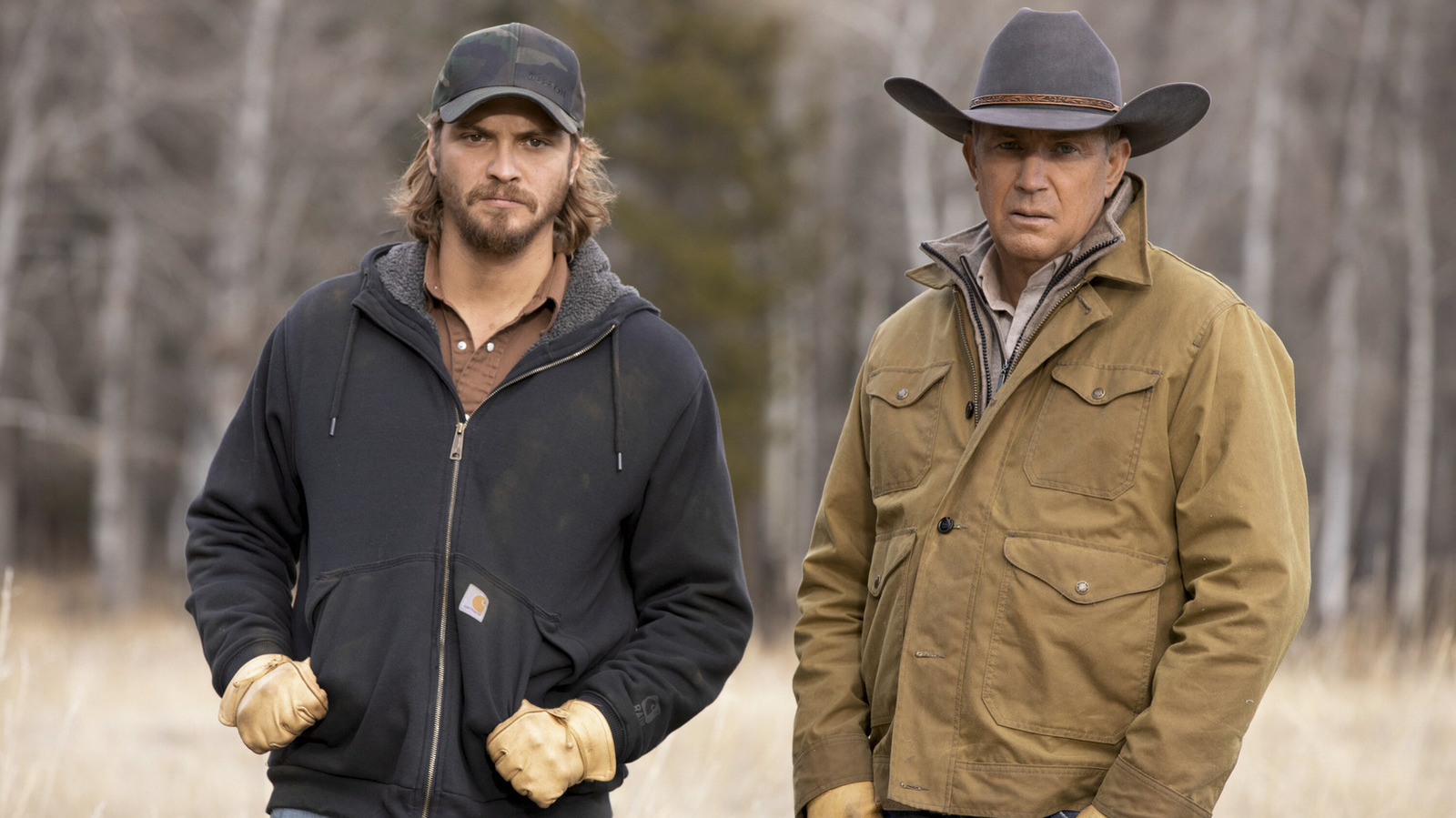
C&I: Finally, I have often asked actors what they think they learned from working with certain other individuals on projects. What do you think you learned from working with Kevin Costner on Yellowstone?
Grimes: That’s a really good question. I think I learned just by watching him and seeing the actual weight of being in his position — and how hard it would be to handle that. Looking back, I wonder if I hadn’t been around someone like Costner, and watching him handle being Number 1 on the call sheet and everything that was coming at him all the time, and the pressure of having a lot of that on your shoulders, if I would be able to try to do that myself right now.
I think the only reason that I’m able to do it is because I’ve been able to watch so many other people do it so well. Just how to navigate that kind of fame and to navigate being an icon. It’s a really hard job. It’s much harder than people realize. In a way, it puts a target on your back. So yeah, I just learned a lot about professionalism and being the guy that carries a lot of the weight.
C&I: Well, now you’re Number 1 on the call list, my friend. And I’m sure that comes with a certain amount of anxiety or dread. But on the other hand, it must feel good, huh? It must feel like, yep, I’m up there.
Grimes: Yeah. Well, I guess it does feel like a bit of a benchmark. When I think about the younger me who wanted to be an actor and had this dream that seemed impossible, now I can sort of in a way think, OK, there’s a benchmark. I did it. I’m really doing this, and I’m lucky to be able to do this not only for a living, but I’m thriving in it. And the fact that people would put their trust in me to lead a show — this really means a lot. And it’s not lost on me.