



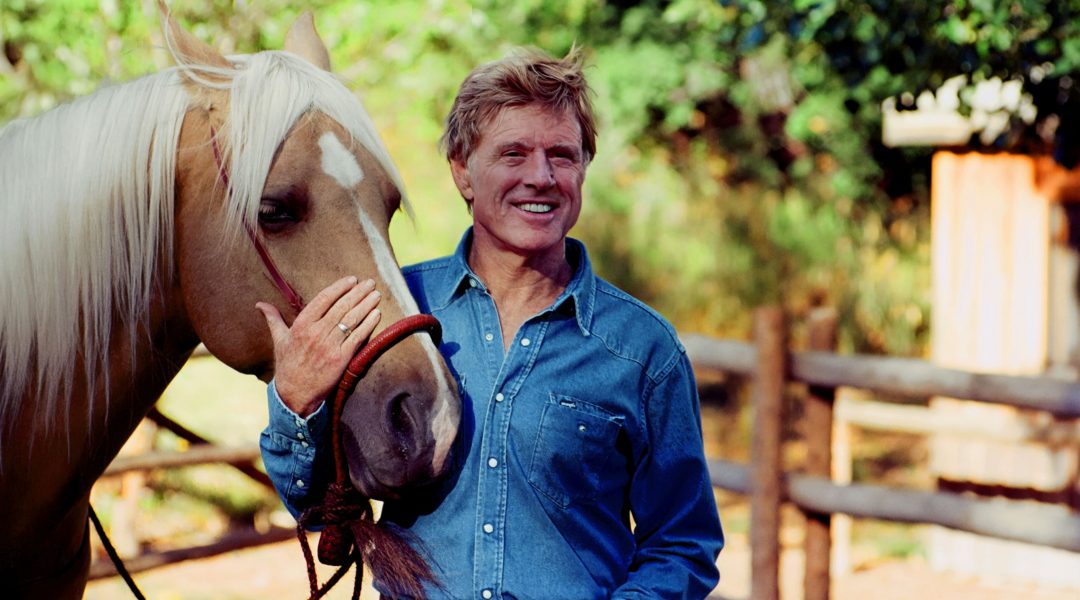
Robert Redford. Nuff said? Not by a mile — and a complex career of more than six decades.
Early on, Mike Nichols recognized the immense talent and dazzling star power of Robert Redford. In 1963, the late director cast the promising young actor in Neil Simon’s Barefoot in the Park — the first Broadway play Nichols ever directed — as a handsome but buttoned-down newlywed who learns to loosen up with his free-spirited wife. They worked so well together that Nichols offered Redford a key role as an ambitious but naïve college professor in Who’s Afraid of Virginia Woolf? — the 1966 adaptation of Edward Albee’s controversial play that was Nichols’ debut effort as a feature filmmaker.
But Redford, much to Nichols’ surprise, turned down the opportunity. Why? Because — as Mark Harris noted in his exhaustively researched 2008 book Pictures at a Revolution: Five Movies and the Birth of the New Hollywood — Redford “disliked the character’s weakness” and took a pass on the project.
The tables turned not so long afterward while Nichols was casting The Graduate, his smash-hit 1967 comedy about Benjamin Braddock, a young man from a well-to-do family who cannot decide on his next move after receiving his diploma and drifts into an affair (more or less because he can find nothing better to do) with the wife of his father’s law partner. Redford was eager to play Benjamin. But Nichols, after serious consideration, turned the actor down.
“I was playing pool with him,” Nichols is quoted in Harris’ book, “and said, ‘I’m really sad, but you can’t do it. You can’t play a loser.’ He said, ‘Of course I can play a loser!’ I said, ‘You can’t! Look at you! How many times have you struck out with a woman?’
“And he said, I swear to you, ‘What do you mean?’ He didn’t even understand the concept. To him, it was like saying, ‘How many times have you been to a restaurant and not had a meal?’”
No doubt about it: Throughout most of his early career before the cameras, and several times afterward, Redford came across as not merely a stunningly handsome and irresistibly charming fellow — he more often than not exuded the confidence of someone who had already read the final pages of the script and knew that, sooner or later, everything would come out hunky-dory for him.
Which makes it all the more interesting, and maybe revealing, that Redford agreed to play against his golden boy appeal not long after losing the Graduate role to an unknown named Dustin Hoffman.
In 1969, the same year he solidified his stardom with Butch Cassidy and the Sundance Kid and transcended the box-office fizzle of Tell Them Willie Boy Is Here, Redford scuffed up his image a tad by playing an undeniably attractive but largely unlikable lead character in TV veteran Michael Ritchie’s feature-film directorial debut, Downhill Racer.
Redford reportedly made the movie as part of a settlement with Paramount after turning down the lead in the notoriously ill-fated 1968 western Blue (talk about dodging a bullet!). But once he signed on for the production, he fully committed himself to the role of David Chappellet, a champion skier who, while nominally a part of the U.S. Olympic Team, repeatedly demonstrates his desire to be a solo superstar on the slopes.
Chappellet’s selfish single-mindedness is a constant source of consternation for his coach (Gene Hackman), a major turnoff for most of his teammates — and the deal-breaker for his relationship with a stunning beauty (Camilla Sparv) who figures, with ample justification, that he is unable to give her the full attention she demands.
He’s partly driven by his unquenchable desire to rise above his humble beginnings in a small Colorado town. (The movie’s original ad tagline: “How fast must a man go to get from where he’s at?”) But his none-too-supportive father dismisses his son’s ambitions. When he tells his dad he wants to be, at any cost, “a champion,” the elder Chappellet replies: “The world’s full of them.”
Chappellet is so fixated on winning a gold medal that he literally cannot conceive of life beyond victory. Before his final race, a reporter asks him, “What are your plans for after the Olympics?” His reply: “This is it.” Nothing else matters.
That exchange is echoed in the next movie he made with director Michael Ritchie, The Candidate (1972), a perceptive and prescient political drama in which he plays Bill McKay, a charismatic and committed public-interest lawyer who’s pressed into a senatorial campaign against a seemingly undefeatable Republican incumbent. Egged on by Marvin Lucas (Peter Boyle), a savvy and cynical political consultant, McKay progressively tamps down his lofty idealism to become a more traditional people-pleaser. He eventually wins the election. But in the film’s final moments, he asks Lucas, “What do we do now?” He doesn’t get an answer.
“In a lot of the films I've been able to design or produce,” Redford told me in 1994, “like Downhill Racer, The Candidate, Jeremiah Johnson, All the President’s Men — there’s a common theme of discovery in the last frame. The character goes through believing one thing and then gets to the end and finds that life works a little differently. And there’s a shock on the character’s face when he realizes at the last moment, Holy shit! This is how this works! It isn’t like I thought at all!”
This was certainly true of Quiz Show, the impetus for our 1994 conversation. Redford served as director for the Oscar-nominated movie, a fact-based drama about the 1950s quiz show scandals, specifically focused on a congressional aide (Rob Morrow) whose campaign to expose corporate and commercial conspirators who rigged the prime-time attraction Twenty-One succeeds only in disgracing a popular winning contestant (Ralph Fiennes).
“A lot of the work I’ve done has involved looking at the American Dream, from all different ways,” Redford said. “Because I was fed such a dose of it when I was a kid. I was given this legacy as a kid about how you’re supposed to play the game to get ahead in life. I didn’t realize that it was a false legacy, that it wasn’t true when they said, ‘It’s not whether you win or lose, it’s how you play the game.’ Because the fact is, for most people, the only thing that matters is whether you win or lose.”
This theme of disillusionment resounds in quite a few of Redford’s films, ranging from The Great Gatsby (1974), in which he played the tragic title character, to Three Days of the Condor (1975), which ends with the ambiguous suggestion that maybe Redford’s CIA factotum won’t be able to tell the world about the dirty business he has uncovered, to Brubaker (1980), a fact-based drama that cast him as new prison warden who comes up short as he tries to expose the brutality of a corrupt penal system.
On the other hand, Redford’s character experienced not so much a bitter disappointment than a rude awakening in Sidney J. Furie’s Little Fauss and Big Halsy, the overlooked and undervalued 1970 drama about highly competitive dirt bike racers. The actor played — arguably for the final time in his career — a thoroughgoing and unredeemable SOB: Halsy Knox, a ruthless motorcyclist who comes off as borderline-sociopathic as he repeatedly exploits everyone in his orbit.
Although the advertising campaign played up Redford’s industrial-strength sex appeal with images of his unshirted hunkiness, the movie emphasizes his character’s moral rot as he gradually repulses even his most ardent admirer, the naïve, young would-be racer Little Fauss (Michael J. Pollard). Halsy’s self-regard is such that he’s genuinely shocked when Fauss breaks away from him: “If this is friendship, I am aghast.” To which Fauss, speaking for himself and likely most of the audience, replies: “I never said I was your friend, Halsy. I don’t even f--king like you.”

Above: Dustin Hoffman, Robert Redford, Jason Robards, Jack Warden, and Martin Balsam in All the President's Men.
In later years, Redford often expressed distaste for Little Fauss and Big Halsy, reserving most of his barbs for what he saw as the dictatorial approach of its director. But according to a 2011 biography of the actor written by Michael Feeney Callan, director Alan J. Pakula (who worked with Redford on All the President’s Men) claimed “it was the last unself-conscious revelation of [Redford’s] real-life edge.”
Of course, for many fans, it may be difficult if not impossible to believe that Redford — the widely beloved actor, icon, and activist who proselytized for all the right causes and selflessly supported indie cinema with his Sundance Film Festival and attendant Sundance Institute — would ever be anything other than a revered Mr. Nice Guy.
“Redford can play this attractive, almost metaphorical American,” director Sidney Pollack, a frequent Redford collaborator, told me in 1990. “And when I say metaphorical American, I mean that there’s a tension that I think exists in him, and always has, between what he looks like and what he is.”
Trouble is, “A lot of people can’t get past his looks. You take a look at this guy, and you say, ‘Well, this guy’s not very complicated. He’s handsome; he’s a kind of prince. Everything’s simple for him, I can’t feel sorry for him.’ But it’s really not the case. I mean, he’s a very complicated, thoughtful, rather emotional guy.
“We actually fought like hell, for example, on The Way We Were. I had to practically drag him kicking and screaming into [the film]. He just thought it was a real piece of shit and that his character was a boring, silly reverse sex object. Like a dumb pretty girl. Only in this case, a dumb pretty guy.”
On the hand, it’s clear that many if not most moviegoers resisted the notion that Redford could walk on the dark side. Little Fauss and Big Halsy was a box-office bomb — so much so, in fact, that it wasn’t even available on home video until fairly recently. And Havana, the movie Redford made with Pollack in 1990, received an only slightly less frosty reception. Still, neither Redford nor Pollack ever made any apologies for that underrated romantic drama.
The film, set during the final days of Fulgencio Batista’s control of Cuba, had Redford cast as Jack Weil, a flashy but fading gambler who’s hoping for one last big score at the Havana casinos. The goneto- hell-but-happy look served the actor well in the part of a middle-aged high roller who knows he’s been at the tables too long. “A funny thing happened to me last week,'' he says, only half-jokingly. “I realized I wasn’t going to die young.”
While looking for high-stakes action, Weil finds excitement of a different sort when he becomes involved with Roberta Duran (Lena Olin), the wife of a Cuban revolutionary. Yes, there are more than a few echoes of Casablanca here. But Pollack didn’t apologize for that, either.
“I wanted to push [Redford] as far as I could,” Pollack said. “And I think he wanted to be pushed. He wanted to reach for that character. Because Redford is a kind of an aristocrat. Well, I don't mean Redford is, I mean that’s what his image on screen is. He’s as close as we have as an American actor to an aristocrat. There’s something slightly aristocratic or privileged that one senses about him in his performances.
“But in this case, Jack Weil is anything but that. This sort of tattooed, gaudily dressed, slightly over-the-hill, little-bit-beardy guy who’s gambling all night, looking for the big sexual experience, or the big card game, or the biggest kick — that’s not the sort of character you expect of Redford.
“And that’s part of the fun of it.”
And if audiences didn’t buy what Redford and Pollack were selling in that film, so what? On some level, it’s nice to know that Redford took to heart Walt Whitman’s self-description in his “Song of Myself.” He was large. He contained multitudes.
Read more of our February/March 2026 cover story: "That Redford Magic" or "Robert Redford: Beyond Sundance"
From our February/March 2026 issue.
PHOTOGRAPHY: Linda Solomon; (All the President's Men) Alamy