




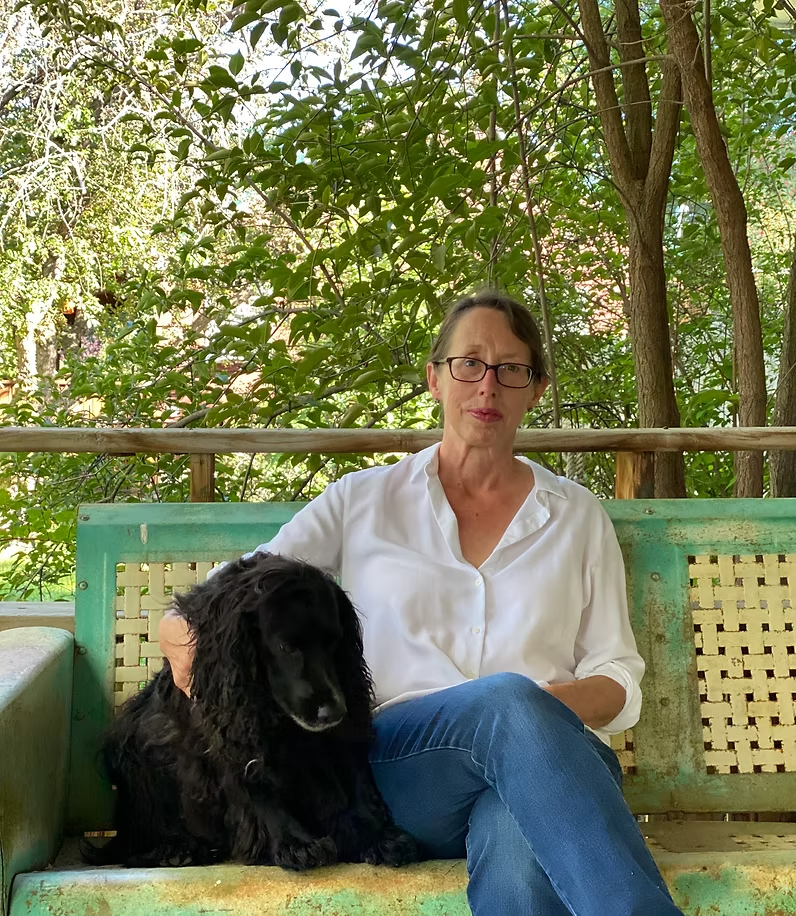
The Jules Clement novelist explores small-town crime, Western identity, and the storytelling pull of Montana.
Few writers capture the layered complexity of the modern West quite like Jamie Harrison. Best known for her Jules Clement mystery series, Harrison has spent decades drawing inspiration from Montana’s small towns, evolving landscapes, and deeply human stories. In this episode of Writing the West, Harrison reflects on how the West became more than a backdrop while also discussing her unconventional path into fiction, including forging her own literary voice as the daughter of acclaimed author Jim Harrison, and why reinvention remains at the heart of Western storytelling.
(This interview has been edited for length and clarity.)
Cowboys & Indians: You’ve lived in Montana for a long time, and at what point did that area of the world simply stop being a place where you lived and become a place where you felt like you could build your stories?
Jamie Harrison: Pretty early, actually. I had come here when I was a kid in my teens. We had friends out here, and I loved it. I simply loved it. And I was working in New York, and I was tired of my job. I was in my late twenties, and I had somebody to run away with me, and we moved out and pretty quickly didn’t want to leave again, didn’t have any interest in moving back to the city. I had some vague idea of actually having a career that paid money and going on to L.A. We just stayed, and I started writing the mysteries within five years. I just tried to sort of suck up the knowledge of the place and the stories of the place and just wanted to tell those.
C&I: Growing up, did writing seem inevitable to you, or was it something, as some other writers have told me, they kind of had to fight for?
Harrison: Actually, it seemed like the last thing a sane person would want to do. My father was a writer named Jim Harrison. He wrote, among other things, Legends of the Fall, and it truly seemed like a bad way to make a living. I worked as an editor, I worked as a cook, I did a lot of things, and I was working as an editor out here for a small press called Clark City Press that did hunting and fishing and literature and all sorts of things, had a good reputation, and we went out of business, and I needed to make a living. And in Livingston, in the late eighties, an editing job at the paper paid $3.50 an hour. So I thought I’d always read mysteries. I obviously knew how to write, knew how to edit, knew how the business worked a little too much, and just tried a mystery and got away with it.
C&I: Having to eat and pay bills always gets in the way of good writing, doesn’t it?
Harrison: Yes, it does. It’s still getting in the way of good writing.
C&I: As you mentioned, you’ve done a number of different jobs and had all those different experiences, and how did those experiences help to shape the way you write your places and characters now?
Harrison: If you’ve had a fully lived life, there’s a lot to pull from. Even if, I mean, somebody might look at me and say, oh, she’s lived in Montana for 40 years. What does she know? You can know a lot living here, and I’ve traveled a lot. I think doing a variety of jobs, I think having to think on your feet, I think living in a place where, at least until recently, it wasn’t sort of—everybody talked to everybody else. When I moved out here before I had children, when I could just go sit down in a bar, everybody talked to everybody else. The university professor was sitting there, the plumber was sitting there. We all knew each other, we all ate together. It was a kind of wonderful, idyllic little moment in time. And it’s slightly less so now because of the pressures that everybody in the West is facing. We have become very popular, and I can’t criticize people for wanting to live here because I did exactly the same thing 40 years ago. But it’s changed. Everything’s changed in America, right? Of course. But I don’t know, you learn a lot talking—just talking to people, volunteering in the school kitchen, going to funerals. God, I’ve been here a while. So you hear stories.
C&I: You mentioned your father, Jim Harrison. I’ve had the pleasure of speaking to a couple of second-generation writers like Anne Hillerman and her father, Tony Hillerman, Louis L’Amour’s son, Beau, we’ve had on a couple of times, and it’s always so interesting to follow the paths of children of great writers. One, how did that help you in your writing career, but also, too, what challenges did that present for you along the way?
Harrison: He was a poet. He was a novelist. He was a screenwriter. The immediate challenge was comparison—how are you going to do this? And people would sort of pat me. And the way I went about doing it was to write mysteries, to distance myself from literary fiction while still trying to write as well as I could.
And that worked. It was certainly easier to make a living. When I first started writing, I got really relatively large advances for my first few books. More writers made more money back then. So it was sort of a calculated bet. And it worked. It was great. And then for about 15 years, it just didn’t work. I didn’t want to write more mysteries. I did scripts with my father, but I’m sort of wandering away from your question, and that is how did it distance? Well, I worked with him, too. It doesn’t really—if you like your parents—
C&I: That helps you learn to adapt.
Harrison: Right. It’s great growing up with smart people. I mean, I grew up surrounded by writers, really wonderful writers. And so the romance of it certainly was dented. But the fun of it was not.
C&I: So much of your stories revolve around these small towns. And what I always love about small towns—I live in one too—is they’re so dense with history, cultural memories of that particular place. And it’s something that permeates every aspect. And was that something that you drew on from personal experience, and what draws you to these more contained areas of the world?
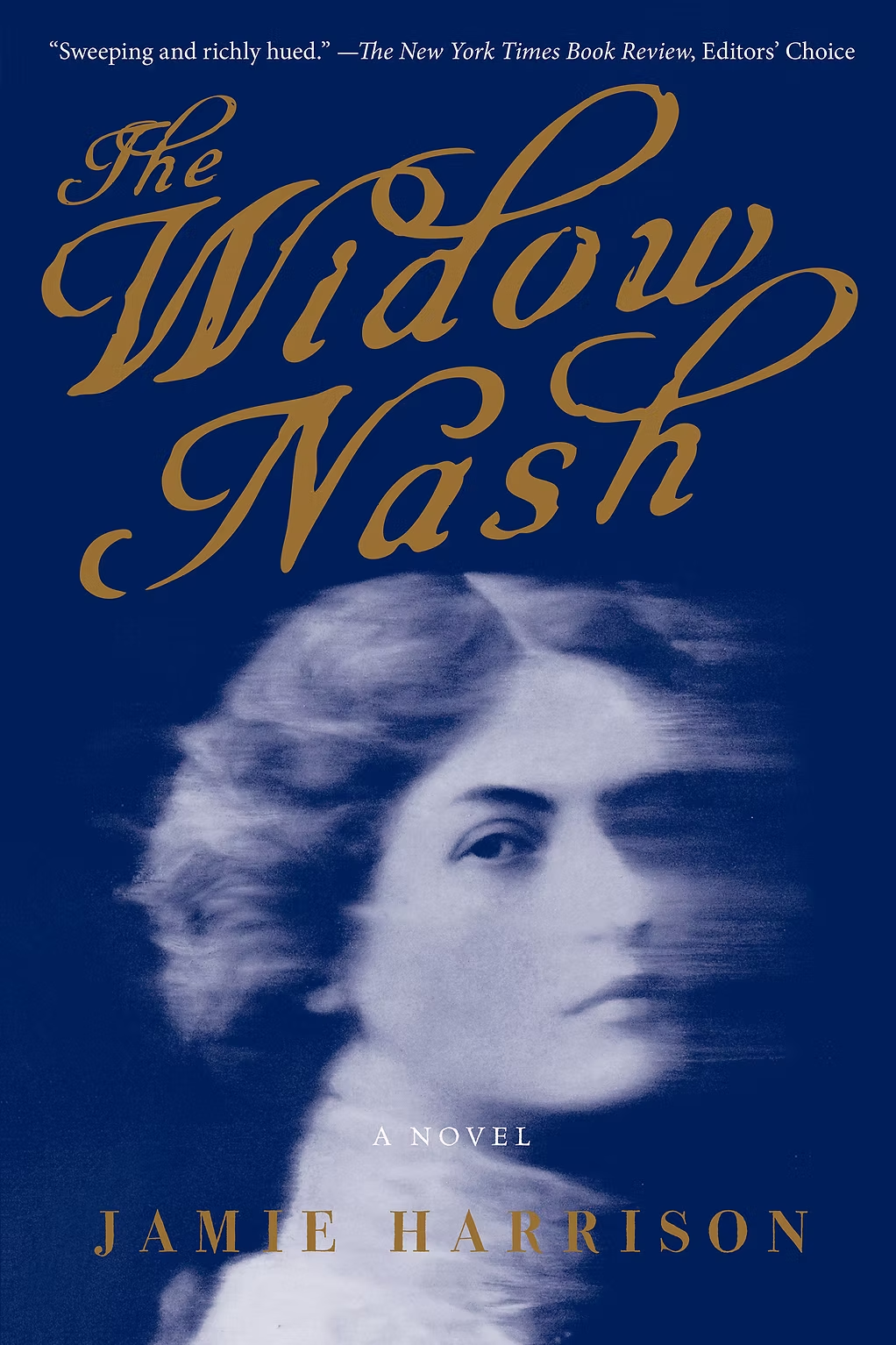
Harrison: Everything’s there. And I think it’s— a couple of my novels actually have sort of moved around more, the straight novels—something called The Widow Nash. But even that was ultimately set in turn-of-the-century Livingston. I would love to write a globetrotting book, and I’ve started a few of ’em, especially when I’m writing here in, say, February. It’s interesting, but because I’m writing a series, there is a richness of detail. There’s no possible way I’m going to run out of crimes or murders, even if I’m sort of pushing believability with the death count — population 5,000. And also, I think a lot of my plots are, you bring your world with you here. The people I’m writing about have lived elsewhere. The people who they’re investigating have lived elsewhere. The past has never passed.

C&I: The thing that always strikes me — and a lot of other readers — with more centralized and localized thrillers and crime novels is that everything seems to hit closer to home, obviously, both literally and figuratively. Characters you come to know and love are potentially in danger. They might not make it through the end of the book, versus a Dashiell Hammett novel where all these characters are just thrown together. But one thing that always strikes me as interesting, and especially in the Jules Clement book set in Blue Deer, Montana, is the area feels like a character of its own. It’s got kind of a force. I love to think of it like a tornado, swirling all these characters around and mixing them up. So when you set out, especially to create a place and a setting for these stories, what is the purpose, and how do you see that through to the end?
Harrison: You’re asking me as I’m trying to finish the last third of a novel, and I’m having so much trouble with it, I’m asking myself the same question. To show how complex people’s worlds are—to have to. I like to bust, as much as possible, expectations, and I especially like doing that about the West. I like writing about a town that is not a traditional cow town. We have cows, we have ranchers. They’re all great, but it’s not a traditional place. So I guess to add complexity, to make people realistic—everybody does know everybody out here, but it’s always surprising. There are some people you don’t know, and it’s sort of a shock to the system, especially if you’re a cop, probably, which Jules no longer is. I kind of backed away from that a bit. His wife still is. I don’t know—the complexity of the place, the fact that you can work in the history. He’s an archaeologist, so I’m working in the past too. And it might seem short out here, but it’s pretty rich in injustice and all sorts of—there’s nothing new under the sun. And most of the get-rich-quick schemes, most of the murders, all of that, it’s all sort of a journal. It could be in New York, it could be here.
C&I: One thing that strikes me in not only the true history of the West, but also in fictional stories as yours or a Craig Johnson or Ann Hillerman story, it always seems like a place where people go to reinvent themselves, or at least attempt to. And from the Gold Rush to the charlatans and gambling hall owners of the 19th century, and now to the world today—like yourself—to go out there and change your future course. Do you think that that has rung true in your own life in the West? And do you also think that presents the challenge of making it harder to escape once you get there?
Harrison: Maybe? I do think that the defining characteristic of the West is reinvention. I completely agree with you. I think that’s the thing that runs through everything. And the people who think that they’re not reinventing it and that they’ve been here forever—well, what is forever? I’m sorry. You have—(laughs)—the most annoying facet of some corners of the West. I don’t think it makes it hard to go away. I know. I don’t know. I’m comfortable with wandering. The next book I’m writing is going to have a chunk that’s written in L.A. in the twenties that’s going to follow the characters from my two straight novels. But that’s all tied to part of what’s fascinating out here. When I first moved here, a lot of people have passed now, but the first people I knew out here, the older people would talk about getting lobsters on the train every week, regularly delivered oysters. I mean, the level of intricacy out here of life and the richness of things was amazing to me—and still is. Butte, Montana, I’d love to write about Butte because there was no richer place in the world. But yeah, I want to escape it sometimes for a vacation.
C&I: You mentioned The Widow Nash — that was your first major publication, if I’m not mistaken, and went on to win the Reading the West Book Award. And I’d love to know just what was the impetus of that first novel? So many writers, I hear, from that first one, it’s such a slog sometimes. Was that the case for you? And what was that process like?
Harrison: Well, I’d written four mysteries by then, but that had been decades earlier—15 years earlier. I was doing research for a documentary on Butte, working on that. And reinvention is actually what it’s about, so thank you. I was doing photo research and looking in the archives and noticing how many newspaper stories there were in, say, 1905, about somebody appearing in town. Where did he come from? He said he was from here. Or Mrs. So-and-so who claims to be widowed seems to be keeping company, basically. I wanted to have a woman run away. And I came up with a character who comes from a somewhat troubled background, who gets off one train and sort of zigs around the West of the time, which was easy to do—goes down to Denver, goes here, goes there—and eventually decides to disappear into this town. And she has another name that she’s using, and her past follows her. And it’s a historical mystery. And it ultimately settles in Montana.
C&I: Along with obviously your connection to Montana, why did you feel like that story needed to ultimately land in Montana, and what was the benefit in doing so for you?
Harrison: Well, I loved reading about the period here. I mean, you’ve got to know that a lot of writers just get lost in what they want to research, right? It’s a rabbit hole. I wanted to sort of explore the idea that sometimes it’s braver to run away—to go. It’s reinvention, one more time. You’re going into a new world and you’re becoming yourself. I wanted to talk about just how sophisticated it was out here at the time, in a way. Good guys, bad guys, money.
C&I: And as you said, The Widow Nash is a little bit different than your more recent novels — and then the historical setting. Obviously the character is much different than who you’re writing now. And looking back on The Widow Nash, how did that story shift your trajectory into the later books that you wrote?
Harrison: I think they’re a little different. I think I’m playing a little less for laughs. Not a lot. I mean, Jules is still — he’s sort of almost a character in those books too. I’ve always written about — he’s an archaeologist. He’s sort of gone back to it. So the past is always coming up, and things perhaps that I looked up for The Widow Nash and the other book — I’m still using newspaper clippings. This, that crime I thought of can be something that plays out today.
C&I: That’s a common thread, like you said, that I see in a lot of my interviews with writers—historian and author go hand in hand in a lot of cases. You become an expert.
Harrison: You want to use stuff. I mean, you literally—I’m trying to think of who I saw an interview with the other day who was actually literally—she owned up to, or he did—finding all these things he wanted to write about and then simply smushing them together. He had to come up with a plot to make it work. And I’ve done that a couple of times. It’s like, I want to start with a floating body in a lake in this place where I’m camping today on a windy day, and what’s it all about then? And I want to end it this way.
C&I: The biggest thing I’ve noticed is that interest and curiosity is what readers attach to as well. They have that same feeling in that same setting and that same scene.
Harrison: Sure. I am absolutely sure that Tony Hillerman — I’m trying to think of the mystery. It was where he had the pegged frogs. They were tied up just far enough away from a puddle so that they died. He comes upon the scene, and I know he thought that up in the middle of the night and then came up with a plot to fit it.
C&I: The Center of Everything was your next novel and a little bit different. And then it shifts into kind of an interior world of this woman, Polly. And she’s got kind of this fractured sense of time—again, going back to history in the past. And what compelled that story in regard to the one you had written prior?
Harrison: I wanted to keep writing about the people who are in The Widow Nash. The characters there appear as her grandparents, but I also wrote that spurred on Polly’s modern-day life in this—basically, essentially—this town now. And one summer when a friend drowned, and every day I would leave the house, there’d be a helicopter overhead looking for this kid. And that was sort of the drumbeat of the thing. There is a modern murder, there is a body in the river. Did she just drown or was she killed? And I used that to go back to an old murder that happened when she was a child. She’s had a head injury and she’s questioning her memory. We all question our memory now. You will too someday. But I just wanted to play with it. But the parallels make her think of the past, yada yada.
C&I: With historical fiction, for instance, there’s opportunity for flashbacks, flash-forwards, what have you, which, in a story like yours, can become quite complicated to line everything up and kind of see where the end is going. How did you do that with The Center of Everything, and what’s your process like for—do you have a tent post at the end you’re always trying to get to, or?
Harrison: I don’t think the ending changed much. I mean, certainly I edit. I edit a lot. I have an editor who is a good editor. On that book, at some point we were talking and he thought I was laughing, and I was in fact crying about cutting 60, but I was hysterical. I was laughing. He was making me laugh. He was saying, you can’t have this. That’s a piece of—it doesn’t work here. He’s a good editor. Timing is really key. So yeah, there is a lot of time spent moving chapters around, which means you have to rewrite the chapter. I believe in editing. I think you come up with a better book. I also believe in cutting, cutting, cutting. I don’t know about you, but almost every book, however good, can use it. And a lot of them don’t get it anymore because there are fewer editors. But balancing and going with the rhythm of a book — what’ll make things — you want that click at the end of a chapter, even if you’re not being overly stagey about it. Your beginnings, your endings, your breaks. There is a kind of rhythm that you try to get to.
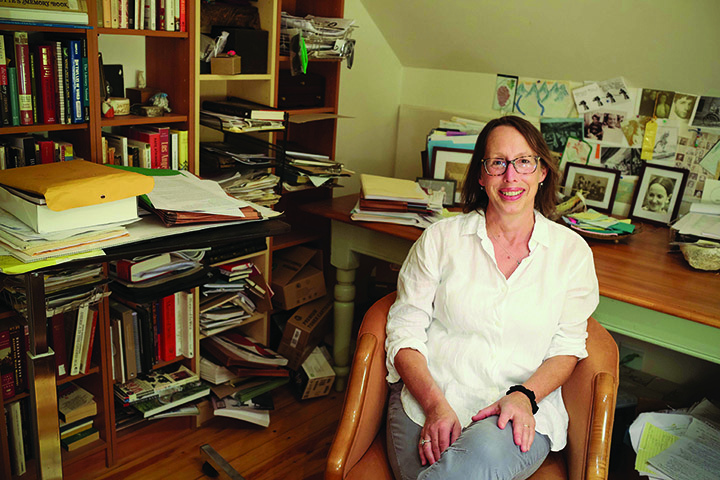
C&I: The Center of Everything is set in Livingston in a more modern era versus The Widow Nash, or at least parts of it. How different was it writing about an actual place that you knew versus a historical version? With The Widow Nash—
Harrison: I was more careful. I have neighbors. I’ve sort of learned to not shoot my mouth off quite so much—change the name—but all kinds of fiction. I mean, everybody knows Blue Deer is Livingston, basically. It’s just a smaller version of it. And I have become more careful. And also I just—in my first novel, I actually—there’s a character who’s very clearly—not faithfully, but clearly—an ex-employer, and I shoot him. It was fun. Unfortunately for a lot of people in town—and he got over it. It’s always fun to use fragments of people, but I’m careful. I try to distance things. And I also don’t try to anymore. I’m really clear that I’m moving the landscape around too. I’m not going to keep everything happening on this one True Creek. And people can get mad at me, but I say right in the beginning, I have scrambled the geography, so leave me alone. No, there is no McMillion Creek. Get over it.
C&I: Your protagonist, Jules Clement, is a reluctant lawman and now in later books more of an archaeologist, private investigator. He’s kind of this person who’s never really at home in any role. Why did that protagonist feel right for you in that series?
Harrison: Probably because I zig around jobs. Probably because I didn’t want to fully commit to him being an archaeologist or being a cop. There’s a level of—I didn’t have a full level of comfort with being sure that I could portray a police officer realistically even when I started writing them, and less so as time went on. I wasn’t sure. I wanted somebody who wasn’t fully comfortable as being a cop, if that’s fair. I wanted a liberal who gave it a shot because his father had been a cop, who wanted to do it for all the right reasons, but might feel a level of discomfort with a lot of the people working, with the way government works, with the way poverty works. I was married—I am married to somebody who was a defense attorney for 40 years, who’s now working for the county prosecuting. But I hear a lot.
C&I: Do you think it lent any flexibility? Because you see so many police procedurals where the cop either has to do what you would hope police do in real life and go by the letter of the law, or if they go against it, then they’re kind of tarnished for the rest of the series. Do you think that gave you a little flexibility to jump him around a little bit?
Harrison: I think it did. And I think being in a small town also did. I mean, there are so many stories in any small town about police departments, sheriff’s departments, and stuff like that. And quality and training of officers comes and goes—and mostly goes now. There’s just not a lot of training out there. I wanted to play with that too. I wanted to be realistic while giving myself, yes, some wiggle room.
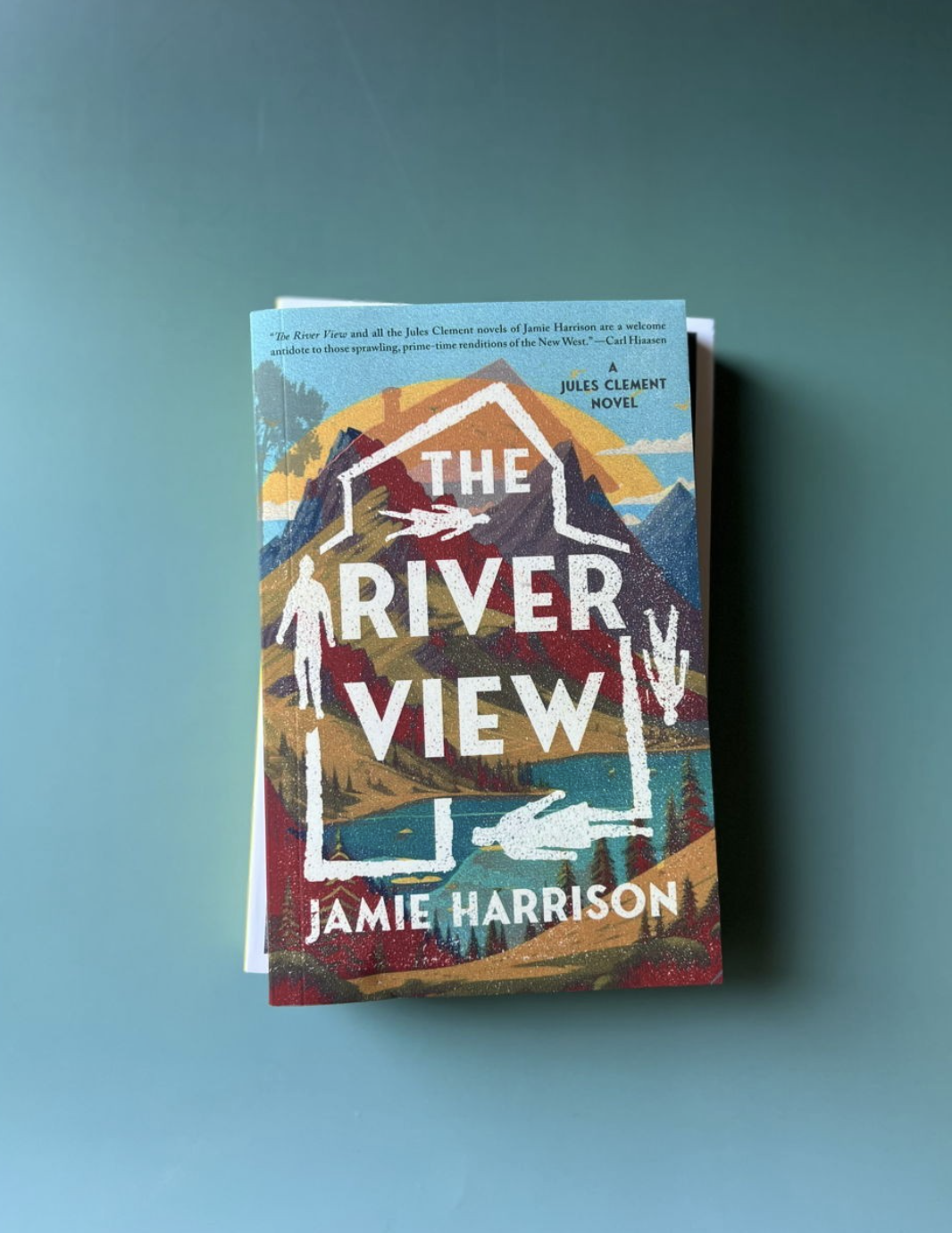
C&I: What I thought was so interesting with your latest book, The Riverview, which came out in 2024 — Jules is a new father and building a home in a destabilized time and area of the world. And I’m sure it’s always a big decision in any book to add more family, because with more family comes more potential liability. But why was it in The Riverview that you decided to make that life change?
Harrison: When I first wrote them, I wrote four in a row and basically at the end of the fourth made it clear he was going to quit. And I guess I wanted to be realistic. I didn’t want him to be that kind of lonely, classic alcoholic cop, which frankly just bores the shit out of me. I wanted him to have a life. The problem I sort of struggled with was it’s really hard to write an exciting mystery series with a married cop. I wrote four books where I had a lot of fun putting Jules through it in terms of women, in terms of misbehavior. It was wonderful. Bar fights, you name it. And I wanted to try to see if I could get away with him settled down. But really it was just realistic. I mean, he’s the kind of guy who would want to be married, would want to have a kid, and would have trouble adjusting to both those things like most people do.
C&I: Other stories, especially ones that are grounded in one area like the Pickett series or the Longmire series, we see so many different things arise from these small towns, like you said—whether it be tourism or law enforcement—and then you have outside mining laws. And I spoke to C.J. Box recently, and we talked about these data centers that are going up out West. Where do you get your inspiration for maybe the issues that you put into your books, or is that something that just kind of comes naturally?
Harrison: They’re the issues that we run into living out here. The railroads, the mining law of 18—what, ’76 or something—which is still a problem. So many themes in the West for the last 150 years have had to do with mineral rights. I did that in a book. I don’t know. I guess they come to me—often an incident comes to me and then I just want to explore all the ways land hoodoos can be done out here, all the ways—this is why people kill each other out here. They kill each other for land. They kill each other for what they see is love. They kill each other for money. They kill each other for family reasons. They all work. Everybody has an excuse. Everybody does. But in terms of the issues, they’re sort of timeless. New people moving in, people not understanding the community, that sort of thing—people thinking they own a community and pushing back that way.
C&I: Being a book centered around a former cop in the first books, obviously there is crime. And one thing that struck me about your books was that it’s not sensational in the way some mass-produced thrillers might be. It was more intimate with the people involved in your stories. And how do you approach writing crime without exploiting it and becoming sensational?
Harrison: I don’t know. I think you just go by your gut when you’re going too far. I mean, every once in a while—just now, in this book—I read about a murder and thought, oh, why didn’t I do that? It would be so simple. Just simple, linear cause, effect, revenge, jealousy. I don’t know. I have trouble writing about dead children. I have trouble. Some of it’s an uneasiness and just a desire to not be realistic—not be sensational—but really try to have something that punches and/or is funny. I mean, sometimes I want to be Carl Hiaasen and sometimes I wish I was Lee Child, but I’m not.
C&I: Let’s talk about Western writing today and the genre as a whole. And it’s changed so much, obviously, not only since its inception with early frontier stories and dime novels and on into the ’50s and ’60s of that kind of traditional Western paperback. And I think now it’s expanding even more so with TV and movies. Do you think that the West as a genre is being taken seriously, and not so much as just a genre as it once was?
Harrison: I think it always kind of has been. I don’t know, but I think of a Western as a John Steinbeck novel too. I mean, I grew up reading everything from John Steinbeck to My Friend Flicka and some Louis L’Amour and Raymond Chandler. I think of the West still too as including L.A. and the Valley and all — The original West. In this next book, I want — some part of it is set in 1918 in L.A., and I wanted to do something with some of the Westerns that were being made there at that time about the incredible mix of one movie set in Egypt right in the next lot with a Tom Mix Western. I think Western writers get a little ghettoized. I think that it’s easier to be a mystery writer in the West than a literary writer in the West, possibly. I think that there’s a tendency to typecast everything Tom McGuane writes as sort of a tough-guy, bare-bones Western rancher. I don’t know. I think it’s not entirely fair. Obviously, there’s a lot of wildly successful people out here, but I think they’re regarded still as “other” by New York. They just are.
C&I: I think what you’re saying is you almost have to look at the Western with a larger lens to encapsulate, because I think we’ve pigeonholed so much of it into that ’50s, early ’60s era. It became so prominent and so culturally identifiable that that’s what you immediately think when you think of Western. But a lot of the books we’ve tried to do on the podcast have tried to shuck that a little bit. But also, like you said, I think it’s so interesting of people who—I know you’ve been there forever—but maybe who weren’t from a certain area that take that area on as their own and have this reinvention and then are able to write that perspective that was so unique to the West. How do you think, jumping off that last question I just asked, is there a way to define success as a Western writer today if even some of the top names maybe are still viewed as “the other” in 2025?
Harrison: I think just doing the best job possible, whether you’re writing genre or you’re writing straight literary stuff. And to back up a little bit, I really have always been interested in the West that is — Gary Cooper was from Helena. He looked good in the suit too. In film from Butte in 1918 of crowd scenes, there are no cowboy hats. There just aren’t. And it’s a wide and varied place and it always has been. But in terms of defining success, it’s just defining it on a national stage. It’s being sold everywhere. It’s avoiding typecasting wherever possible. I know that sometimes you have to play to it, and some series do, and I bet I would do better — have done better — if I had played to it. You know what I mean? And I’m not accusing C.J. Box or anybody of doing anything, but I think, say, Hillerman was a great example of somebody who used place, but didn’t meet expectations — sort of had to really examine that world. But yeah, I’m trying to think. No, I mean, Western writers are just like anybody else. Half of them live out here now, right? How many writers does Livingston have? So many.
C&I: That’s one thing that strikes me too with a lot of the interviews we’ve done is most of the great writers who write about the West live in the West, and it’s just something that seems to permeate every aspect of their writing. And I think gone are the days of, like, the mid-century where you could have writers in New York City writing about cowboys in Colorado without ever having stepped foot near that area.
Harrison: There have been a few novels lately, and now I’m trying to think — and this probably isn’t worth including — where people have been going back to the 19th century and they are writers out of Brooklyn and they’re writing about journeys, they’re writing about — and I’m completely forgetting who wrote Trust — great novel. I think it won the National Book Award — but he wrote about a journey from California basically back East in 1820 or 1850. And it was fascinating, but it was a little off. Every once in a while you read — I think it’s really hard to get the West right if you don’t live here, if you don’t spend time here. It’s something as simple as saying he went outside and it’s February and you know he is going to die, but he doesn’t die. You know what I mean? It’s not thinking of the environment hard enough and what it really means.
C&I: Decades of living and breathing the West — what keeps you coming back to it as really not only a setting of your stories, but that driving force, especially in your Blue Deer novels?
Harrison: Maybe because it is a place that is full of change and it’s filled with people who are in flux. I don’t have that much interest in just writing about a town where everybody has always lived and the problems that result from that. Do you know what I mean? I don’t want to write about a fairly insular New England town and its traditions. I really like the fact that in the West, it all gets ripped up and sort of put back together again. There is a tradition, but so many things. Every new entry into a town changes town a little bit, tweaks it a little bit and changes the mood and changes.
C&I: It even hearkens back to the lone rider coming into the Western town, no one knows, and it upends everything they thought. It’s the Western trope. But yeah, it’s so interesting. And you can see that permeate throughout most Western novels. It’s just this smattering of different people with different ideas and beliefs and the chaos it ensues after.
Harrison: The chaos and the kind of darkness. I mean, I’m trying to think of the director who said the Western noir is somebody hitchhiking five miles on an empty highway, five miles away from the prison. That’s noir here. It’s not alleys. It’s not this and that. It can be bleak. It can be spooky. It can be great. It’s a great setting for horror novels. People have started doing that too.
C&I: What amazes me as well is that the West is so vast — there’s more cows than people in some of these places — and yet all these people managed to find their way together. We just can’t stay apart.
Harrison: There are still bars. More bars than churches, usually.
C&I: What projects do you have in the works, and is there anything that you can give fans to whet their appetites for any of your work coming up?
Harrison: I’m working on a novel called Blue Ghosts. It’s a Jules novel, and I’m getting close to having a really good first draft rather than the rough mess I’ve been working on. And it’s actually about a friend of Jules who disappears on an archaeological expedition when he is in his late 20s, 10 years earlier, and his bones showing up and dealing with that. And then also dealing with what we have out here is a sort of particularly interesting kind of thing in banks. We still have safe deposit boxes, but they’re not like the spiky, Inside Man safe deposit boxes. You walk in, you rarely have to show your ID. You rarely have to do anything. Either they know you or they trust you or whatever, but I’d say the lack of security has just blown my mind, and I’m writing something about a con with some safe deposit boxes in the same novel. And I want to write something that goes back to the characters from The Widow Nash and The Center of Everything—the characters of Henning and Dulce. And one part of that would be set in L.A. in 1918.
C&I: Thank you so much for your time. It’s been wonderful to talk your books and the West and writing, and we’re eagerly anticipating the next Jules novel.
Harrison: Really enjoyed the questions. Thanks so much.