




The late, great Native American star appeared in a wide range of stage, film, and TV productions.
Graham Greene felt slightly awkward as he settled into his supporting role for writer-director Aaron Sorkin’s fact-based 2017 film Molly’s Game. He had been cast as the presiding judge for the trial of the title character, Molly Bloom (played by Jessica Chastain), who stood accused of running a series of underground poker games for Hollywood celebrities and other high rollers.
And while his character had relatively few lines, Greene loomed large throughout much of the film by sheer force of his gravitas-infused presence. When the time came to shoot his first scene, however, Greene hesitated. “Aaron, the director, was looking at me sitting behind the bench,” Greene said. “I had a puzzled look on my face. He said, ‘Are you all right?’ I said, ‘Yeah. I’ve just never seen the bench from this side before.’” Both men chuckled. But then Sorkin managed to put Greene at ease by pointing out a face in the courtroom set. “He said, ‘Do you know that guy sitting over there?’ And I looked over and there’s Kevin Costner. I said, ‘What the hell are you doing here?’ Turns out he was playing Molly Bloom’s father. Which I thought was hilarious.”
Greene roared with laughter as he shared this anecdote with me during a 2021 interview. He had no idea before he signed on for Sorkin’s project one of the nearly 200 movie and TV credits on the First Nations actor’s résumé that the film would mark his reunion with the director and star of Dances With Wolves, the Oscar-winning 1990 epic western that elevated him from being a well-regarded stage actor in his native Canada to an in-demand international movie star.
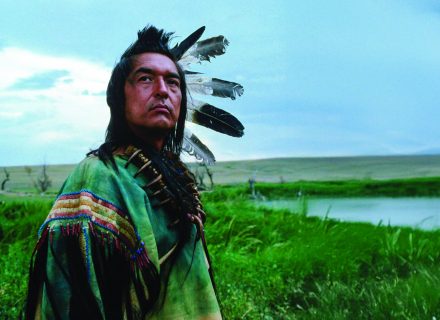
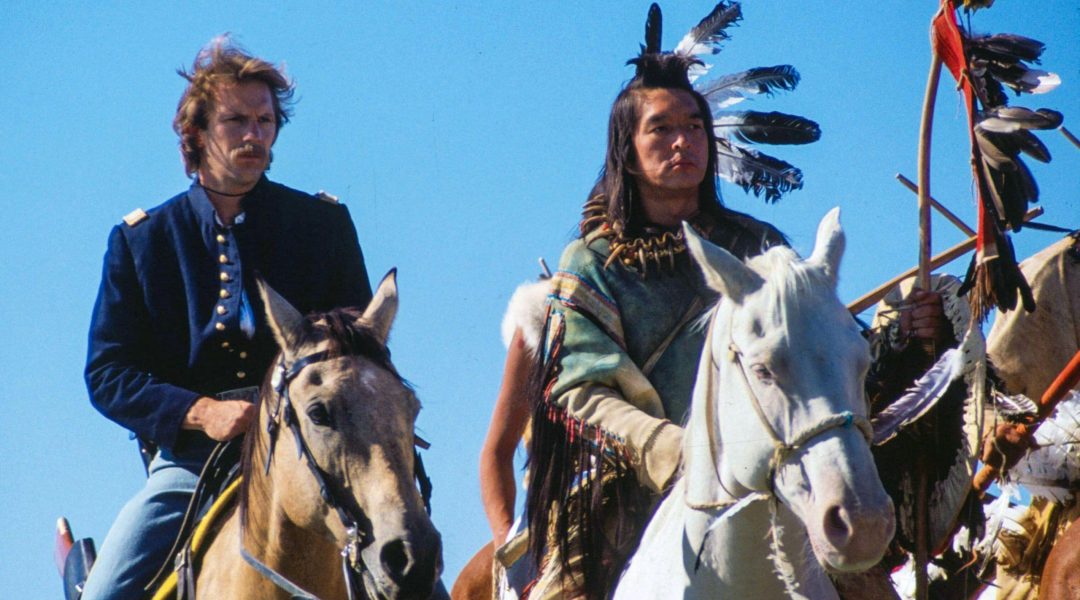
Greene landed an Oscar nomination for his portrayal of Kicking Bird, the Sioux holy man who accepts John Dunbar, the white Union lieutenant played by Costner, into his community and forms an alliance with him. The character, Greene later stated, offered him a welcome opportunity to shatter movie stereotypes of Indigenous characters as stoic and humorless.
In a 2024 interview for Canada’s Theatre Museum, Greene said: “When I first started out in the business, it was a very strange thing where they’d hand you the script where you had to speak the way they thought Native people spoke. And in order to get my foot in the door a little further, I did it. I went along with it for a while. You gotta look stoic. Don’t smile. You gotta grunt a lot.” Even though, he added, “I don’t know anybody who behaves like that.
Native people have an incredible sense of humor.” And that’s what he told Costner at the outset. “I said, ‘You know, the people in this film, in this village they have an incredible family, incredible relationships, and fun has always been part of that. Fun is 50 percent of how they live and enjoy things. Family is family, no matter what.’” When Greene passed away at age 73 last September, Costner eulogized him with respect and affection on social media: “A few things come to mind when I think of Graham Greene and our time together on Dances With Wolves. I think of how willing he was to learn the Lakota language. I think of my joy when I heard that his work on the film was recognized with an Academy Awards nomination. And I think of [how] he was able to establish so much about the relationship between Dunbar and the Natives with so few words. He was a master at work and a wonderful human being.” When we spoke in 2021, Greene expressed a similarly high regard for Costner. Asked what he thought he had learned from the actor-director, Greene immediately replied: “Persistence. He didn’t give up. I believe he mortgaged his house to finish [Dances With Wolves].”
Greene didn’t win the Oscar for Dances With Wolves. (The Best Supporting Actor prize went to Joe Pesci for Goodfellas that year.) But he didn’t seem to mind. “I’ve said that being nominated is better than winning,” Greene told me. “Because after you’re nominated everybody wants you.”
R E M E M B R A N C E
And Greene thoroughly enjoyed being wanted, as long as he could avoid typecasting. “I like diversity in roles,” he said. “I played a judge in Molly’s Game. I played God twice. I played the Archangel Gabriel. I guess that’s pretty much got it covered.” Among his many notable credits after Dancing With Wolves: Walter Crow Horse, a tribal police officer who reluctantly helps an FBI agent (Val Kilmer) investigate a murder on a South Dakota reservation in Thunderheart (1992); Joseph, a tribal leader whose dry wit and sarcasm enabled him to steal several scenes from star Mel Gibson in Maverick (1994); NYPD detective Joe Lambert, an ally of the resourceful hero John McClane (Bruce Willis) in Die Hard With a Vengeance (1995); veteran tribal police chief Ben Shoyo in Taylor Sheridan’s Wind River (2017); and Skully, the title character’s robustly playful grandfather, in the Marvel Comics-inspired TV series Echo (2024).
And while he was making movies, Greene continued to amass impressive stage credits. One of his career highlights: He played Shylock in The Merchant of Venice and Lennie in Of Mice and Men in repertory at the 2007 Stratford Shakespeare Festival. “I was doing Merchant of Venice at one theater in the afternoon, then going to another theater at night and doing Of Mice and Men,” Greene said. “Mice and Men was an incredible production. And nobody could get tickets for it. It was sold out.”
“Graham Greene was a master at work and a wonderful human being.”
— Kevin Costner
If you look closely at Greene’s résumé, you may be struck by how often he made an indelible impact in movies where he had a minimal amount of screen time. In Transamerica, writer-director Duncan Tucker’s marvelously empathetic 2005 road movie, he has only a few scenes as Calvin Two Bears, a sweet-natured rancher who’s drawn to a trans woman (played by Independent Spirit Award winner Felicity Huffman) a few days before the operation that will complete her transformation. But Greene makes every moment count. Indeed, at one point, he gets to strum a guitar and warble “Beautiful Dreamer.” On the other side of the angels, Greene had even fewer minutes of screen time in one of his final films, King Ivory (2025), as Holt Lightfeather, leader of the Indian Brotherhood cartel, whose incarceration in an Oklahoma state penitentiary scarcely impedes his ability to operate his illicit activities.
He’s positively chilling as he calmly explains to a visiting cop (James Badge Dale) why he switched from heroin as his stock in trade: “The current generation wants what’s new. Well, fentanyl is new.”
Greene appeared in so many movies and TV shows during his decades-long career that he was long accustomed to being recognized in public. Trouble is, he said in 2021, some folks who approached him couldn’t remember why they recognized him. “Yeah,” he said, “I’ll have people come up to me and say something like, ‘Hey, where do I know you from?’ And when they do, I’ll usually say, ‘Man, just Google it.’” Mind you, Greene laughed when he said that. Because, really, even he recognized that he had played such a wide variety of characters that admirers and autograph-seekers might find it difficult to recall precisely where they had seen him before.
“Sometimes,” he added, “someone will come up and say, ‘Hey, man, you were great in such and such movie. I really loved you in that.’” Pause. “But I was never in it.” Hard to believe, but it’s true: Graham Greene wasn’t everywhere. It just seemed that way.
Title Photo: Dances with Wolves (1990)Kevin Costner & Graham Greene
Supplied by Capital Pictures