





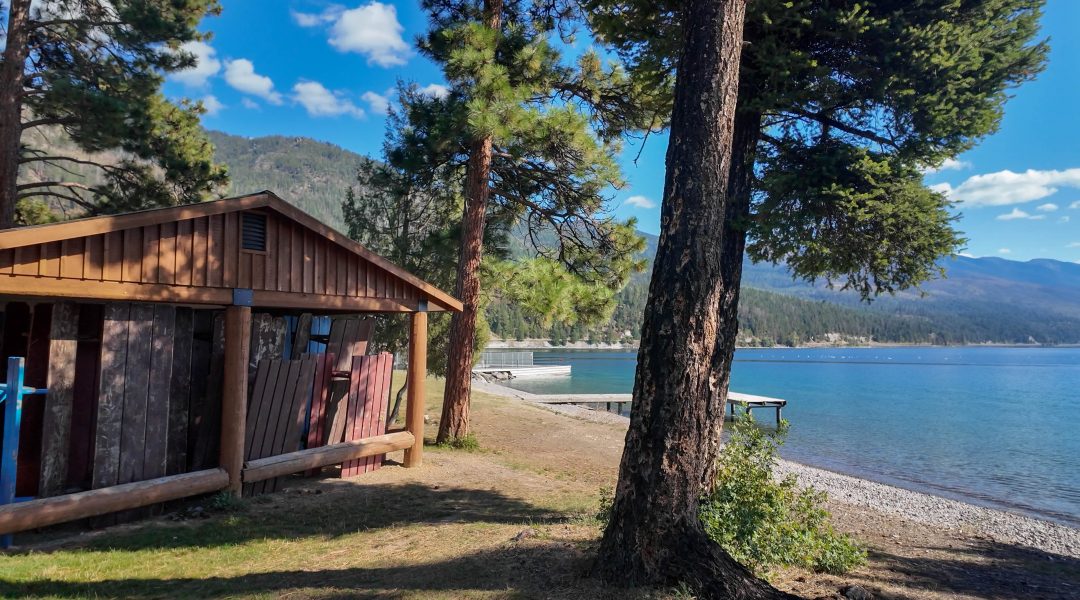
On Montana’s Flathead Reservation, the Confederation of Salish and Kootenai Tribes blend ancient wisdom and modern science to heal the land — and everything that lives upon it.
The pond shimmers under the late summer sun. Behind it, the Mission Mountains run shoulder to shoulder, north to south. On the far left, flashes of white flit to and fro on the water. These marvelous creatures draw birders from across the country to visit Flathead Reservation in Northwest Montana.
With necks like a fishhook, bright white feathers and distinctive wail, trumpeter swans are instantly recognizable. To see them on this particular Mission Valley pond on this particular day is a triumph of luck and good timing.
To see them day after day, month after month, year after year all across Flathead Reservation’s 1.3 million acres, is a triumph of the Confederation of Salish and Kootenai Tribe’s Department of Natural Resources, who are blending tribal wisdom with modern science to manage their land.
It’s the methods they use that are set firmly in the present day.
We interviewed five men and women deeply involved in conservation efforts for CSKT. All of them described living and working in two worlds — the world of their ancestors and the world they inhabit. They long to return the landscape and culture to what it once was, and they employ modern techniques to do so.
Some of this work takes reintroduction. Take the trumpeters. Feather collectors and subsistence hunters had wiped out the swan population in Northwest Montana by the end of last century. But in the late 1990s, under the guidance of Dale Becker, a tribal biologist who has since retired, that the CSKT started reintroducing the swans.
At the beginning of the program, the swans were outfitted with tracking devices, and at first, they often didn’t stay. They fled to coastal regions or returned to where they came from. Many were killed when they flew into power lines or collided with cars.
But eventually, some of the birds did stay in Montana, says Kari Kingery, program manager for CSKT’s wildlife program, who was part of the team that transported swans from out of state in horse trailers lined with hay.
They did so, she says, because they developed a sense of place. The reservation felt like home, and they didn’t want to live anywhere else. Once they rooted here, they blossomed and the population is now self-sustaining. No more relocation is needed. “2004 was the first time we had a trumpeter cygnet born in the wild in over 100 years,” she says. “And now in 2025 we are seeing 80 cygnets produced a year.”
That has resulted in perhaps the most visible of the tribe’s conservation efforts. Kingery describes her delight in seeing 300 bright white swans on the Flathead River, where they congregate when other water sources dry up.
“Whether they’re swimming along the Flathead River or you’re seeing them flapping as they battle each other for the right to mate, it’s just amazing to see,” Janssen says.
They look right at home in a landscape that was home for thousands of years.
But what if an invasive species seizes on a place and crowds out animals who have lived there for millennia, threatening their very existence? That’s what’s happening in Flathead Lake, and it has spurred the most creative of the tribe’s conservation programs.

Flathead Lake runs 30 miles from top to bottom, 15 miles at its widest, with a maximum depth of 371 feet. To stand on its south shore as the sun sets, mountains horseshoeing around you, is to stand inside a painting as an artist creates it. The colors arrive one after the other, pink then red then purple, and they slide along the mountains, casting a glow on the water.
But trouble lurks beneath the surface.
Bull trout were a crucial fish throughout the CSKT tribes’ history in Northwest Montana. But in 1905, mackinaw (lake) trout were introduced into Flathead Lake. They co-existed with the existing ecology for about 80 years, until the state introduced mysis shrimp into the system. Lake trout devoured those shrimp, their population exploded, and the native bull trout’s population dwindled.
View this post on Instagram
Mack Days—a combination of fishing competition and conservation effort—is an attempt to reverse that trend. This unique tournament started in 2002 and runs in spring and fall, with nine weeks to fish during each window. Before each event, fish are caught, chipped, and returned to the lake. There’s a $10,000 fish, three $5,000 fish, five $1,000 fish and 9,000 fish with values ranging from $100 to $500. Plus, you earn escalating cash bonuses based on how many fish they catch. You can fish one day or every day and can catch as many lake trout as you want.
The tribe’s intention is not to eradicate the lake trout; in a lake as big as Flathead, it’s hard to imagine that’s possible. Their goal is to remove enough of them for the bull trout to return to its place of prominence.
“In 20 years, you don’t want someone looking at you and saying, ‘What happened out here? The native fish are gone. Why didn’t you do something?’” says Cindy Benson, a tribal fisheries specialist who manages Mack Days.
In keeping with the tribes’ holistic approach to conservation, the lake trout are sold to restaurants, and the entrails are used for compost.
In the early days, the limit was 20 fish per day. Now it’s 100, and as big as that number is, it gets hit, and often. Many of the fish are taken by anglers who stay at Blue Bay Campground, which is tribally owned and sits along the lake’s eastern shore. It’s a popular spot for anglers to camp because they can fish from shore, fish from the dock or launch their boats.
The water there glistens like a green-blue emerald, giving the lake an almost tropical feel, even though it’s less than 100 miles from the Canadian border.
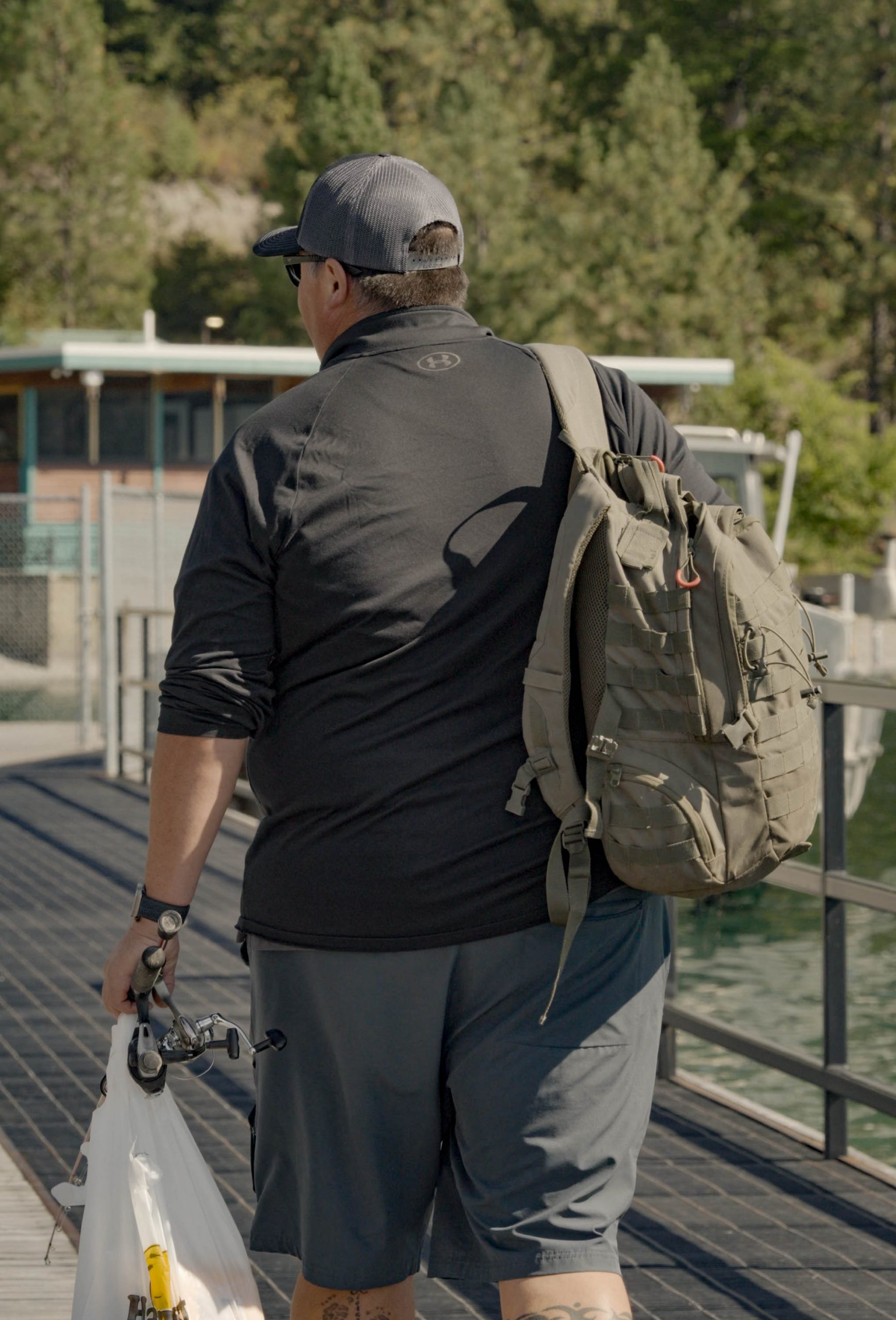
On this bright September day, Tony Incashola Jr., CSKT’s executive director of Tribal Resource Management (and an avid fisherman) parked his Jeep at the campground, opened the back door and pulled out his fishing gear.
Incashola’s father was the director of the CSKT’s culture committee for 43 years. The son grew up bearing witness to his father’s efforts to keep alive tribal knowledge, culture and language. “I got the traditional way of thinking installed into me,” he says.
As he grew up, he wanted to work outdoors, so he got a degree in environmental forestry. That background in tribal culture and science makes him ideally suited for his role as executive director of Tribal Resource Management, through which he oversees efforts like Mack Days and The Bison Range. “It took me a few years to really know how to blend traditionally ecological knowledge and western science,” he says. “We use western science to accomplish traditional management.”
In Mack Days, that means getting rid of as many lake trout as possible. The spring edition of Mack Days this year yielded 60,000 fish, a staggering number to Benson, Janssen and Incashola, all of whom have been around the event for two decades.
View this post on Instagram
That number alone is seen as evidence that Mack Days is making progress. Plus, Incashola and others have noticed they are catching more bull trout and cutthroat trout than ever before when they are actually targeting lake trout. There is evidence, too, in the fact that many of the lake trout being caught are smaller than in previous years. “Hopefully that’s a good sign that the main population of adults is decreasing, and younger fish is all that’s left,” Benson says.
With Trumpeter Swans and bull trout, the CSKT conservation projects are about restoring animal populations to what they once were.
With the grizzly bears, it’s about preventing a decrease.
Janssen pedaled his mountain bike along a trail in North Crow Canyon when he saw a flash of brown. He squeezed the brakes. On the trail ahead of him stood a grizzly bear.
Janssen has worked for the tribe for 34 years, the last 15 as head of the DNR. He has dedicated his life to the preservation of outdoor moments like this. And even he found this face-to-face encounter arm-hair-raising, unbelievable, transcendent.
Straddling his bike, keeping a safe distance, he marveled at how big, how powerful, how majestic that creature was. “That’s as close as I ever want to be on a mountain bike,” he said. “I’m not at the top of the food chain.”
He backed away in the same direction he came from and waited five minutes, 10, 15, before pedaling forward again. The bear was gone by that point, and Janssen continued on one of the most memorable rides of his life.
His story, though, illustrates the challenge the tribe faces. Man and animal often travel the same paths. The encounters are often sublime, and not necessarily dangerous. But when cars are involved, these meetings become a real problem. Car versus grizzly ends badly for the grizzly (and the car), and the tribe is working on innovative ways to prevent such crashes.
The bears are traveling where they’ve always traveled — along wetland and riparian habitat. The problem is, there are highways where once there was wilderness. “The landscape is constantly evolving. And so our management techniques are constantly evolving,” Kingery says, talking loudly as cars on Highway 93 roar between her and the Mission Mountain Wilderness, home to a healthy grizzly bear population that numbers around 100.
Highway 93 runs north and south through Montana’s grizzly bear country. An 11-mile stretch accounts for “at least 27 percent of all grizzly bear mortalities in the entire northern Continental Divide ecosystem,” Kingery says.
So how to fix the problem?
Imagine a pedestrian bridge, only uniquely designed for a bear. The CSKT have been leaders in Montana in creating successful crossings. There will eventually be 81 crossing structures across Highway 93, making it the largest such project in the country.
View this post on Instagram
What does a bear bridge look like? As much like the landscape as possible. “In order for a grizzly bear to use an overpass, it can’t be too steep. It has to be wide enough. It has to really blend into the landscape and the surrounding area,” Kingery says.
Returning the landscape to the past by using methods of the present — whether it’s radio chips on swans, ID chips in fish or bridges for bears — all have one goal: A better tomorrow, a little bit more like yesterday.
“Preserving the land, the wildlife, our food, our culture, really is how we save and preserve our people into the future,” Kingery says. “So having that tie to the landscape and keeping it healthy is really important, and it’s something that the tribe still takes at high value today.”
View this post on Instagram
To learn more, go to visitmt.com