




The homes and ranches in the West have long taken inspiration from the earthy landscapes and lapped-up luxuries the world around. These new books celebrate that connection.
Three new coffee table books celebrate three very different takes on architecture and interior design inspired by rugged landscapes and the heights of luxury. Here, we take a chapter from each.

A Dan Metz oil painting, Fanfare, keeps watch over the gathering room, where a bronze moose sculpture by artist Tim Shinabarger catches the window light. Fireside reading is a pleasure when seated on the luxe sofas or the wing chair covered with antique leather. Credit: Chris Little.
1. Montana Forest Fairytale
Designer William Peace imparts how he added layers of refinement and elegance to an off-the-grid getaway in Montana.
Excerpt: Hiking through the Custer Gallatin National Forest in Montana, one is immediately struck by similarities to the Black Forest in Germany. Dense groves of fir trees, open meadows, and ever-present wildlife are the hallmarks of both forests. Although the Brothers Grimm were not explicit about the exact forest where their fairytales took place, it’s true that Bavaria was the setting for many of their magical stories.
When we were approached to design a cabin in the woods of Gallatin Canyon, we felt as though we were embarking on our own fairytale adventure. Situated on 680 acres and accessible only by car for a few months each summer or by snowmobile via a logging road in winter, this remote, secluded haven is probably the type of home most people dream about owning, but few are daring enough to create due to stringent environmental constraints. The homestead was designed for the owners to be profoundly integrated with the forest. For them, it is a story of give and take in the truest sense: The forest shares the environment, and the owners are careful to leave a minimal, almost indelible footprint. In this improbable location, this family’s home proves that luxury and modest size are not mutually exclusive.
The log house is tucked behind a grove of trees and is not visible from the gravel road that leads to it. When designing and building this multigenerational homestead with Matt Miller and Joe Roodell of Miller-Roodell Architects and John Evans of North Fork Builders, we wanted to ensure that it would always remain a unique place that represents the owners who appreciate fine wine as much as an old-growth fir tree.

An antique Spanish iron chandelier highlights a pair of bronze mohair sofas as well as the cabin’s reclaimed planked walls and stone and vintage-oak floors. Credit: Chris Little.
Although off the grid and powered only through solar and geothermal panels with a safety backup generator, the house feels solid and sturdy, as though it has weathered many winters and is stronger for it. A fireplace handcrafted of Montana moss rock commands the gathering room. It features an arched opening with keystone construction and a considerable stone mantel. Furnishings from around the world and different periods blur the lines of when and for whom this house might have been created. An antique Spanish iron chandelier hangs above a pair of mohair sofas, while a bronze moose treads under the window, remindful that one might be right outside. These refined furnishings might seem at odds with a modestly sized log cabin hidden in the woods, but that’s exactly the charm of this place.
This is a home that feels collected across countries and centuries—as though a homesteader may have brought some heirlooms and continued to collect over time. Sumptuous finishes and furnishings evoke an old-world charm in this distinctly American Western home.
From Peace in the West: The Rustic Luxury Interiors of William Peace by William Peace, Gibbs Smith publisher.
Meet the Author
Founder and principal of Peace Design, William Peace talks balanced design that honors both people and place.
Southern Roots Translated Out West
Growing up in Kentucky I gained an appreciation for nature: the rolling hills and pastures in the bluegrass, the limestone outcroppings, and the clear lakes and rivers. The rugged stone and forests of the West translate seamlessly into my appreciation of the Western landscape. When I got to Montana, the dramatic Rocky Mountain peaks and the ever-reaching Western skies captivated me, and they continue to inspire me and influence our work in this amazing part of America.
Making a Mountain Home Feel Lived-In
We create primary homes, vacation homes, and ranches for our clients. Irrespective of whether it’s a primary or vacation home, we layer our homes with indigenous materials such as stone and wood, and we’re always conscious of the views and landscapes as we begin the design process. When we get to the furnishings, we focus on creating rooms that are layered and feel as though they’ve been curated and collected over time. Luxurious fabrics and comfortable seating mix with art and sculpture, and fireplaces always enhance rooms.
What Every Western Home Should Have
We’re known for creating rooms that are layered in terms of places, people, and textures. By that we mean that we think that homes should have a strong and handsome natural stone fireplace surrounded by comfortable seating in luxurious fabrics, and with beautiful views of both the landscape and nature, as well as art.
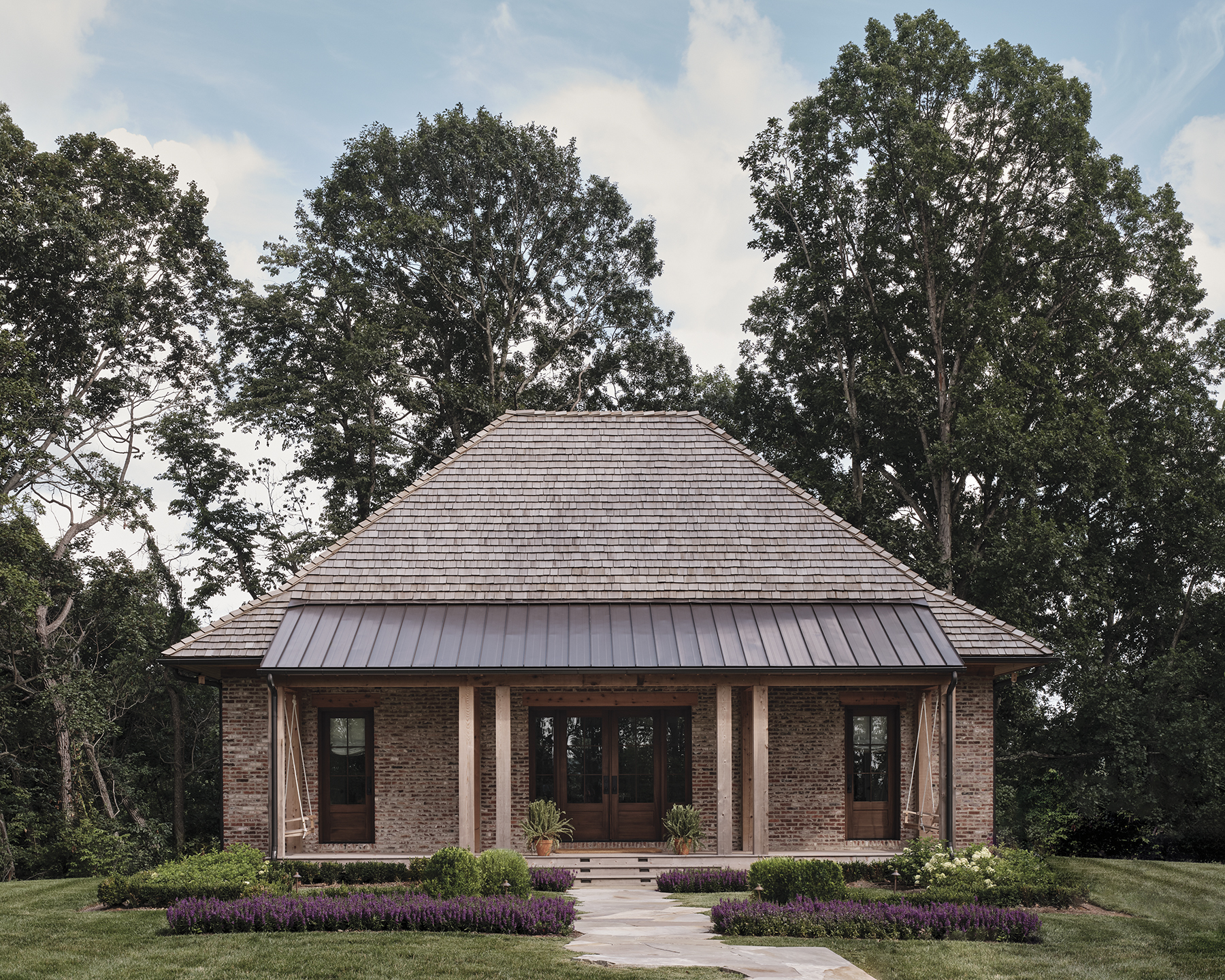
Thanks to designer Stephanie Sabbe’s touch, an idyllic cottage is the just-right spot for inspiration to strike. Credit: Joseph Bradshaw.
2. Nashville Writer’s Retreat
In designer Stephanie Sabbe’s hands, a writer’s retreat in Nashville becomes a true storybook setting.
Excerpt: I once sat in an airplane headed for Las Vegas reading every last word of a book I picked up called Blue Like Jazz, by Donald Miller. The book talked about smoking cigarettes and eating chocolate while reading the Bible, which barely cracks the surface of what it was really about. But 15 years later, that’s what still sticks with me. It felt scandalous at the time, which only made me love it more. I was so intrigued that I bought a ticket to hear the author speak and stood in line to have him autograph my book. So it was one of those crazy, coincidental (or perhaps God-ordained) moments in life when 13 years later my phone rang and the caller introduced herself as the personal assistant of Donald and Betsy Miller, and they wanted to interview me for a couple of upcoming projects.
The Writer’s Cottage is the second project I designed for the Millers. Intended to be used as an escape from the real world. Architect Preston Shea of P. Shea Design drew the plans and exterior elevation. Then it was back to me, with the help of Nathan Chadwick, to dream up something big for the interior. Storytelling is Don’s profession, and storytelling through interiors was very quickly becoming a part of mine. Although the cottage was not a historic building, we dreamed up a story of an original 1800s log cabin that was later added on to and updated.
Nathan and I took a trip to Kingston Springs, a town 30 minutes west of Nashville. There, at a mill called Pioneer Lumber, we sat with the owner to select the wall material as well as the hand-hewn beams for the ceiling. I had Nathan test a half dozen different colorways of chinking until we felt like we got it just right. I found vintage glass-front cabinets and oversized industrial pendants, and I used both to create a more deconstructed kitchen of sorts, like back when people used all of their appliances freestanding in the kitchen.

Built-ins are filled to the brim with books. Credit: Joseph Bradshaw.
Preston had drawn a typical gas-insert fireplace in the family room. As I studied the plan and referenced photos of more historic architecture, I came up with the idea to leave the niche, but instead of an insert, I’d use a freestanding cast-iron stove. I added the little window to really seal the deal on the charm factor. The dining area sits between the kitchen and family room and is visible along the very clear centerline that runs front to back through the middle of the home. I loved the idea of using barrister chairs, also known as juror chairs, in a guesthouse. I know from experience, there is nothing more uncomfortable than seeing a broad-shouldered, large-statured man trying to enjoy dinner on a delicate antique chair. Juror chairs, on the other hand, were literally built to hold everyone (whether they liked it or not!).
We very much designed the house from back to front. So as if walking backward from the original log-cabin structure to the “newer” addition, we designed the long hallway to serve both corridor and coat-closet functions. And to keep the visuals clean, we used “jib” (or hidden) doors to enter the powder bath and laundry. The entry is the preamble—as you stand there, you can pretty much see in all directions of the home, including the sleeping porch, the log cabin, and the entries to each guest suite. But what you are most affronted with are books! So many books—this is the Writer’s Cottage after all!
From Interiors of a Storyteller by Stephanie Sabbe, Gibbs Smith publisher.
Meet the Author
Designer Stephanie Sabbe talks pattern play, old-school finds, and Nashville cowboys versus “real” cowboys.
Maintaining a Sense of Cohesion
The pattern and color mixing is really a gut thing for me. We basically have one stripe, one plaid, one floral, and few “others” in the mix for every space we do. I try really hard to find things that work but shouldn’t. You cannot be too contrived. You also have to leave room for more, always. A home should always be in a state of evolving. It’s a living space, not a showroom.
Creating Things That Last
We buy old dining tables and cut them down for coffee tables because new coffee tables are too pristine. And who uses coasters anymore? We like unlacquered brass and natural copper and things that change over time. We love vintage Turkish rugs and all of the un-precious things. My best projects are the ones where people do not think anyone even used a designer—I’m just around to bring out the story.
Bringing a Hit of “Western” to a Space
I have never shot an animal in my life, but I am a big fan of mounted antlers. I always have been. I usually buy them in antique shops and flea markets. We also have mounted fish at our lake house; they include plaques with the men’s names and the dates they caught the fish, which is hilarious. Real cowboys should really give a hard time to Nashville cowboys. Our “cowboys” are all aspiring musicians who wear cowboy hats as a nod to, again, their ancestors. But they’re not really living that cowboy life. In the South, we’re just all about that aesthetic.

A large open-sided fireplace separates the dining room from the gathering room, filling the open living area with a feeling of warmth. Credit: Audrey Hall.
3. Wyoming Modern Manse
Writer Chase Reynolds Ewald and photographer Audrey Hall share a peek behind the grand front door of a modern mansion in Wyoming.
Excerpt: As a building material, board-formed concrete injects a certain level of contradiction into a project. It is manmade yet imprinted with a touch of the natural. It has an industrial feel yet carries with it a warmth through tone and texture. Formed with wood boards that are then stripped away, it takes advantage of the plasticity, strength, and durability of concrete while celebrating the natural imperfections—and the natural beauty—of wood.
The material seems tailor-made for modernists seeking a new form of expression in the Mountain West, yet it wasn’t that long ago that residential architects were only tentatively suggesting it to their clients. Larry Pearson of Pearson Design Group had long been interested in the potential for rustic modern environments created with board-formed concrete, glass, steel, and reclaimed wood. On a 60-acre site outside of Jackson, Wyoming, he found the perfect setting and ideal clients with whom to collaborate on bringing this vision to life.
Originally, the owners weren’t so sure. “I kept thinking farmhouse modern, but when I asked Larry to draw his vision, he was leaning more modern. The whole spine and front of the house were going to be board-formed concrete,” says the wife. “It was a little out of my comfort zone, but my husband was all for it. I said, ‘Guys, I’m from Texas. If we do this, we have to have a lot of warm materials, like reclaimed white oak floors to soften it. We can’t build a concrete box.’ And they said, ‘Absolutely. Let’s do this!’”

The primary bedroom features a double-sided fire- place and access to big views. Built-ins frame a collection of special books. Furnishings from Baxter, Poltrona Frau, and Maxalto mix with Round Top finds in the living room. The calming neutral palette extends to the kitchen, where natural elements shine. Credit: Audrey Hall.
The home’s exterior is defined by expanses of board-formed concrete punctuated with large panes of glass that reflect the mountains and trees, barnwood applied both horizontally and vertically, stonework, and beams of steel and reclaimed wood. The structure is laid out on two perpendicular axes defined by spines of board-formed concrete, which visibly extrude at either end of the east-west axis. From the entry on the south side to the great room and the covered patio on the north, the roof slopes upward to embrace the views. There, paired chimneys of stone and steel thrust dramatically upward, piercing the wood-clad roof and anchoring the home on its site.
The interiors were designed by Michon Anne Combs of MC Design. “My first goal,” says the designer, “was to try to keep them as quiet as possible because I wanted the focus to be on the outdoors. And the house itself is so beautiful, the materials and the shell are so gorgeous, I didn’t want to fight it too much. Over the years, we’ve added more [details] to make it a little bit warmer and more layered. But the approach was to keep everything super quiet to allow the architecture to take the lead.”
From Modern West by Chase Reynolds Ewald and Audrey Hall, Gibbs Smith publisher.
Meet the Team
Writer Chase Reynolds Ewald and photographer Audrey Hall discuss the exponential evolution of modern design in the West.
The Changing Face of Montana
Chase: We’ve been writing and photographing homes in the Northern Rockies and all over the West for more than 30 years. We remember the big log homes from the 1980s and ’90s.
Audrey: Now, we’re seeing an influx of younger people who want their homes to feel like an expression of their lifestyle, aesthetic, and taste. That comes through their art collections, furnishings, and lighting selections—things that reflect modern living as much as modern design.
Designing Mod in the Mountains
Chase: All of these homes are directly informed by the landscape—they speak to the landscape and are shaped by the landscape and are designed with the weather patterns, migration patterns, and water flow in mind. The more horizontal lines of modern design lend themselves to homes that are built on the slopes.
Audrey: Back in the homestead era, the homes had small windows because of the importance of keeping the house warm in the late 1800s. That’s changed because the window-glazing techniques, heating efficiency, and insulation of homes have advanced, plus our ability to harness passive solar and focus on sustainable materials. All those advancements make it more user-friendly for people to live in a more modern design with large open spaces.
Furnishing the Feel
Audrey: Even when the aesthetic is minimalist, the materials bring texture to very fluid spaces. In this particular project, the spaces are warm because of the harmonious mix of glass, limestone, steel, and reclaimed white oak.
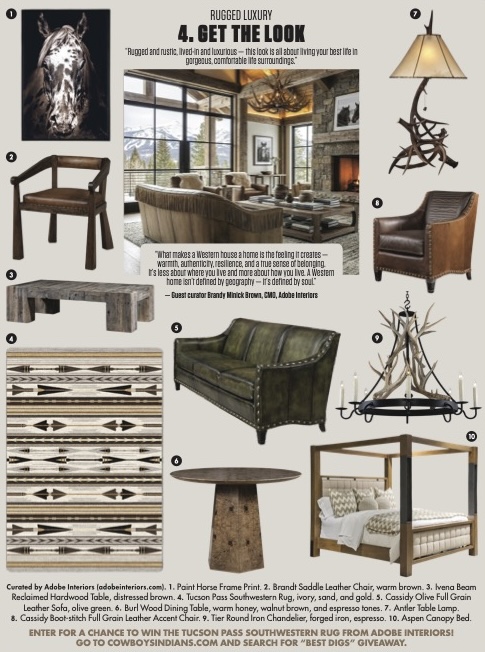
4. Get the Look: Rugged Luxury
“Rugged and rustic, lived-in and luxurious—this look is all about living your best life in gorgeous, comfortable life surroundings.”
Curated by Adobe Interiors: 1. Paint Horse Frame Print. 2. Brandt Saddle Leather Chair, warm brown. 3. Ivena Beam Reclaimed Hardwood Table, distressed brown. 4. Tucson Pass Southwestern Rug, ivory, sand, and gold. 5. Cassidy Olive Full Grain Leather Sofa, olive green. 6. Burl Wood Dining Table, warm honey, walnut brown, and espresso tones. 7. Antler Table Lamp. 8. Cassidy Boot-stitch Full Grain Leather Accent Chair. 9. Tier Round Iron Chandelier, forged iron, espresso. 10. Aspen Canopy Bed.
Enter for a chance to win the Tucson Pass Southwestern Rug from Adobe Interiors!
From our May/June 2026 issue.