





In a speech to the 2025 Big Sioux River Stewardship Summit in Sioux Falls, author Barry H. Dunn, the 20th president of South Dakota State University, laid out the key to the future for grandchildren everywhere.
My grandfather, Claude Lamoureaux, was a cowboy and an Indian. For a boy growing up in the 1950s and ’60s, that was just about the coolest thing ever. He and my grandmother, Hattie, ranched south of Mission on the Rosebud Reservation. My boyhood memories are of driving across the ranch in a two-wheel-drive, green Chevy pickup with my grandfather, checking the cattle and the windmills and making sure all the gates were closed and the fences were tight. Many times we rode horses, and from early on I saddled my own.
Grandpa was never very talkative, but I peppered him with questions to the point of annoyance, and I learned by some sharp looks that I needed to be quiet. I have no memory of him tucking me into bed or telling me he loved me or playing games. That was Grandma’s job. But on horseback, in his truck, around the supper table, he taught me many lessons, most of which I understand better today.

Spring branding on the L7, 1958.
I graduated from high school at Christmastime and immediately went to the ranch working full time. Sadly, my grandma died soon after, and I found myself alone with Grandpa Claude. He was grieving, and I was trying to grow up, so it was a poignant time for both of us.
By then, his brown skin had darkened even more, and he had wrinkles from a hard life defined by scarcity. He wasn’t a tall man, but he was still rugged and straight, and his love for the land was obvious.
He was a member of the Sicangu Lakota. He was born on the Rosebud Reservation south of what is now Winner, into extreme poverty and just three years after the Wounded Knee Massacre on the Pine Ridge Reservation, a few miles to the west.
As a teenager, Grandpa rode in the last open-range roundups in the Dakotas, clearing the reservations of Texas cattle to open the way for homesteaders. He described the landscape back then as beautiful, endless grassland, except for an occasional cottonwood grove, which was a sign of water and perhaps some shelter.
Right after World War II, he bought a place called the Antelope Ranch. He used his Indian preference status and was very entrepreneurial, buying abandoned homesteads for dollars an acre. He put together 12,500 contiguous acres and renamed it the L7 Ranch, after his brand. He received that brand from his father, and I still have it.
Most ranchers talk about their prize cattle and their best horses, and Grandpa was very proud of his livestock. He ran a band of mares with a stallion. But his true love was for the land.
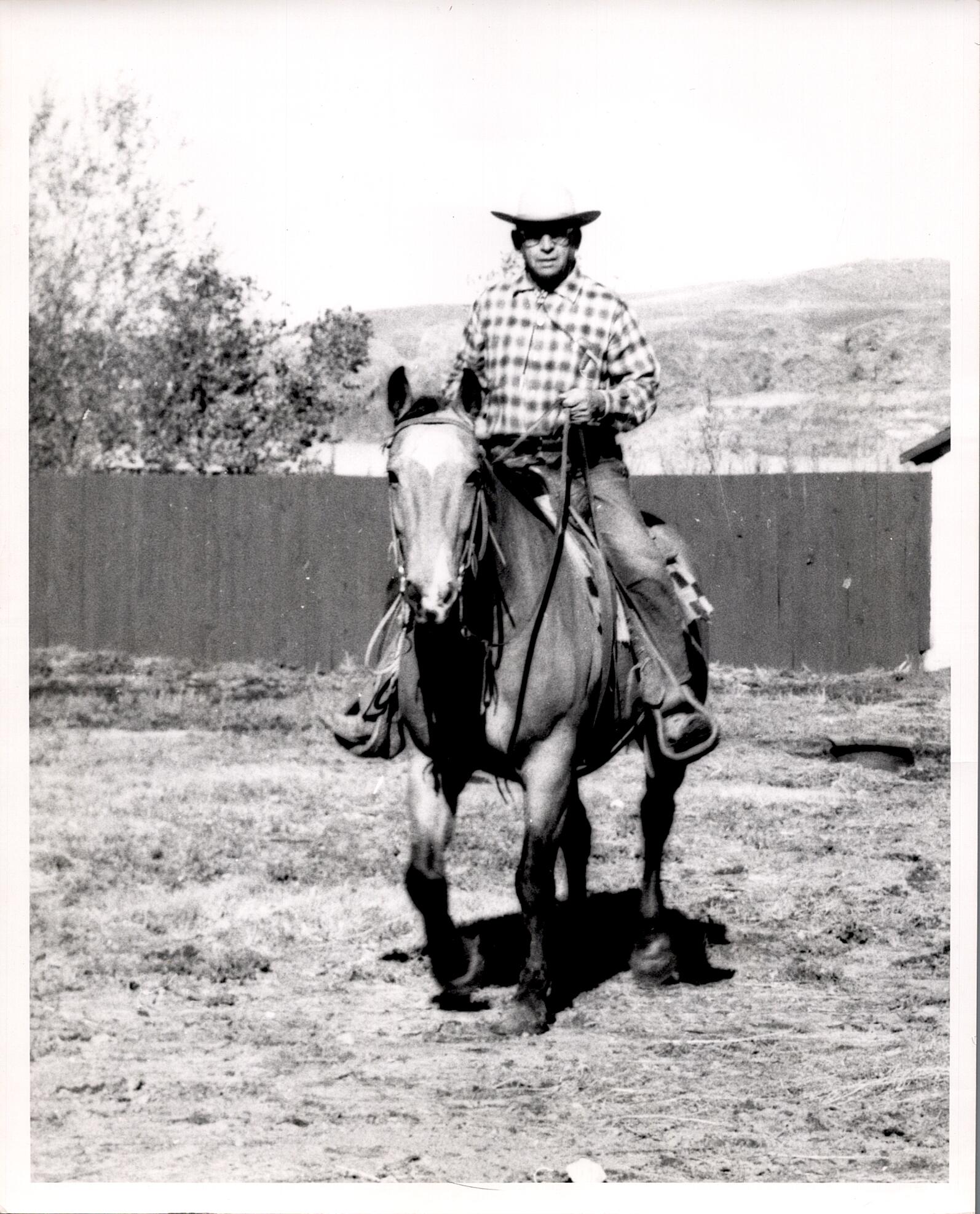
Claude Lamoureaux, 1893–1973, Sicangu Lakota, rancher.
Based on the Fort Laramie Treaty of 1868, the lands of western South Dakota belonged to the Lakota people. But after decades of conflict, and without tribal consent, the United States government had confined them to one of five much smaller reservations in western South Dakota. The Sicangu Lakota, the tribe my grandfather belonged to, were given the Rosebud Reservation, which consisted of nearly 3.2 million acres. But in 1904, the federal government opened the Rosebud for homesteading to non-Indians.
In 1908, over 100,000 homesteaders entered the lottery land drawings for what was referred to as “surplus land” on the Rosebud Reservation. This dwarfed the Lakota population and created a patchwork quilt of land ownership that had two dramatic impacts: It diminished the community and cultural aspect of the Indigenous population and required the plowing of the prairie as part of the homestead contract.
Today, the Rosebud Reservation is less than 1 million acres.
The agricultural practices that had been developed and become popular in the eastern landscapes of the United States had a dramatically different impact on lands west of the 100th Meridian. For example, annually plowing, discing, harrowing, and then planting and cultivating crops in the semiarid landscapes of the Rosebud Reservation pulverized its fragile soils and resulted in dramatic wind and water erosion events, culminating, of course, in a decade known as the “Dirty Thirties”—and ultimately with the failure and abandonment of the homesteads they were intended to support.
Exact numbers for different regions are impossible to determine, but estimates of homestead failure range from 60 to 90 percent.

While the human cost of these failures has been vividly described in history and literature, as in John Steinbeck’s The Grapes of Wrath, the environmental damage, from the Canadian border to the Rio Grande, was incalculable. Perhaps the best evidence of the collective damage to the western landscapes by homesteading farming practices was the response by the U.S. Department of Agriculture in creating the Soil Conservation Service in 1935.
When the homesteaders on the Rosebud Reservation failed during the Dust Bowl, they left the land abandoned, scarred, and unproductive. Even a decade later, my grandfather found the old fields that he bought for taxes, so to speak, covered with weeds and annual grasses. He used to say that weeds were Mother Nature’s way of covering her nakedness.
Without understanding the modern concepts of ecological succession, he called those fields “go back”—meaning to him that they were trying to go back to their natural condition. As I reflect on that, I’m left wondering where that understanding of the power of succession, of Mother Nature’s power to reclaim herself, came from.
He also knew that planting grasses would hurry the healing, and he worked with the Soil Conservation Service, which is now the Natural Resources Conservation Service. He planted hundreds of acres of scarred and blowing land back to introduced and native grasses, way back in the 1940s and ’50s.
He planted alfalfa with cool-season grasses because he knew it was a natural fertilizer for hay ground, like he knew that purple prairie clover was a natural legume in grasslands. He knew the pastures needed to be properly stocked, so he was careful to put just the right number of cattle in each one.
Beavers had been eliminated from the landscape a century earlier by fur trappers—some of them my ancestors—and he understood that by building a series of small dams on Antelope Creek, he could raise the water table of the entire valley, increase its productivity, and provide water for livestock and wildlife. An interesting phenomenon occurred after that: The beavers came back.
My grandpa didn’t use fancy words when he talked about conservation and stewardship. He was pragmatic, blunt, usually quiet. He didn’t mention his Lakota heritage as part of his values, but upon reflection, they were on clear display. His principles and practices are timeless and elegant. He loved the treeless prairie and taught me to love it.
One year, he won a small award from the Todd County Conservation District. He was so proud of it, and I was proud of him. My lifetime commitment to conservation was inspired by my grandfather and then solidified by education at South Dakota State University.
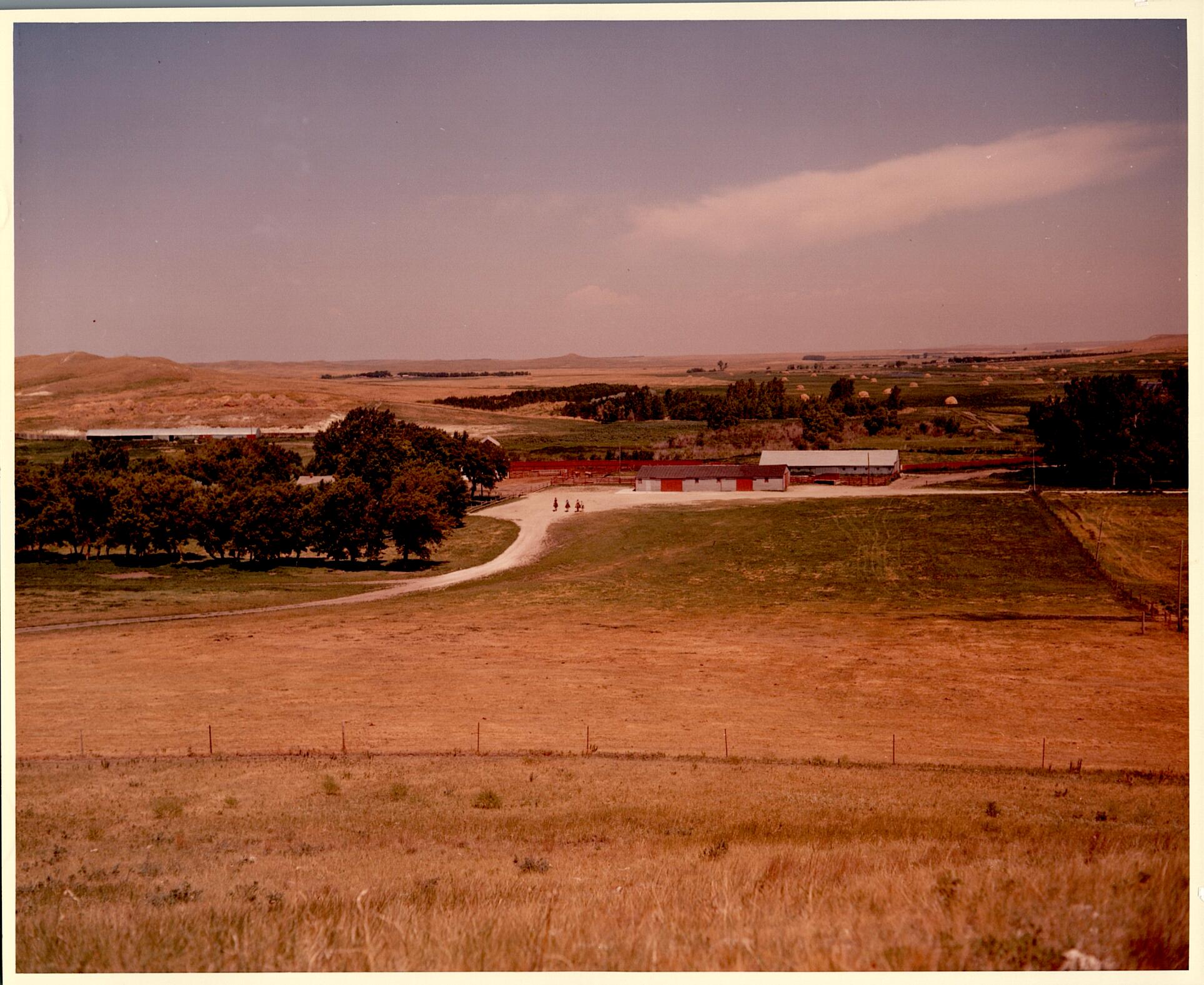
L7 Ranch headquarters, 1960.
From earning my undergraduate degree in biological sciences way back in 1975 to securing a master’s and then a doctorate, I’ve had many opportunities to learn more about the ecology of our great state and the grassland biome that runs from Canada all the way to northern Mexico, and from the Rockies to the Mississippi River.
Many years after that eventful spring and summer following my grandma’s death, I saw a quote by the famous conservationist Aldo Leopold that reminds me of my grandfather. Leopold said, “The land ethic simply enlarges the boundaries of the community to include soils, water, plants, and animals, or collectively: the land.”
In short, a land ethic changes the role of Homo sapiens from conqueror of the land community to a plain member and citizen of it. It implies a respect for the fellow members of the community.
Leopold also said, “Teach the student to see the land, understand what he sees, and enjoy what he understands.” In those terms, my grandfather was a successful teacher.
He was an old man when he built dams, planted grass, and stocked his pastures. He didn’t live much longer than my grandma, because he couldn’t live without her. He wasn’t around to see or personally benefit from most of the conservation work that he did. He didn’t have to take the responsibility to leave the land better than when he found it, but I am certain he believed he did. His conservation work and land stewardship were an expression of his values and ethics.
It inspired me then and still does today. I clearly remember the moment when Grandpa’s land ethic clicked with me. It was 1971, during that pivotal time I spent with Grandpa after Grandma died.
It was a spring morning following some really good rains, which aren’t frequent in Todd County. It was a picture-perfect scene, something you’d expect to see in a western movie. I was by myself, atop a horse, checking fences in an area I had ridden a hundred times before. And there it hit me, as vividly as Dorothy’s world went from black-and-white to color when she landed in the Land of Oz.

Barry Dunn and family, 1991.
We all know how South Dakota’s prairie can be that earthy amber color, a warm and sun-kissed reddish brown with golden undertones. But not that morning. Grandpa Claude’s hillsides were lit up. Wildflowers were everywhere in response to those infrequent rains, and it was amazing. But the experience was much deeper than that.
When I looked across the great expanse before me, I could see the difference in land ethics based upon land ownership. Grandpa Claude’s hills were a quilt of blossoms stitched together by sun, wind, and open sky. I didn’t even need the fences to mark the boundaries.
The lack of conservation methods and stewardship and a land ethic contrasted drastically before me. The adjacent lands next to Grandpa’s pasture were being farmed for potatoes in Todd County, believe it or not. They looked like drought-scabbed earth—patchy, uneven, gray, brown. They looked worn and diseased.
Beyond the beauty, there are important reasons why we all need those flower-covered hills. The journal Science recently reported that butterfly populations in the United States are dropping dramatically. In conservation terms, butterflies are what is known as a key species. The relative health of their population is an excellent indicator of the health of the ecosystem in which they live, and the health of all insects.
Conservation, another science journal, reports that 40 percent of all insect species in America are in a dramatic decline. Insects help pollinate crops, and they’re on the food chain for birds and other animals. They’re critically important in the loop that Leopold described, because it’s an interconnected world. Conservation ethics—or land ethics, as Leopold called them—are an important link in life’s fragile chain, whether we live in cities or in rural settings.
As I mentioned, Grandpa wasn’t much for talking, but his actions and results spoke volumes. His land ethic instilled in me a love and respect for every blade of grass, every butterfly that flutters by, and even a bird’s nest where we don’t want it. He’s the reason I brush worms back into the dirt from the sidewalk, why I pick up litter, why I recycle everything I possibly can.
My question for you today is: Will our grandchildren or great-grandchildren have the same opportunities?
Will they experience the beauty of a swallowtail butterfly in its natural environment, or just view them in a museum of natural history or butterfly house? Will they hear a meadowlark sing or marvel at a red-tailed hawk on the hunt flying low across the prairie? I’m concerned that they will not.

Over the last several decades, native grasslands in South Dakota and the entire grassland biome that I described earlier have dramatically declined in total acres, and with it, biodiversity, whose value we can’t possibly measure. Fortunately, we know what to do. We know the basics of ecology. We know the importance of soil health. We know the principles of good range management. We know that with the right tillage systems, we wouldn’t have dust storms. We know that conservation pays. We know what to do.
What we need are ethics. We need core values that reflect a love for the land on which we live and from which we receive our sustenance. But can we muster the common sense and selfless spirit of our grandparents to do that? I’m not sure.
I think we need to commit again, every day, individually and collectively, to have a land ethic that expresses our care and compassion and our responsibility for the land.
I’ll leave you with another quote from Theodore Roosevelt, one of my favorite presidents.
“Here is your country,” he said. “Cherish these natural wonders, cherish the natural resources, cherish the history and romance as a sacred heritage, for your children and your children’s children.”
Reprinted with permission of the author and South Dakota Searchlight (southdakotasearchlight.com).
From our January 2026 issue.
PHOTOGRAPHY (All images): Courtesy Barry Dunn.