



In northwest Montana, the Confederated Salish and Kootenai Tribes reclaim the Bison Range, restoring balance to a landscape and a story nearly lost to history.
The Mission Mountains loom ahead of me, slowly turning from black to gray as the sun rouses to life behind them. Round at the top and gently sloped, the peaks look like giant fists with the knuckles lined up against each other. They run north and south for as far as I can see as I stand on a gravel road inside The Bison Range in the Flathead Reservation in northwest Montana.
Mission Creek runs toward me, maybe 20 feet wide, perpendicular to the mountains, slashing through a grassy field at a speed out of sync with the otherwise peaceful surroundings. Nothing I have seen this morning—not the bison, not the elk, not the deer, and certainly not me—has moved with anything resembling that urgency.
I lean against my rental car. My breath turns white against the morning chill. Movement on the other side of the creek grabs my attention. A deer snatches a bite of grass, brown in the early fall, then disappears into a copse of trees.
My eyes trace the creek back toward the mountains as the dull dawn starts to sparkle. I imagine the creek is a rope and it is moving fast so it can pull the sun up, up, up. Though it is still behind the mountains, the sun burns lasers through the mist as it rises, and those lasers paint the sky. Pink and orange and red and purple bleed into each other as the morning fully shakes off its sleep. Finally the sun crests the mountains, bathing Mission Valley in white light.
To look up, to look out, to look around, is to be mesmerized, amazed, grateful to be standing right there right then.
Then I look right in front of me, and I’m mesmerized, amazed, grateful all over again.
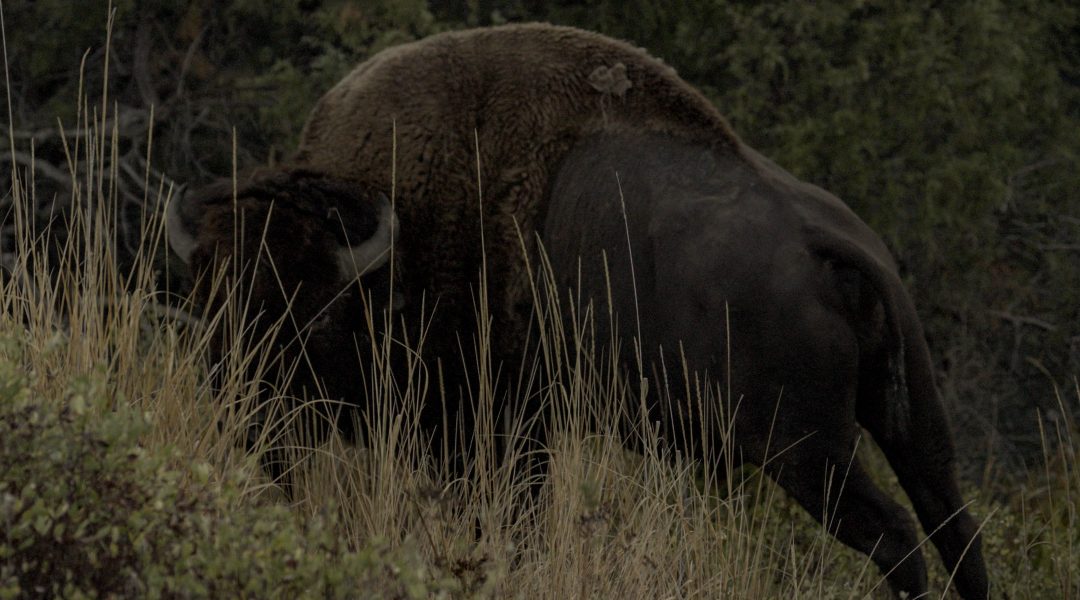
A few feet off the road, an absolutely massive, mystical, majestic bison chomps away at grass. He stands six feet tall and weighs 2,000 pounds. His head looks like it’s covered in brown shag carpet; the rest of him is smooth. I would think someone shaved him if I didn’t know better.
He seems oblivious to what is happening around him; he cares not for my breath-holding awe, the clicks of a photographer’s camera, the sun warming his coat or the muscular mountains that stand watch over him.
Awesome doesn’t impress awesome, I guess.
This creature—so big, so old, so triumphant in survival—defies belief. So does the story that brought him here, to the side of this gravel road, in a Bison Range being run by the Confederation Salish and Kootenai Tribes (CSKT). It is one of incredible perseverance and resilience.
“Bison remind me so much of Native people because of what all we’ve been through,” says Stephanie Gillin, a wildlife biologist who works as an information and education program manager for CSKT’s Division of Fish, Wildlife, Recreation and Conservation. “They’ve battled brucellosis. We’ve battled smallpox. But we’re still here. They’ve almost become extinct. We’ve almost become extinct. But we’re still here.”
View this post on Instagram
With The Bison Range finally again under tribal control more than a century after the government illegally seized the land, there is a new story to tell about what bison and Native people have been through together. And Gillin is eager to tell it.
The history of bison in the west is tragic. Numbering as high as 60 million according to some estimates, they sustained Native Americans for thousands of years, and then European settlers arrived and all but wiped them out.
The story of The Bison Range sits within that broader history. The range traces its long and complicated history to a member of the Qlispe tribe named Little Falcon Robe, who in the 1870s asked for and received permission from tribal leaders to bring orphaned calves to the Flathead Indian Reservation.
By the end of the 1800s, those calves had grown into the largest herd of plains bison in the world. But the federal government took the land in the early 1900s, and the tribes spent the next 100-plus years trying to regain control of the range. That finally happened in 2022.
That marked the beginning of a new story and with it a new opportunity to tell it in a new way. Like the sun bursting over the mountains, the tribes relish the chance to use the range to pull their story about bison and survival up, up, up, out of darkness. “This is our opportunity to have our history told by us,” Gillin says.
As Gillin walks through the range and a museum at the welcome center, she recounts that history. The overall theme is “reciprocity,” a word you don’t hear often related to conservation. But it is crucial to understanding why The Bison Range is so important to CSKT tribes and their members.
View this post on Instagram
Reciprocity, in this sense, is like letting your elderly parents move in. They took care of you, now you’re taking care of them. Bison provided for the tribes that comprise the CSKT for as long as the tribes have existed, and now the tribes are returning the favor by creating circumstances to allow the bison to thrive again on the plains.
“That’s always been who we are as a people,” says Rich Janssen Jr., head of the CSKT’s Department of Natural Resources. “It’s been passed down from generation to generation.”
The CSKT is made up of three tribes, the Se̓liš, Qlispe and Ksanka (also known as the Salish, Pend d’Oreille, and Kootenai). For thousands of years before settlers arrived, they used bison for food and clothing. They turned horns into spoons and toys, bones into arrows and tools and bladders into water bottles, and much more. Even bison dung – massive Frisbee-shaped scat that looks like art suitable to be hung on a rustic coffeehouse wall – served as fire starter once it dried out enough.
“It wasn’t just meat, and, gosh knows, it’s a lot of meat,” says Tony Incashola Jr., CSKT’s executive director of Tribal Resource Management, “but everything in that bison was used and had a purpose.”
Bison didn’t just change Native American’s lives. They changed the very landscape they lived on. Biologists call bison a “keystone species” because of their enormous impact on their environment.
They eat unevenly as they move across the plain, cleaning their plates here, leaving a ton of leftovers there, creating a mosaic of living grass, trampled grass and eaten grass. Deer, pronghorn and elk feed on what the bison leaves behind.

When bison “wallow” on the ground—roll around to get rid of insects and excess fur—they create holes 10 to 15 feet across and four to 10 inches deep. In the spring, those holes fill with water, in which grow wildflowers otherwise absent from the plain. When those holes are dry, still more unique vegetation grows in the indentation. The more diverse plant life leads to more diverse animal life, too.
The Bison Range has been called “the crown jewel” of The Flathead Indian Reservation’s 1.3 million acres, and when I relay that description to Gillin, a broad smile crosses her face.
The range has two roads, foot trails, a kiosk at the gate and a welcome center. But make no mistake, this place is wild, like, wilderness, like, the rules say stay within touching distance of your car and you’d be a fool to disobey that because of the bison and because apex predators including grizzly bears, mountain lions and wolves live within the range’s 18,766 acres.
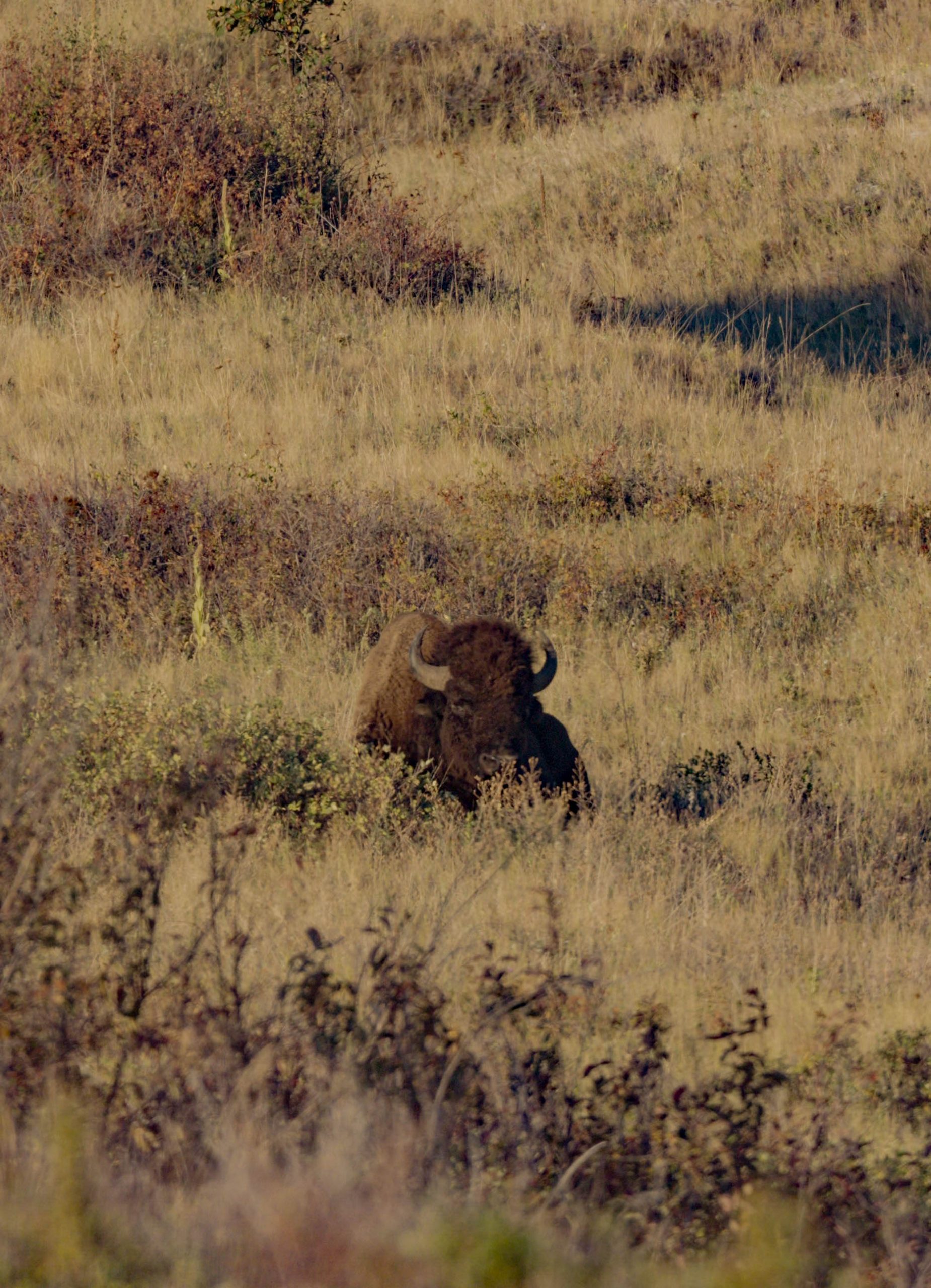
I saw roughly 100 bison (out of 350), a handful of elk, a bunch of deer and three pronghorns, most of them from far off and one (the bison) from very close. In the time I spent gaping at him, he barely moved. Wildlife biologists say he’ll eat nine to 11 hours a day. He can also run 35 miles per hour, jump high fences and turn on a dime.
View this post on Instagram
I visited during the elk rut, when they bugle in the morning and at night, nature’s epic pickup line. One elk, framed by trees on either side, bluing sky behind him, misty creek in front of him, stood atop a ridge, and turned his massive head and antlers toward me as if posing for the cover of Elk Illustrated.
A pronghorn sprinted left to right across my line of vision, showing off the fact he is the fastest runner on the continent. He stopped alongside another pronghorn, then sprinted back toward a third. It looked like a communication ritual, though what they had to say to each other I have no idea, nor do I know, now that I think of it, if he was even a he.
And it’s not just the animals who are wild. So is the very ground they run on. The soil has never been dug up and replanted, so everything that grows there is native, which is increasingly uncommon, even in rural northwest Montana, Gillin says.
The lack of cell phone coverage, the native plants and animals, the mountains, the creek, the bisons’ imprint on the landscape … all of that contributes to the range having an unmistakable sense of place—undiluted, unmanipulated, natural, bucolic, where the goal is to “let bison be bison,” as Gillin put it.
Janssen loves the range for “what it brings to our soul as a people … being able to drive through and watch the mighty bison as they congregate in their groups or even the mighty bull who might not want to be bothered.”
That creates a connection between the past and the present. Native Americans have watched bison in much the same way for centuries. Back then, bison took care of them. Now, they are taking care of the bison. “It’s a prehistoric animal that survived hundreds of thousands of years, even the onslaught of potentially being eradicated from this earth,” Janssen says.
You can’t help but be absorbed by that history when you’re there. It feels old. “Just being here brings you joy,” Gillin says. “The beauty, the natural feel about it—no matter how you feel, the hustle and bustle of work, you come here, and it’s calming.”
Gillin exults in the range’s essential otherness, especially in the spring, when 60 to 70 newborn calves dot the landscape. There’s a story she loves to tell about watching a family of bison walking. An older female lagged behind her kids, maybe her grandkids, too.
The younger ones congregated on a hillside. The older female was stuck, confused when the gravel road she had been following turned to grass. The calves on the hillside grunted as if shouting instructions to her. She couldn’t get from where she was to where she wanted to go, where she belonged.
It dawned on Gillin what was happening: The older female was blind, and the young ones were trying to lead her to safety. Finally, as if pulled by an unseen rope out of darkness and into light, she joined them on the hillside, up, up, up.
To learn more, go to visitmt.com