



The occasional surprising discovery of old reels or fragments of lost westerns lightens the loss of countless trashed and disintegrating films.
Last November, film historians were happily surprised to learn of the discovery of an extant print of The Scarlet Drop, a 1918 western directed by John Ford that has not been seen in its entirety since its original release. Perhaps the most unusual aspect of this news was the location of the print’s discovery: a warehouse in Santiago, Chile, that was scheduled to be demolished the day after the property’s owner discovered a collection of film canisters that belonged to a local collector who died 40 years earlier. Previously, only about 25 minutes of the 50-minute The Scarlet Drop was known to exist.
“The film is 106 years old. It was stored in conditions we don’t know about,” said Jaime Cordova, the director of Chile’s Valparaiso Recovered Film Festival and a professor at the University of Vina del Mar, in a Chilean media interview. “I think there are films that decide to live. I once found a Richard III starring Laurence Olivier; all the reels had vinegar disease — they had to throw it all away. That one is from 1955, this one from 1918. And this has survived much better. It decided to make itself known, which I find miraculous.” Steve Latshaw, historian and archivist at the Museum of Western Film History in Lone Pine, California, considered the long-lost full version of The Scarlet Drop to be a major missing piece in the western genre.
“It’s a very important film,” he explained. “John Ford cut his eyeteeth making what at the time were considered just straight westerns with Harry Carey at Universal. And that jump started his directing career. Harry Carey was very important because he was one of the few cowboy actors at the time whose acting style was very natural and realistic. And Harry Carey had a major influence on John Wayne in terms of performing style.”
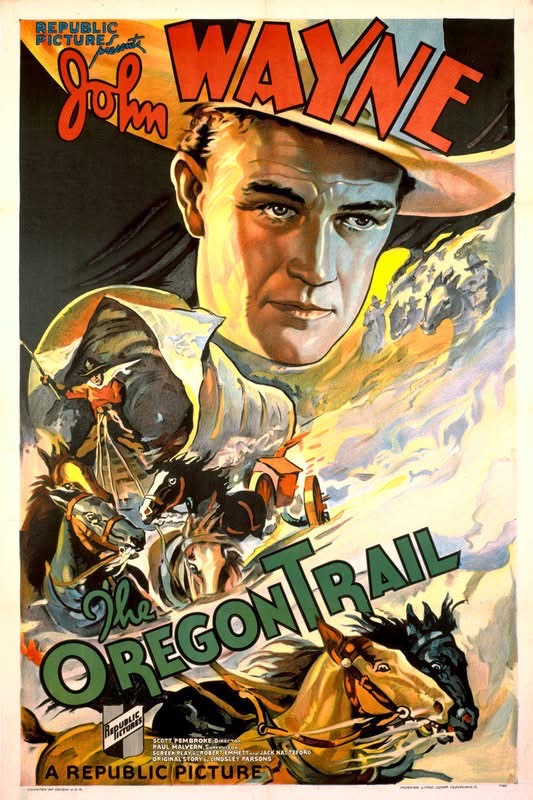
Republic Pictures poster art for The Oregon Trail.
Latshaw pointed out that if the print of The Scarlet Drop had not been picked up before the Chilean warehouse was demolished, it would have remained part of the vast realm of films that disappeared forever. “In terms of lost films, these are pretty scary numbers,” Latshaw continued. “The Martin Scorsese Film Foundation has said that more than 90 percent of films released prior to 1929 are lost. And according to the Library of Congress, 75 percent of all silent films have been lost.”
How did so many films vanish? Edward Lorusso, a film historian and preservationist who is currently working on a digital restoration of the 1928 western Court Martial, noted that many of Hollywood’s pioneers did not see their output as being worthy of keeping.
“If you go back to the teens and in the early ’20s, a lot of times the studios purposely destroyed the films because once they were released and they had made their money, they didn’t see that there was any value in them,” he said. “And so, the nitrate film was melted to retrieve the silver content. This also happened in the early talking films period when, if a studio was making a talkie version of a film, they would purposely destroy the silent film version of it — which seems completely ludicrous, but I guess it was seen as being an inferior thing at that point and there was little regard for silent films.”
Nitrate film — formally known as nitrocellulose — was developed by Eastman Kodak in 1889 to enable the projection of moving images on a screen. When stored properly, nitrate film could have a long shelf life. But nitrate film came with a big problem: Improperly stored, it would either deteriorate beyond repair, or it could prove highly flammable. Nitrate-film fires can be traced back to 1897, and the earliest fires at film storage facilities were recorded in 1914.
“Nitrate film was stored badly, basically just shoved in a warehouse,” Lorusso lamented. “Over and over and over again, we’ve had these vault fires that destroyed thousands of films.”
But this raises the question of why some films were able to survive while others disappeared. There is a disproportionately high number of films released between 1927 and 1929 that are lost — this could be blamed on the tumult in Hollywood when film production transitioned from silent films to talkies. Yet The Great Train Robbery, the groundbreaking western released in 1903, has always been part of the movie viewing experience.
“It’s just a fluke,” said Frank Thompson, film historian whose 1996 book Lost Films: Important Movies That Disappearedwas instrumental in highlighting the disappearance of major productions. “The Great Train Robbery was one of those films that, for whatever reason, was still released after its original run of the theaters. I remember buying an 8-millimeter print of it in 1974 and it had the original color tinting — and I was just blown away by it. But how things survive is just a fluke. Film history is just a series of accidents, in some ways — what survives, what’s lost, it sometimes just makes no sense.”
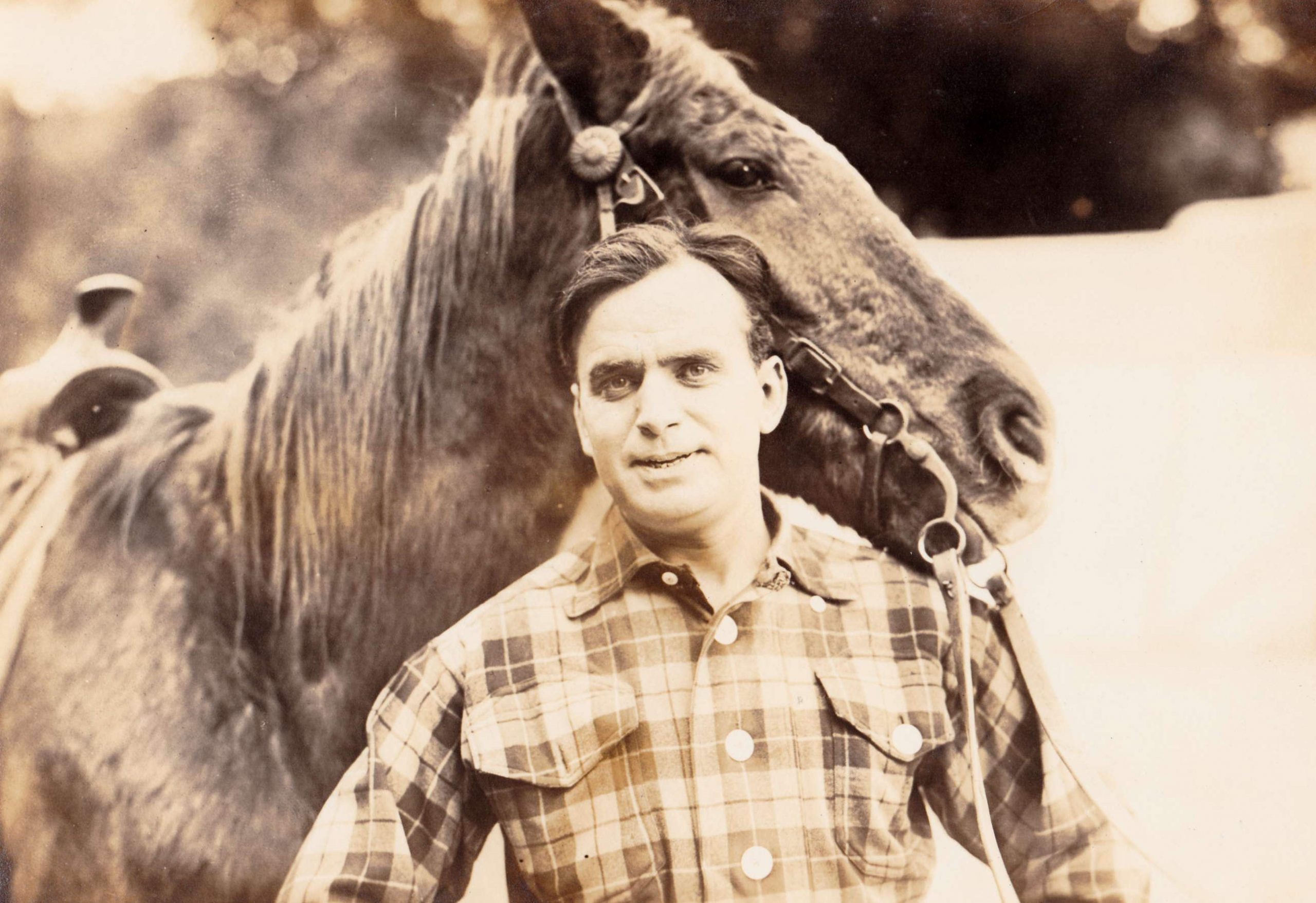
Douglas Fairbanks in the 1919 The Knickerbocker Buckaroo.
The Appeal Of Westerns
Thompson observed that audiences during the silent film era were strongly attracted to westerns for glorifying rather than documenting the cowboy way of life. “There was already a tendency for the movies to turn the West into something slightly different than it really was,” he said. “The non-Western public knew this was the West of the movies rather than the West of reality.”
Two now-lost westerns called attention to the divides between the Western lifestyle and the more cosmopolitan urban centers east of the Mississippi River: The Knickerbocker Buckaroo (1919) found Douglas Fairbanks as a wealthy New Yorker who heads to Texas and is mistaken for a Mexican bandit, and Roped (1919), another John Ford-directed film starred Harry Carey as a ranch owner who goes to New York City to find a wife who will join him out West.
The Knickerbocker Buckaroo was significant in Fairbanks’ career for being his last film under his contract at Paramount Pictures before he co-founded United Artists with Mary Pickford, Charlie Chaplin, and D.W. Griffith. It was also his last western before embarking on more ambitious and expensive swashbuckling period pieces that he produced at United Artists, including Robin Hood (1922) and The Thief of Bagdad (1924). Roped was among a series of 25 films made by Ford and Carey, of which nearly all are either completely lost or survive only in fragments. Thompson noted that Ropedstood out from the other Ford-Carey collaborations for taking place largely in New York and for having Carey’s on-screen character elevated to a millionaire rancher rather than “just a saddle tramp in his other pictures.”
Another long-lost western, 1918’s Riddle Gawne, was notable as both a starring vehicle for William S. Hart, an iconic cowboy star of the era, as well as being a stepping stone for an actor who was never associated with the genre. “The reason why that film is so sought-after is because it presents a rare western role for Lon Chaney,” said Geno Cuddy, a film historian who hosts and produces the B-western retrospective series Sunset Cuddy’s Six-Gun Theatre on YouTube. “Lon Chaney gets to battle it out with William S. Hart. Chaney had left Universal Pictures after a contract dispute, and it was that film that gave Chaney the exposure that later led to his greater fame.”
Cuddy said only two reels of Riddle Gawne survive in the collection of the Library of Congress, but, he added, this footage — along with other surviving William S. Hart titles — has never been made available for online or home entertainment viewing. And while these films aren’t lost to the ages, they are mostly lost to the general public that cannot access them. “There are still some films that are available, but they’re locked up in film archives, and the only way you can get those is if you put in a direct order, go to the archives, and try to organize a screening,” he said. “The more William S. Hart films that are made available, the better he would be known.”
Oddly, some western films that no longer exist in their complete form managed to escape total oblivion by having bits and pieces of footage used in later films. One such title was the 1926 Universal Pictures epic The Flaming Frontier, which recreated the Battle of the Little Bighorn. Footage of Indian attacks from this silent film was recycled by the studio into its 1930 serial The Indians Are Coming, which dramatized a wagon train’s difficult journey across the West. And the 1931 Warner Bros’ non-musical, black-and-white western Stranger in Town reused some wagon train footage from the studio’s long-lost 1930 Technicolor western musical Song of the West.
According to Thompson, it was not unusual for silent westerns to have some of their footage inserted into sound films. “It was very common, especially in the early 1930s when the technique did not look out of place. There was a guy named Anthony J. Xydias who produced silent historical epics — well, epics is pushing it, but he meant for them to be epics — and his aim was to remake them all in the 1930s. The only one that he remade was Heroes of the Alamo in 1937, but it’s filled with stock footage of his 1926 film Davy Crockett and the Fall of the Alamo. You also see that in the serials a lot — it made sense if there was footage of a big battle scene or some kind of epic moment, it would be a lot easier just to clip it and put it into your serial than to try to refilm it.”
The Lost Detour For The Oregon Trail
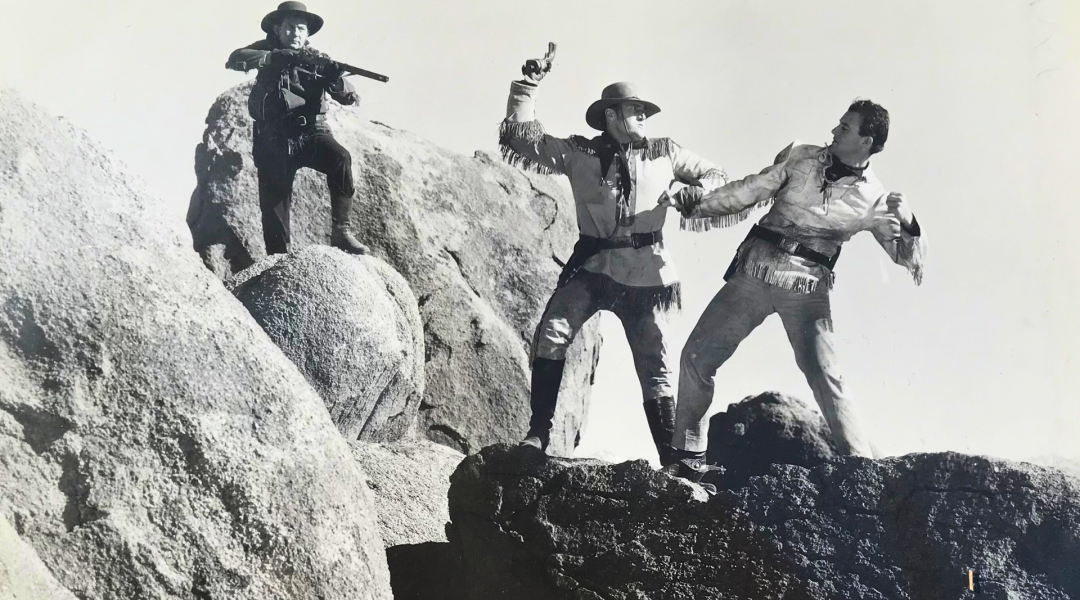
While many people assume that only silent films are lost, a considerable quantity of sound films have also vanished. Among the lost westerns of the sound era, perhaps the most sought after is the 1936 Republic Pictures feature The Oregon Trail, which has the distinction of being the only film starring John Wayne that no longer exists.
The Oregon Trail cast Wayne as an Army captain in search of his missing father. According to film historian James L. Neibaur, author of The John Wayne B-Westerns: 1932 – 1939, the film came at a time when Wayne was on the cusp of superstardom. “He was doing the B-westerns, and that’s where he thought he was going to end up staying,” Neibaur said. “It was towards the end of his tenure in B-westerns — he did Stagecoach about three years later, and that just took off.”
While many low-budget westerns created by tiny independent companies in the sound era later became lost when their producers went out of business, Neibaur acknowledged the loss of The Oregon Trail was out of the ordinary for an established studio during this point in time. “This was an aberration because Republic has a really good track record for its prints existing,” Neibaur said. “I think the reason for that is because they were so cheaply made and they featured people that were later to become stars. So they figured, hey, we can make money off these 1935 – 36 westerns, because John Wayne’s a big star now. They threw them out in the neighborhood theaters as second features, and a lot of people went thinking, Oh, John Wayne — OK, let’s go. And those low-budget studios were the first to sell their movies to television in like the late 1940s because big studios like MGM, Paramount, and Warner Bros. were thinking, Well, wait a minute — TV is going to take audiences away from us. They can just stay at home. So, they were reticent about initially selling their films to television. But Republic had no problem with that.”
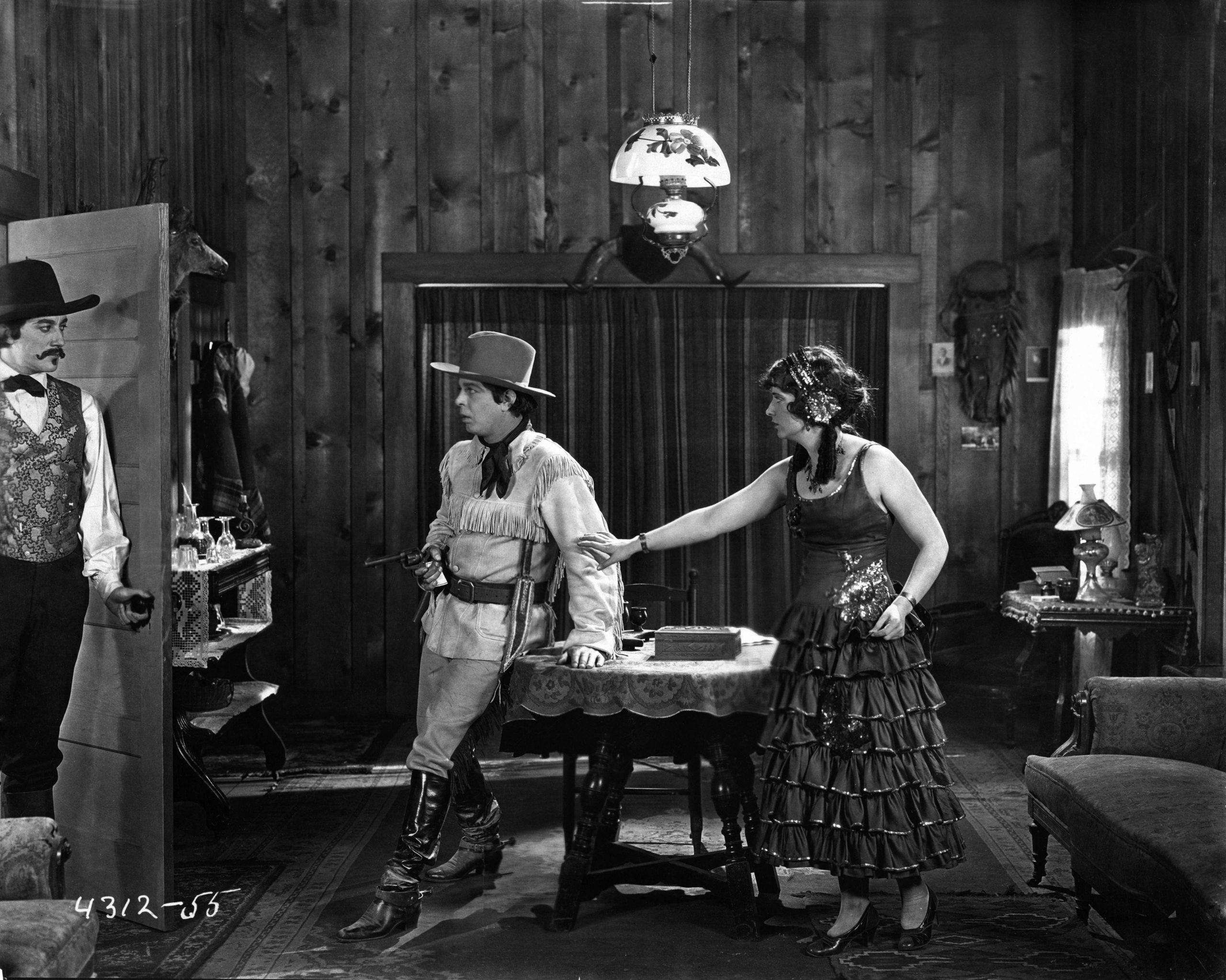
Ward Crane, Hoot Gibson, and Kathleen Key in The Flaming Frontier.
Ironically, The Oregon Trail was the rare Republic-produced John Wayne western that was not rereleased after his star ascended following Stagecoach. And it was only in the mid-1950s, when the film was being prepared for television syndication, that the studio discovered half of the nitrate materials in its possession disintegrated — the surviving half, incredibly, was junked by the studio.
While Wayne never held great emotions for The Oregon Trail — Neibaur said it was “just one of his many B-westerns which he spoke of fairly dismissively” — film historians feel otherwise. A worldwide search for The Oregon Trail has yet to turn up a print.
However, many westerns that were long lost in their home country later emerged in film archives overseas — a collection of 20 silent Tom Mix westerns at the Národní Filmový Archiv turned up in the Czech Republic, while Russia’s Gosofilmofond contained the last known prints of 1919’s Valley of the Giants starring Wallace Reid and the 1923 westerns Call of the Canyon starring Richard Dix and Canyon of the Fools starring Harry Carey. More recently, lost films unexpectedly turned up in such bizarre places as a yard sale, an eBay auction, and in the case of The Scarlet Drop, a Chilean warehouse.
Neibaur holds out hope that many films considered to be irretrievably lost might turn up when and where they are least expected. “You think, Ah, we’ll never see that, and then suddenly, somebody finds some print in New Zealand in a cave or something bizarre,” he said. “It has happened with the various films. It’s never impossible.”
As for the return of The Scarlet Drop, the film has been digitized, and the unrestored version was screened at a Chilean film festival. The film awaits a full restoration and rerelease. Stay tuned!
PHOTOGRAPHY (header): John Wayne (right) fights off a pair of villains in The Oregon Trail (1936).
From our October 2025 issue.