



Native music's new sound
From the pop R&B of Jana Mashonee to the country-folk of the Crow Girls to the power punk of Blackfire, American Indian music goes far beyond traditional.
Web Exclusive
From the pop R&B of Jana Mashonee to the country-folk of the Crow Girls to the power punk of Blackfire, American Indian music goes far beyond traditional. Here we talk with Karen Donaldson Shepherd of the Crow Girls and Mashonee about their music.
• Jump to Crow Girls interview

Jana Mashonee
Jana Mashonee
A rising star from North Carolina's Lumbee Nation
• Artist site
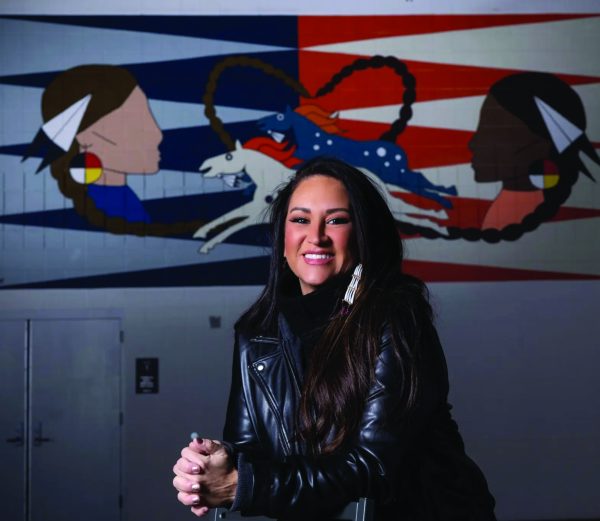
Jana Mashonee is the pride of the Lumbee Nation. A talented singer- songwriter, she flawlessly integrates Native American music with world, R&B, soul, and pop. She also personifies an ancient Lumbee proverb: "She walks in beauty, in two worlds."
A graduate of Davidson College in North Carolina, Mashonee has been nominated for a Grammy and has won seven Nammys, including Best Female Artist of the Year and, most recently, Best Short Form Music Video for her song "The Enlightened Time" (see the video below). She has twice had the honor of headlining at the American Indian Presidential Inaugural Ball, and in 2001 she performed for more than 70,000 at the National Scout Jamboree.
After an uneventful five years signed to Curb Records, where she inexplicably recorded five singles but no full-length records, Mashonee refocused her life and musical career. She moved to New York City and recorded four diverse, well-received albums: Flash of a Firefly, American Indian Christmas, the Grammy-nominated American Indian Story, and her latest release, the R&B-influenced New Moon Born.
Now she seems poised to garner the fame her music deserves. We talked with Mashonee about being an "urban Indian," sharing Native healing music, and covering Sam Cooke.
Cowboys & Indians: You've described yourself as an "urban Indian." What does that mean?
Jana Mashonee: From a cultural perspective, I describe myself as an "urban Indian" because I am a Native American person who "walks in both worlds" — an expression that refers to Natives who live their lives in both the traditional and contemporary/modern worlds. Natives living on or off the reservation describe themselves this way. More than 50 percent of Natives today now live off the reservation, and many more are [using this] coined term to distinguish themselves as living in an urbanized setting. From a musical perspective, my music is not just traditional Native American powwow drums and flute but is a mixture of Native American and contemporary instrumentation that is a unique blend of many cultures.
C&I: Tell us about your splendid new album, New Moon Born.
Mashonee: New Moon Born is about rebirth and renewal. It is a metaphor about the cycle of life, a traditional Native theme. This album represents a new phase in my life and an exciting new direction for me. It is my most personal record to date, as it reflects many aspects of my life and what I've seen and experienced of other people's lives. I believe that there will be many people who can relate to what I wrote on this record, and I hope that it touches their souls in some positive way.
C&I: As you diversify your music toward a more pop-oriented sound, how important to you is it to continue the expression of your heritage?
Mashonee: I call myself a Native American musician because I am a musician who happens to be Native American. My music is not limited to one specific genre, which I pride myself in, but it also represents a challenge, because people want to put you into a specific category. I always carry my heritage proudly on my sleeve and will continue to represent my people in the most positive way I know how — through my words, through my music, and from my heart.
C&I: You've played all over the world. Do you have a favorite venue in the western states?
Mashonee: It's hard to pick just one place that I've played that is amazing, because I've been to many places across this country and overseas where the people have been so kind and special that it's hard to pick a favorite. I do have wonderful fans, though, in the Southwest, and I always love playing in New Mexico and Arizona especially, not only because of the beautiful scenery, but the people are so wonderful.
C&I: Besides working on your own music, you work with Native children to encourage their musical abilities.
Mashonee: Yes, through my nonprofit organization, Jana's Kids, which focuses on encouraging Native youth to believe in themselves and to achieve their goals through the positive motivations of mentoring and music. I've been blessed to be able to travel across the country to many reservations to talk to youth and address issues of cultural identity and education. From this, I've been able to raise enough money to offer scholarships to deserving Native youth in the artistic, academic, and athletic fields — my "Triple A" scholarships. I gave my first scholarship in 2006, and I hope to continue having more Natives apply so there won't be any excuse for not getting an education! I have applications available on my website at janamashonee.com.
C&I: What is "Native American healing music," and why is there a controversy about sharing it with non-Native peoples?
Mashonee: I believe in the Lakota saying, "Mitakuye oyasin": We are all related. I don't adhere to any notion of the exclusivity of music or religion. I believe that music is a universal language and should be shared and enjoyed by everyone and anyone. There are some people who feel that certain sacred music should only be heard/sung in particular settings and not "exploited" to the masses, but I feel that beauty should never be hidden, as the beauty of these sacred songs should be expressed to all who want to listen.
C&I: Your breathtaking rendition of Sam Cooke's "A Change Is Gonna Come" seemed almost sacred when you sang it at the 2009 American Indian Presidential Inaugural Ball.
Mashonee: It was simply amazing performing at the American Indian Inaugural Ball this year, not only because of the historical significance of that day but also because there was a great feeling of solidarity of the people there. "A Change Is Gonna Come" is a very special song that is symbolic of what people around the world are wanting so badly — change. It represents what my New Moon Born album is about: looking at mistakes from the past, reflecting on them, and making that change within yourself and having hope that everything will be okay with yourself and the world.

The Crow Girls
The Crow Girls
Two Cree women inject country roots with Native American soul
• Artist site
From deep in the heart of Alberta, Canada, in the city of Edmonton, come the Nammy Award-winning Crow Girls, perhaps some of the best unsigned artists making music today. Not since the days when Faith Hill was releasing independent-label records down in Texas or Ani Difranco was selling homemade CDs from the trunk of her car in Buffalo has a music act created such a buzz.
And the Crow Girls have only begun to make a name for themselves in country-roots circles. Their music bridges the singer-songwriter chasm between James Taylor and Willie Nelson with some Mary Chapin Carpenter and Indigo Girls colorings. We talked with lead songwriter Karen Donaldson Shepherd about the Crow Girls' music, being Cree, and the West.
Cowboys & Indians: Where did your band get its name?
Karen Donaldson: The name was originally going to be the Crow Babies. I found a little baby crow once and it was so cute. I like crows — the way they're so family-oriented. The name allows us to be indigenous folk but a bit of Loreena McKennitt, too.
C&I: How did you and band-mate Julie Golosky Olmsted meet?
Donaldson: Julie and I met while singing in another group about 10 years ago. We were together in that group for about two years, then decided we loved the way we came up with stuff. I particularly enjoy the way we perform onstage — I feel relaxed and totally myself when we're singing and playing together. We also share the same musical influences such as Tom Petty, Loreena McKennitt, Dolly Parton, Willie and Lobo, The Judds, and Buffy St. Marie.
C&I: Where did you first play together?
Donaldson: Our first gig as the Crow Girls was for The Institute for the Awareness of Aboriginal Women in Edmonton, Alberta. They put on a splendid conference and gala each year.
C&I: On your debut record, Where the Green Grass Grows — which won a Nammy for Best Folk Album — you recorded the Woodland Cree language song "My Love." What does that song mean to you personally?
Donaldson: Actually, I wrote it not thinking of anyone at the time. I was walking home on a particularly cold Edmonton winter night. The moon was out and the song just came right into my head. A few years later I met my husband, then thought, That one is for him. The first time I performed it, it was more Celtic in flavor. But then I asked [Cree singer] Darlene Pearl Auger if it would be okay if she translated it into the traditional Woodland Cree language. I am of Cree heritage. When we went into the studio, I thought about making it into an ethereal gypsy violin song with a strong backing rhythm. Then I asked Sue Vaartstra, my great friend and the piano player for the CD, to do some magical playing with rich, deep chords in triple time. Bill Hobson, the engineer, was also putting his two cents in and embellishing the drums [performed by Tony Olmsted]. Now Julie and I perform it just the two of us with a bit of guitar accompaniment.
C&I: How does being Native American affect you artistically?
Donaldson: I was adopted as a baby to wonderful Caucasian people, Allan and Joan Donaldson. All of my siblings are also aboriginal or métis [having one French Canadian and one American Indian parent]. I grew up in a small town called Dauphin in Manitoba in western Canada. I didn't really get into my indigenous roots until my twenties. When Julie and I began singing together, it was in an all-women aboriginal ensemble. I was able to hear really cool sounds from powwow music and traditional Native music. It was like a door opening — I just walked through and immersed myself in it. I don't necessarily write with Native themes in mind. I write the words and music together and I hear what accompanies it. Sometimes the Nativeness gets mixed up into it all, like a big pot of chili.
C&I: How do the West and Western culture influence your music?
Donaldson: My father is a huge Johnny Cash fan. My grandfather had tons of books on Native people and the frontier lifestyle that I read. We lived on a farm when I was growing up. We went to rodeos in the summer and lived in a little cabin on a lake. As a child I spent hours and hours outside riding horses. Musically, I studied classical violin, yet people were always after me to play the Charlie Daniels Band song "Devil Went Down to Georgia." Finally I took the plunge and loved playing the fiddle. I found that I love bluegrass and Western swing music. There is a groundedness and a sense of something amazing when I can stand under a huge sky with nothing around but open prairie around me.


Email
Print