





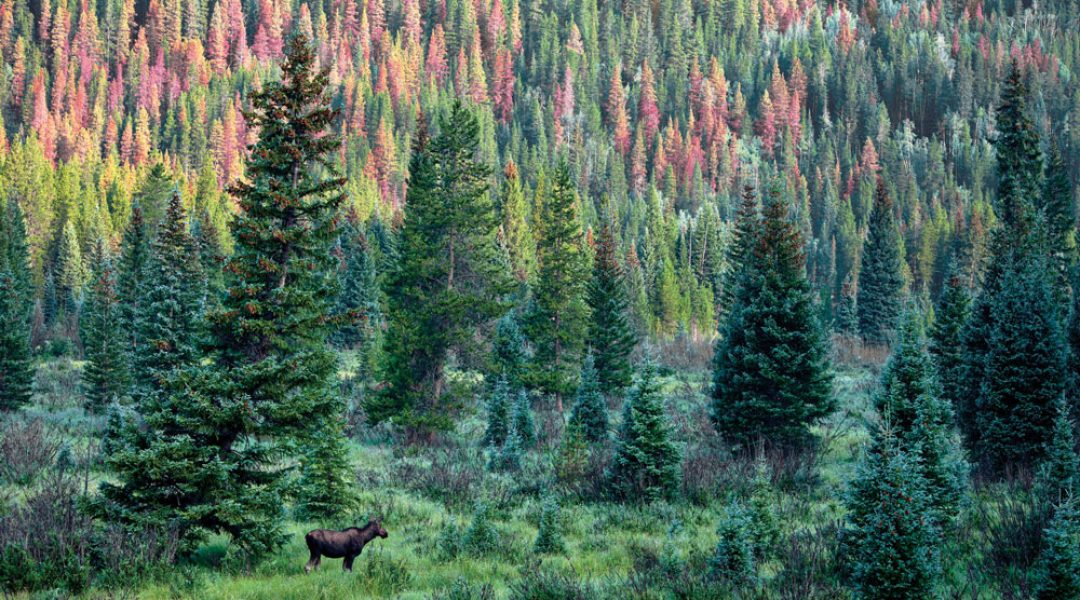
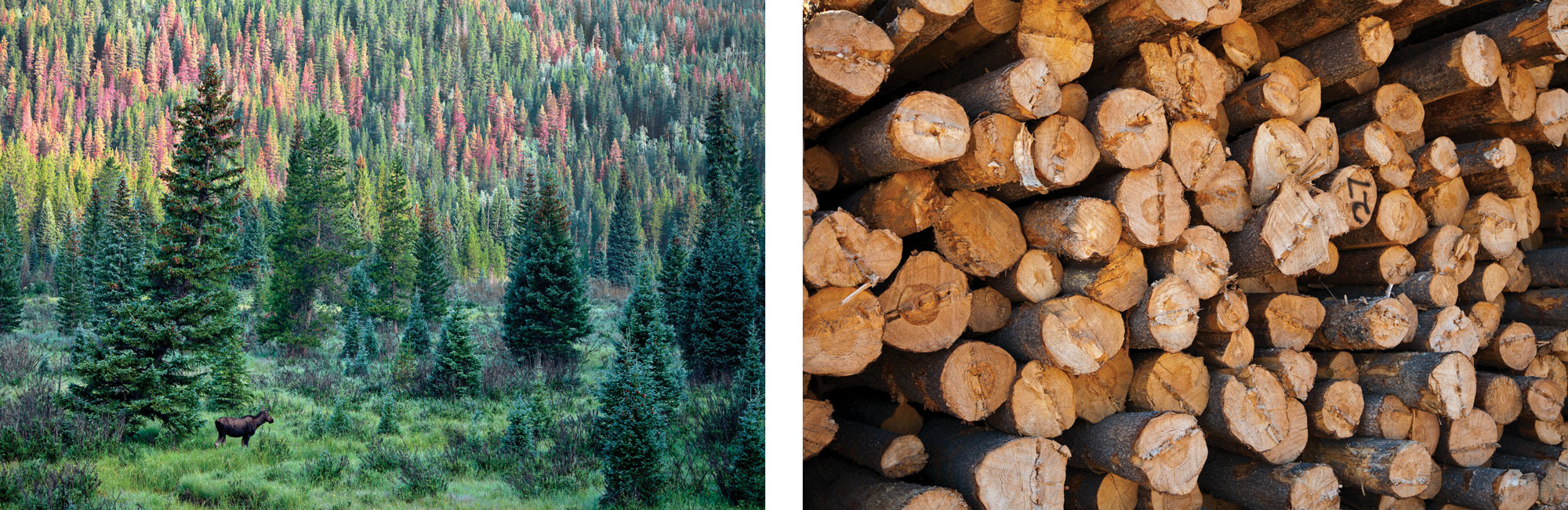
As pine beetles continue to ravage the West and the construction market continues to stall, entrepreneurs and environmentalists struggle to give new life to dead wood.
The sky was the limit in 2007. Home prices were skyrocketing. Little more than a signature harvested big loans. Everyone was spending. And on nearly 3 million acres of the Rocky Mountains, a treasure trove of virtually free “red and dead” trees inspired savvy entrepreneurs, who saw golden opportunity in the red-hued hills swollen with pine bark beetle-ravaged lodgepole pines.
For mountain-town dreamers, it was a heyday. They ordered expensive lumber-milling machines and hired lumberjacks, eagerly conjuring up money-making ideas born from the bounty in their backyards. Where the masses bemoaned the red death painting the mountainsides, the entrepreneurs saw full communities of affordable log homes, countless living rooms outfitted with gray-blue tinted woodwork, and houses heated with cheap, efficient wood pellets.
Then the sky fell. The collapse of the housing market burst the Big Beetle Kill Blitz that should have mirrored the Great Gold Rush that pioneered the West. Instead, sweeping swaths of dead trees across 4 million acres in Colorado and southern Wyoming are now dotted with at least 170,000 slash and unmerchantable piles of material. The region’s few large lumber mills battle through foreclosure to process the occasional truckload of beetle-kill timber. Policymakers proffer plans and promises, while a hardy few entrepreneurs attempt to weather the decline.
“It’s ironic, isn’t it,” says Mike Jolovich with a heavy sigh. “Such a beautiful wood.” Outside Jolovich’s office at his Ranch Creek Ltd. sawmill on a muddy hill above Granby, Colorado, workers churn out crude fence posts from the four truckloads of beetle kill that arrive each day. In 2007, when Grand County saw $639.9 million in real estate sales, Jolovich bet his family’s future on log homes and smooth lumber for cabinets and floors. Last year, when the county saw a meager $215 million in real estate sales, those lumber milling machines were largely dormant as the Ranch Creek crew harvested and sculpted rough-hewn lumber for posts, pallets, and crates.
“Here we have all this timber at such a low cost, and then the economy just falls apart. The irony is just painful,” says the 58-year-old resident of Grand County, one of the more beetle-ravaged locales in North America. “We poised the business to address this great new market and then the market suddenly isn’t there. It’s just cruel. We’re shifting and changing just like we always have, but it sure isn’t easy. This is one of the more difficult economic times I’ve experienced in my life.”
The housing market collapse was a double whammy for beetle-kill visionaries like Jolovich. Buyers stopped buying and existing owners stopped remodeling. And alternative energy planners found their critical funding vaporized. So many projects simply stalled.
“We had members who intended to build an entire town out of beetle-kill timber,” says Lorne Curl, founder of the amply membered but largely idle Colorado Beetle Kill Trade Association. Curl still heralds the beetle-kill bonanza as the ultimate economic stimulus, able to create more than 20,000 jobs in the Rocky Mountains. “But now there’s just a lot of thought and a whole lot of ideas sitting idle in the minds of local entrepreneurs,” he says. “It’s all kind of resting on the economy right now.”
Colorado and Wyoming still host hundreds of woodworkers who are using beetle kill for anything from skis to framing lumber, flooring, and furniture. But gone — with a few exceptions — are the armies of big-idea entrepreneurs planning to churn through millions of the decimated lodgepole pine trees sprawled across the intermountain West. And while plans foment and policymakers wrangle over limited funds, options for actually using the red and dead trees are dwindling.
A dead lodgepole in the dry West can almost cure on the stump, reducing the need for lengthy heating in a kiln. But after several years, the small-diameter trees often twist and split, virtually destroying their use as lumber. And once they fall, the extraction from remote tangles is difficult and costly. But experts, citing warmer temperatures that animate the tiny but aggressive pine bark beetles (which are only about the size of this “i”), estimate a minimum of 100,000 dead trees will fall to the forest floor every day for the next decade. The upside is that downed trees allow sunlight to finally reach the forest floor, spurring regenerative growth and the next generation of forest.
With the timber clock ticking, the U.S. Forest Service and the Colorado State Forest Service are working hard to facilitate entrepreneurs. One recent step toward that goal, aside from a steady stream of grants for tree removal, came last fall when the federal government canceled money-losing timber sale contracts first forged with the few remaining sawmills in Colorado, South Dakota, and Wyoming during the home-building boom. Canceling those contracts has kept the mills open for processing beetle kill.
Those struggling mills are a fraction of the number that once operated in the West, long before states like Colorado began importing 95 percent of its lumber. Still, removing beetle kill from public areas — like around roads, trails, power lines, ski and recreation areas, and communities — remains a top priority for budget-strapped land managers, who have enlisted as many as 100 different cutting operators across the Rocky Mountain region. The focus on public safety zones has land managers eyeing removal of just 20 percent of the estimated 4 million acres of beetle kill across Colorado and Wyoming.
With funding through the U.S. Forest Service totaling $40 million in 2010 and $30 million in 2011, land managers cleared 27,000 acres of dead and dying trees in both 2010 and 2011, and some of that timber was piled and burned because contractors could not find a market for the timber at Colorado’s one large mill and several smaller mills, which have to compete with low-priced Canadian timber imports. Land managers have identified another 160,000 acres near mountain communities in Colorado and Wyoming that pose the greatest risk to public safety, but funding for those acres is still pending. The urgency and the lack of funding to put a dent in removing a swath of dead trees larger than Connecticut is prodding the government to reach out to anyone who can help.
“These economic times and the cost of removal really drives us to partner up with as many groups as we can,” says Cal Wettstein, commander of the U.S. Forest Service’s Rocky Mountain Region Bark Beetle Incident Management Organization. “We are looking for towns and entities to join us. There are already a bunch out there doing it. Folks are hammering away at it and we are making progress, but I guess it’s not as fast as we hoped.”
With mills struggling to process the lumber, pragmatists are turning from hopes of tapping beetle kill for its spectacularly hued beauty in cabinets, flooring, and shelving toward biomass and energy options. Two pellet makers in Colorado — Confluence Energy in Kremmling and the Rocky Mountain Pellet Company in Walden — are grinding the timber into pellets for stoves that emit less than 15 percent of the particulates spewed by traditional wood-burning stoves or fireplaces.
John Frink, co-owner of the Rocky Mountain Pellet Company, recently drove from Grand County to his sparsely populated Jackson County over the lonely Willow Creek Pass. Above the sea of deathly red, the sky was filled with smoke from tons of burning slash piles.
“That is just the worst thing, seeing the resource wasted,” says Frink, who saw his highest sales of Rocky Mountain pellets during his first winter in 2008 – 09. Undercut by the Canadian government’s timber subsidies on both shipping and harvesting, Frink has struggled to compete with the flood of inexpensive pellets flowing from the beetle-blighted forests of the Great White North. “Canada has definitely hurt us,” says Frink, who strips bark from his beetle kill before converting it into pellets, which creates a cleaner, hotter burn.
Education about pellet heat is swelling Frink’s hopes for a rebound. Out East, home heating oil suppliers now are stocking and selling pellets. Municipal and regional governments are mulling building conversions to pellet heat, which could stir long-term contracts. Industrial use for large buildings — a rarity in the United States — would establish pellets as a viable heat source for all structures.
“An industrial user could mix pellets with coal to clean their emissions,” Frink says. “That technology is coming.”
Innovative entrepreneurs are tinkering with out-of-the-box concepts to address the ravaging beetles, like using woody biomass to power gas engines, while scientists are trying to find ways to eradicate the deadly pest. Microbiologists at Colorado State University have concocted a serum of liquefied crab and shrimp shells, but to date it’s proved ineffective in killing the bark-munching beetles. Other ideas include blasting threatened forests with amplified beetle sounds that drive the bugs crazy and dousing them in pheromones.
While stopping the beetle’s munching march is admirable, finding a use for the massive supply of timber is more pragmatic. Some companies are thinking big, like Denver’s New Town Builders, which is using beetle-kill wood for vertical supports in all the houses it frames, and Alamosa, Colorado’s Independent Log Company, which offers classes to aspiring log-home builders. Renewable Fiber Inc. in Fort Lupton, Colorado, converts beetle kill to wood shavings for animal bedding. Other Colorado companies, like Nature’s Casket in Longmont and Meier Handmade Skis in Glenwood Springs, are thinking small. Nature’s harvests beetle kill for caskets while Meier uses locally harvested beetle kill as ski cores.
Although entrepreneurs big and small are playing a role in the removal and use of the region’s beetle kill, lasting solutions require a comprehensive approach that tackles the issue that has plagued beetle-kill dreamers from day 1: how to tackle the massive task of removing dead trees from the forest and moving them to the sawmill, lathe, or kiln.
“The big blockade when the economy does come back is transporting timber to where it can be used or processed,” says the Colorado Beetle Kill Trade Association’s Lorne Curl. “Transportation has always been a difficult challenge. While alternative energy needs to be a more worthy investment opportunity, the solutions lie in organizations that can use this timber millions of pounds at a time.”
From the June 2012 issue.