






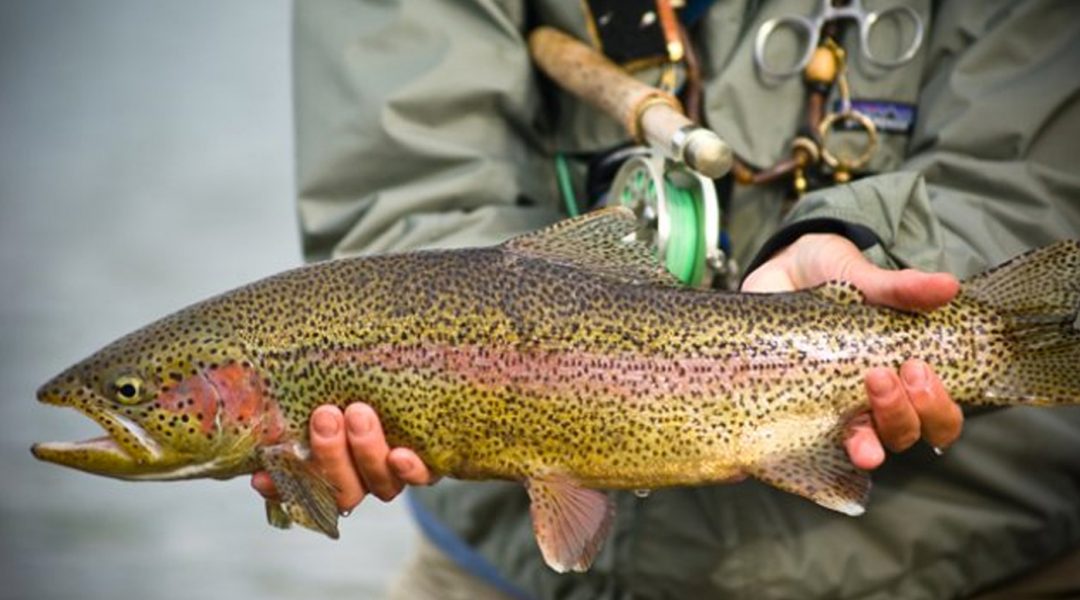
If you live in the Western United States or Canada and haven’t taken up fly-fishing, maybe it’s time you did.
Along with northern Russia, southern South America, and New Zealand, the North American West is an international fly-fishing Mecca. While many fly 12 hours from London or 18 hours from Tokyo to fish one of our fine trout streams, you may only have to drive an hour or less, even if you live in a major city. And due to the current practice of releasing game fish unharmed (called “catch-and-release”) combined with lowered limits for those who do kill fish, as well as improved laws governing access and water quality, fishing in Western waters is better than it’s been in decades.
Afraid fly-fishing is too complex or its skills too demanding? Not likely. After writing a dozen books and hundreds of magazine articles on fly-fishing subjects — and introducing many newbies to the sport — I’m convinced most people can learn enough about the basics of fly-fishing to go out and catch some fish after just a few hours of solid instruction.
OK, it’s not quite that simple. Take trout streams. There are remote rivers full of eager trout where everybody catches fish. Then there are others, rich with feed, whose satiated and educated trout defy even the sharpest fly fishers to hook anything at all. But that’s part of the appeal of this elegant sport: It’s filled with variety and, for those who seek it, challenge.
It’s filled with uncertainty, too. As with a game of cards or a tennis match, almost anything can happen when you toss out that fly. From one day to the next the fishing may turn from hot to mediocre or even useless, then back to hot. Perhaps you put on a fly that makes absolutely no sense under the circumstances, and minutes later it ties you to a line-straining brute. Looking for consistency and predictability? Take up crochet. But if you like mystery and surprises, fly-fishing may be the perfect sport for you.
THE FISH
A stunning variety of fish are now taken regularly on the fly: pugnacious largemouth bass in lakes and smallmouth bass in warmer rivers, round little bluegill in farm ponds, brutish carp wherever they have taken up residence, man-size tarpon in tropical salt waters ... the list goes on and on. But 336 years after Englishman Charles Cotton first published Being Instructions How to Angle for a Trout or Grayling in a Clear Stream as part of Izaak Walton’s The Compleat Angler, it remains true that trout (particularly in rivers) account for the great majority of fly-fishing. So that’s what I’ll focus on from here out.
THE CAST
Knowing how to toss a bobber out with a spinning rod won’t help you learn to cast a fly rod. That’s because the spinning rig carries a fine monofilament line that is drawn out of the rod by the weight of the lure, while in fly-casting it’s the weight of the tapered line that carries out the lightweight artificial fly. To make this happen, the fly caster makes a somewhat unnatural combination of movements.
A skillfully executed fly cast is elegant. The rod swings through an accelerating arc to stop suddenly — quite high — and immediately a graceful loop, something like a French curve, glides from the rod’s tip out with the line. It’s not difficult to learn with a little instruction. At fishing shows I’ve taught adults and children to make fishing-length casts in less than 10 minutes.
THE EQUIPMENT
It would be hard for most contemporary fly fishers to imagine thick, fragile silk tippets and costly, care-intensive split-bamboo rods as their only options, but that’s how it was just a few decades ago. Now our lines are durable high-floating synthetics; our leaders and tippets are fine, tough monofilament; and our rods are lightweight tubular graphite, costing only a fraction of the price of bamboo. We have it easy.
The only snag with modern fly-fishing equipment is the staggering range of options. Take leaders: There are knotted, pre-tapered, furled, and fluorocarbon leaders in lengths from 6 feet to 12, with breaking strains from a meager 3 pounds or less to a stout 20 pounds or more. Consequently, the standard refrain of the beginning fly fisher selecting his or her first outfit is “Help!” And there is help — fly-shop salespeople, beginners’ books and videos, the Internet, fly-fishing clubs ... . Thankfully, the basics are still simple and still the best way to start out. For example, a plain old 9-foot pretapered leader remains the reliable choice for fishing most any trout river.
THE TECHNIQUE
Some things don’t change much because they don’t need to. Take trout rivers. The standard approach is about the same now as it was in Cotton’s time: Cast a floating fly upstream of a trout, then let the fly drift naturally with the current. But there are also newer options. For example, fishing a weighted “nymph,” a fly that typically imitates immature aquatic insects, has become standard practice. The common approach is to work the nymph close along the riverbed below a strike indicator — really, a bobber. When the indicator stalls or dives or twitches, the angler sets the hook.
You could go a long way on trout streams with only the dry-fly and nymph techniques. But then there’s the skittered dry fly, the hopper-dropper rig, Czech nymphing, and Japanese tenkara fishing — techniques as intriguing as their names imply. If you’re so inclined, try them all; exploring new stuff is part of the fun.
THE WATER
You’ll typically find few or no fish in some parts of a river and good numbers or even an abundance in others. Finding those areas where fish gather is called “reading the water.” In rivers, such areas include the heads and tails of pools; those even, moderately swift, shin-to-hip-deep sections called “riffles”; deep and streamy runs; undercut banks; and the tiny pools behind boulders in pocket water.
THE BUGS
Most dedicated fly fishers who haunt rivers develop a fair understanding of entomology, or the study of insects. Whenever we’re driving to a river and my fellow fly-fishing author Rick Hafele (who for 22 years worked as an entomologist for the state of Oregon) rattles off the number of spines on the anal hooks of the Rhyacophila caddisfly larva — which most of us call the green rock worm — I’m reminded how little I and my fellow fly fishers really know about the insects we imitate with our flies.
But we know enough. We know, for example, what huge orange-and-black salmonflies look like, and that when they’re scrambling and flying everywhere we should toss our salmonfly-imitating dry flies mostly close to the bank-side cover of outstretched tree limbs or grasses leaning over the water. And we know the more we pay attention to the movements and habits of these fascinating river insects, the better fly fishers we become.
THE FLY
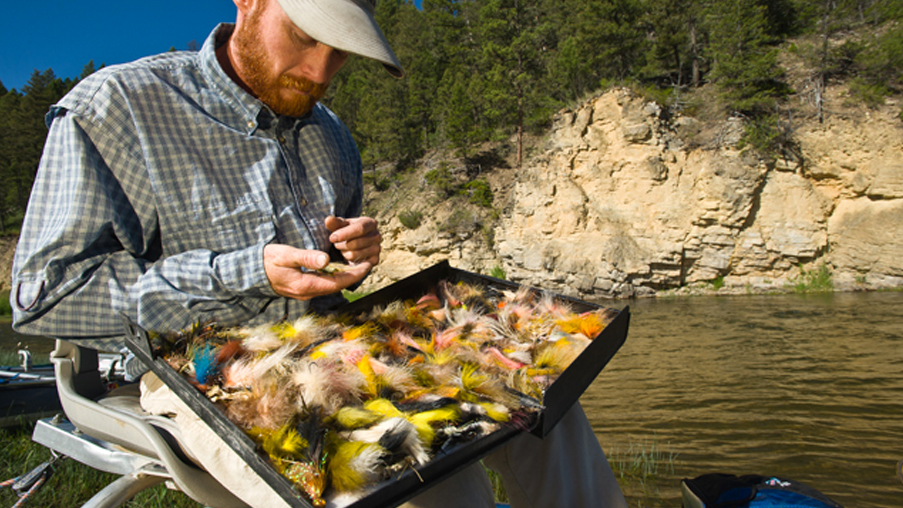
There are hundreds of thousands of established fly designs, and even after writing seven fly-tying books I’m still bewildered by the sheer number of ways you can bind a feather or clump of hair to a hook. Fly tying is such an intriguing craft (or “art,” depending on how you see and practice it) that some practitioners never take up fishing at all. Flies range from scruffy fur and a few feather fibers on a hook to little masterpieces that almost perfectly mimic graceful mayflies and stout grasshoppers. The great thing is that even elemental flies can be deadly.
THE LITERATURE
Some of the finest writers of the English language — winners of such literary honors as inclusion in The Best American Short Stories and the Pulitzer Prize — have written on my beloved sport. Ernest Hemingway wrote about fly-fishing in his tough, austere, and brilliant way. Coloradan John Gierach writes about it now with humor and a narrative appeal that quietly draws you from sentence to sentence. But my favorite fly-fishing writer remains Roderick Haig-Brown, the Canadian conservationist whom I’ve read since my teens and who still captivates me with his now-familiar stories and honest fascination with fish and their water and all that touches them.
So there they are: the elements of fly-fishing, from the skills to the strategies to the art and the lore. And like so many fly fishers, I love it all. But then I live in the North American West, where if your genetics include even the slightest urge to stalk a fish when you see one, it’s almost a crime not to.
Skip Morris is the author of numerous books on fly-fishing, including Trout Flies for Rivers: Patterns from the West That Work Everywhere (Stackpole Books, 2009), which he coauthored with his wife, Carol Ann Morris.
From the May/June 2012 issue.